Argon · element 18
Nearly one per cent of every breath you take is a gas that refuses to react with anything
Key facts
Take a deep breath. Around one per cent of what you just inhaled was argon, and every bit of it will come straight back out again unchanged. Argon does not burn, does not corrode anything and does not take part in chemistry of any kind. Its name comes from the Greek for idle or lazy, and it earned it.
Yet this inert gas is the third most abundant component of dry air, far ahead of carbon dioxide, and it is worth a lot of money. Its refusal to react is exactly what makes it useful.
Where it is found
Nearly all argon on Earth is in the atmosphere, where it makes up about 0.93 per cent by volume. Almost all of it is the isotope argon-40, and it got there in an unusual way. Potassium-40, a radioactive isotope present in all rocks, slowly decays into argon-40. Over billions of years this argon has leaked out of the crust and built up in the air. The Earth has been quietly manufacturing its own argon since it formed.
That origin has a neat consequence. Argon in the wider universe, made in stars, is mostly argon-36, so the Sun's argon has a different isotope mix from ours. On Earth, argon is extracted by cooling air until it liquefies and then separating the components by their boiling points, a process called fractional distillation. Small amounts are also dissolved in seawater and trapped in rocks.
How it was discovered
Argon was hiding in plain sight. In the 1780s Henry Cavendish removed the nitrogen and oxygen from a sample of air by sparking it, and found that a small stubborn bubble remained that would not react. He could not explain it. A century later Lord Rayleigh found that nitrogen extracted from air was slightly denser than nitrogen made from chemicals. Working with William Ramsay in 1894, he stripped every known gas out of air and was left with a new one whose spectrum showed lines nobody had seen before. Ramsay went on to find helium, neon, krypton and xenon, filling in a whole new column of the periodic table. Rayleigh and Ramsay each received a Nobel Prize in 1904.
What we use it for
Argon fills ordinary incandescent light bulbs, because the hot tungsten filament would burn out almost instantly in air. It is the shielding gas in welding, blanketing the molten metal so that oxygen and nitrogen cannot weaken the joint. It sits between the panes of double glazing because it conducts heat less well than air. Steelmakers blow it through molten metal to stir it and carry off dissolved gases.
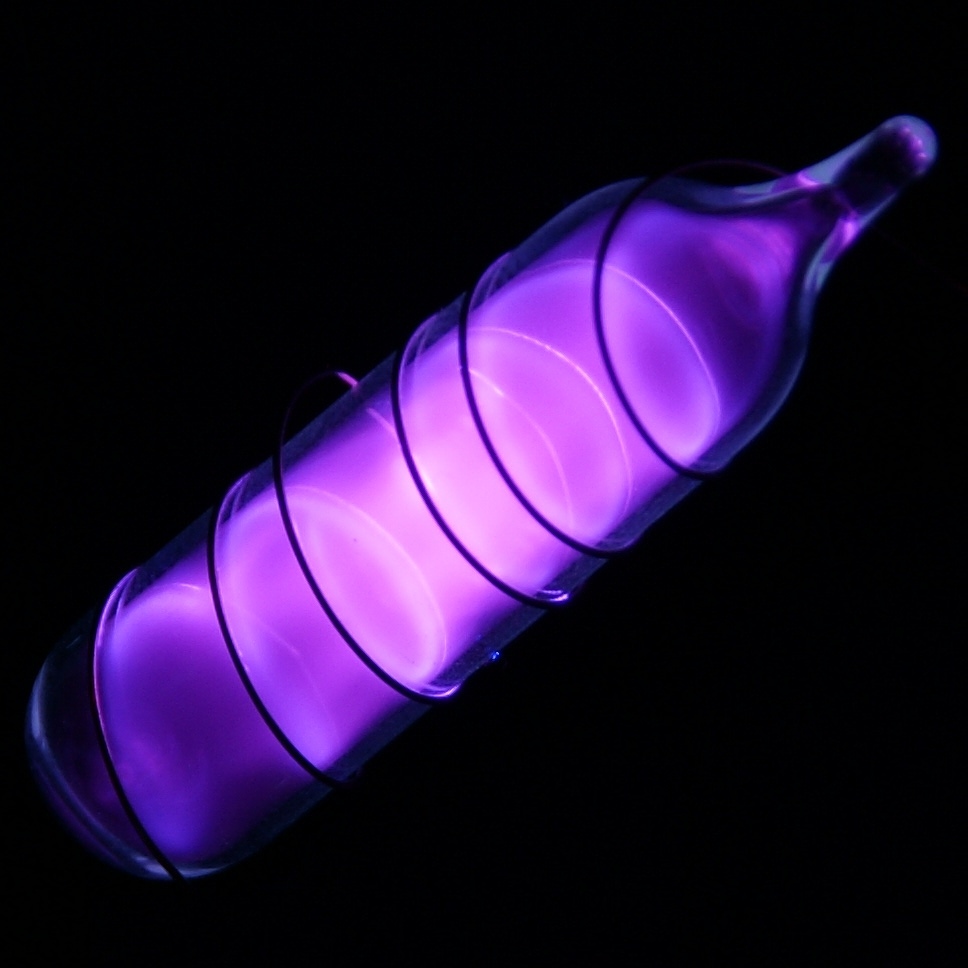
In laboratories it protects air-sensitive reactions and preserves old documents. Argon-filled tubes glow lilac or violet under high voltage, and mixed with mercury vapour they give the blue light used in signs. Argon is also used in dating rocks, in lasers for eye surgery, and as a fire suppressant in rooms full of electronics where water would do more damage than the fire.
Reading the numbers
Argon becomes a liquid at about -186 °C and freezes at about -189 °C, a gap of only three degrees. Compare that with water, which stays liquid over a 100 degree range. Such a narrow liquid range is typical of noble gases, whose atoms barely attract each other. As a gas its density is 1.784 grams per litre, about 40 per cent heavier than air, so it can be poured slowly from one beaker into another. The configuration [Ne] 3s2 3p6 is a completely filled outer shell of eight electrons. There is no room for another and no benefit in losing one, so argon has no measured electronegativity and a negative electron affinity, meaning it actively resists taking an extra electron. Its first ionisation energy of 1521 kJ per mole is the highest in period 3. It sits at the far right of its row, closing the period, exactly where the pattern of filling shells predicts.
Safety and the environment
Argon is not toxic, but it is an asphyxiant. Because it is heavier than air and has no smell, a leak in a confined space such as a welding bay or a storage tank can displace oxygen without warning, and people have died this way. Liquid argon causes severe cold burns. Environmentally it is harmless: it is taken from the air and returns to it, with no greenhouse effect and no impact on the ozone layer.
Did you know?
- Argon was the first noble gas to be discovered, and its discovery earned Nobel Prizes in both physics and chemistry in the same year, 1904.
- Almost all of Earth's argon was made by the radioactive decay of potassium in rocks, and potassium-argon dating uses that build-up to work out the age of ancient lava flows.
- In 2000 chemists in Finland made argon fluorohydride, the first true compound of argon, but it only survives at temperatures far below -250 °C.
- The thin atmosphere of Mars contains nearly two per cent argon, a higher proportion than Earth's.
- Argon has a higher atomic mass than potassium, the element that follows it, one of only a few places where ordering by mass and ordering by atomic number disagree.
More in the noble gases
These share a column with argon, so their outer electrons are arranged in a similar way and they tend to behave alike.
See all 7 noble gases on one page, or browse all 118 elements.
Compare Argon with another element
Each comparison has a side-by-side data table and a plain-English summary of the differences.
Frequently asked questions
Why is argon used in light bulbs?
The tungsten filament in an incandescent bulb runs at well over 2000 °C and would burn away in seconds if oxygen were present. Argon is cheap, completely unreactive and slows the evaporation of the filament, so it makes the bulb last longer.
Is argon dangerous to breathe?
Argon itself is harmless and you breathe it constantly. The danger comes when a leak fills an enclosed space and pushes the oxygen out, because it has no smell and gives no warning. Welders and workers around liquid argon tanks need good ventilation.
Why does argon not react with anything?
Its outer electron shell is completely full with eight electrons. That arrangement is so stable that argon gains nothing by sharing, taking or giving up electrons, so under ordinary conditions it forms no compounds at all.
Why is there so much argon in the air?
Radioactive potassium-40 in the Earth's rocks decays into argon-40, and over four and a half billion years this gas has seeped out into the atmosphere. Because argon never reacts, nothing removes it, so it has simply accumulated.
Read next
Guess the mystery element in six tries. A new one every day, free, no sign-up.
Written by Anthony. Updated September 2026. Numerical data from Periodic-Table-JSON (CC BY-SA), cross-checked against the Argon reference article. Spotted an error? Tell us.