Boron · element 5
The element that toughens glass, soaks up neutrons and turns a flame bright green
Key facts
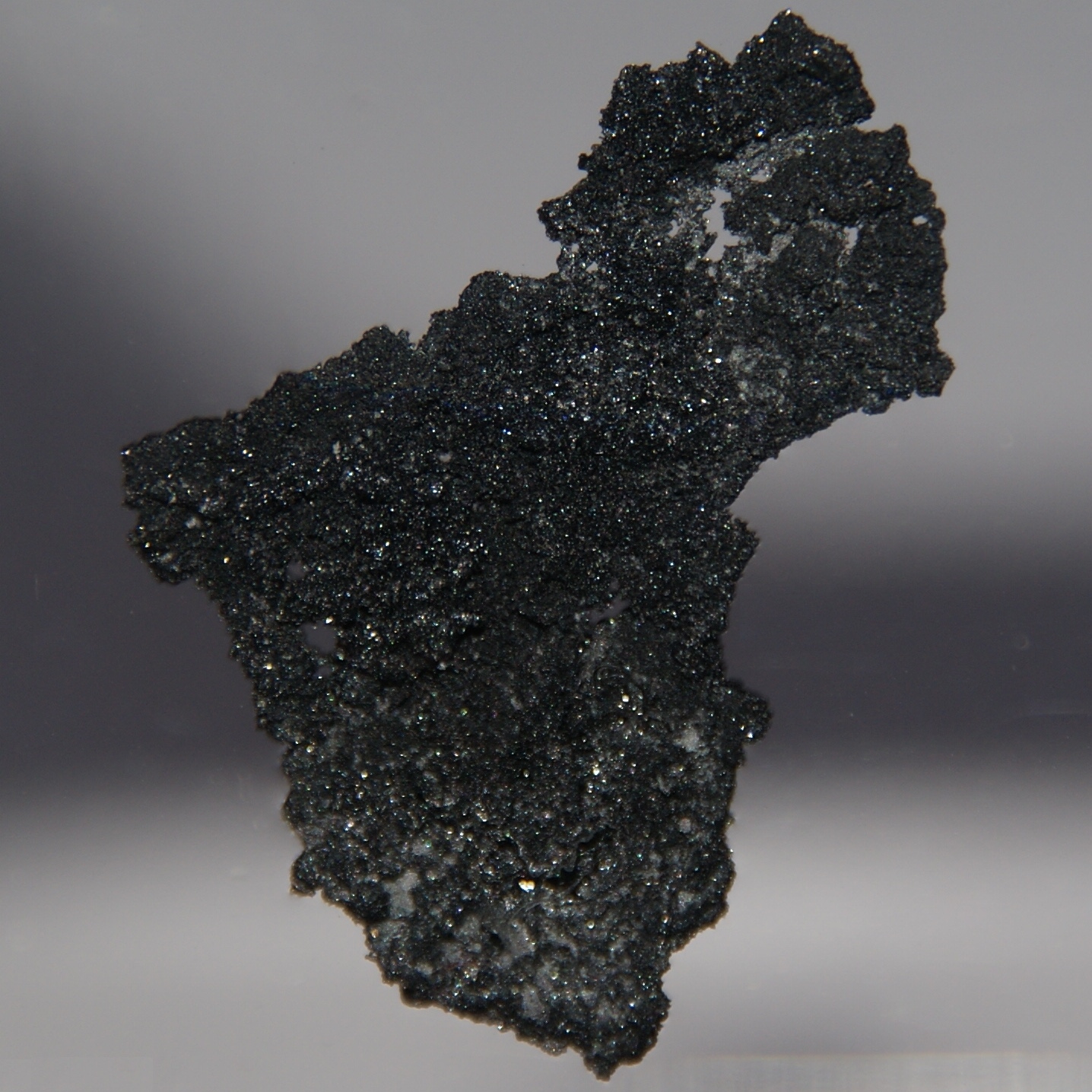
Boron is a dark, brittle, very hard solid that is neither quite a metal nor quite a non-metal. Chemists call it a metalloid. It has three outer electrons, which is not enough to bond in the ordinary ways, so it builds unusual cage-shaped clusters that keep researchers busy to this day. Pure boron is rarely seen outside laboratories, but its compounds are everywhere.
Borax has been traded for over a thousand years, first from dry lakes in Tibet and later from the deserts of California and Turkey. Today boron compounds strengthen glass, protect wood, feed crops and control nuclear reactors.
Where it is found
Boron is rare in the Earth's crust, about ten parts per million, but its compounds dissolve easily in water and gather wherever water evaporates. Ancient lake beds in arid regions hold thick deposits of borate minerals such as borax, kernite, colemanite and ulexite. Turkey holds the largest reserves by far, and the mine at Boron, California, is one of the biggest single sources.
In the cosmos, boron is an oddity. It is not made in the ordinary fusion reactions inside stars. Almost all of it forms when high-energy cosmic rays shatter carbon and oxygen nuclei in interstellar gas. That is why boron, along with lithium and beryllium, is far scarcer in the universe than its low atomic number would suggest.
How it was discovered
Borax was known to medieval goldsmiths as a flux that helped metals melt and flow. The element hidden inside it was not isolated until 1808. In Paris, Joseph Louis Gay-Lussac and Louis Jacques Thenard heated boric acid with potassium metal and obtained an impure brown powder. In London, Humphry Davy did something similar within days, using the powerful new tool of electrolysis. Each side claimed the discovery.
What they made was far from pure. Boron clings tightly to oxygen and carbon, and truly pure crystalline boron was not produced until the twentieth century. The name comes from borax, itself derived from an Arabic word for the mineral, with an ending borrowed from carbon to signal its similar properties.
What we use it for
The largest use of boron is in glass and ceramics. Adding boron oxide produces borosilicate glass, which barely expands when heated and so survives sudden temperature changes. Laboratory glassware, oven dishes and many cooktops rely on it. Perborates and borates appear in detergents and cleaning products.
Boron-10 absorbs neutrons very efficiently. Control rods in nuclear reactors and boric acid dissolved in reactor cooling water both use it to keep chain reactions in check. Boron carbide is one of the hardest materials known and is used in bulletproof vests and tank armour. Farmers add boron to soil where it is deficient, because plants cannot build cell walls without it. The rare earth magnets in electric motors and hard drives contain neodymium, iron and boron.
Reading the numbers
Boron melts at about 2076 degrees Celsius and boils at about 3927 degrees, among the highest of any element and far above its neighbours beryllium and lithium. Such a stubborn solid is held together by a strong network of covalent bonds between boron atoms, arranged in twelve-atom clusters. Its density of 2.08 grams per cubic centimetre is about twice that of water but only a quarter that of iron.
The configuration [He] 2s2 2p1 gives boron three outer electrons. Losing all three would cost a great deal of energy, so boron does not form simple B3+ ions. Instead it shares electrons covalently, usually forming three bonds and leaving an empty orbital that makes its compounds hungry for electron pairs. Its electronegativity of 2.04 is close to hydrogen's, which fits its position on the borderline between metals and non-metals. Boron heads group 13, the first column of the p-block.
Safety and the environment
Elemental boron is not considered toxic, and the small quantities of boron in food are probably useful for health. Borax and boric acid are mildly toxic if swallowed in quantity, and boric acid has long been used as an insecticide against ants and cockroaches. The European Union classifies some borates as potentially harmful to fertility at high exposure, so they have been removed from many consumer products.
In the environment boron is a double-edged nutrient. Plants need a little and are poisoned by a lot, and irrigation water high in boron can damage crops. Boron mining in dry regions is generally an open-pit operation with the usual concerns about dust and land use.
Did you know?
- Boron is one of very few elements not made inside stars. Almost all of it comes from cosmic rays splitting heavier atoms apart.
- Boron compounds burn with a bright green flame, and boric acid is used to colour green fireworks.
- Borosilicate glass, developed in the 1890s, is used for laboratory glassware because it barely expands when heated.
- Boron-10 is such a good neutron absorber that boric acid is dissolved in the cooling water of nuclear reactors to control the chain reaction.
- Boron carbide is one of the hardest materials known and is used in ceramic body armour.
- Twenty-mule teams hauled borax wagons across the Mojave Desert from Death Valley in the 1880s, and the image became a famous brand.
More in the metalloids
The nearest neighbours of boron in the family, by atomic number.
See all 7 metalloids on one page, or browse all 118 elements.
Compare Boron with another element
Each comparison has a side-by-side data table and a plain-English summary of the differences.
Frequently asked questions
Is boron a metal?
No, it is a metalloid. It is a hard, dark solid that looks a little like a metal but is brittle and conducts electricity poorly at room temperature. Its chemistry is closer to that of silicon and carbon than to the metals.
What is boron used for?
Mostly for heat-resistant borosilicate glass, glass fibre insulation and ceramics. It is also used in detergents, fertilisers, nuclear reactor control, super-hard boron carbide armour and the neodymium magnets in motors and hard drives.
Is boron good for plants?
Plants need a small amount of boron to build cell walls and move sugars, and deficiency causes stunted growth and poor fruit. Too much is toxic, so farmers apply it carefully and test soil first.
Is borax safe to use at home?
Borax is mildly toxic if swallowed in quantity and can irritate skin and eyes, so it should be kept away from children and pets. Because of concerns about effects on fertility at high exposure, it has been withdrawn from many consumer products in the European Union.
Read next
Guess the mystery element in six tries. A new one every day, free, no sign-up.
Written by Anthony. Updated September 2026. Numerical data from Periodic-Table-JSON (CC BY-SA), cross-checked against the Boron reference article. Spotted an error? Tell us.