Cadmium · element 48
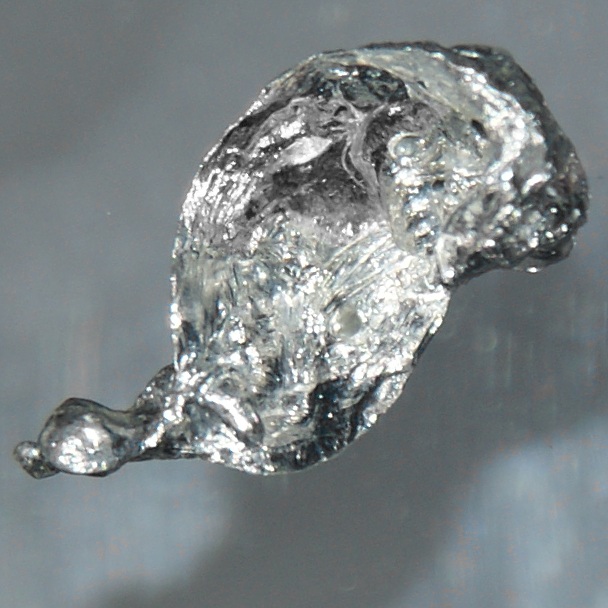
The soft blue-white metal that gave painters their brightest yellows and gave chemists a reason to worry
Key facts
Cadmium is a metal nobody set out to find. It turned up in 1817 as an impurity in zinc medicines, and it has stayed in zinc's shadow ever since. The two elements sit next to each other in the periodic table, behave similarly, and are mined together, so almost all cadmium is a by-product of zinc production.
For much of the twentieth century cadmium was everywhere: in rechargeable batteries, in bright yellow and red paints, in the anti-rust coating on nuts and bolts. Then its toxicity became clear. Today it is one of the most tightly regulated elements in consumer products, and most of its old jobs have been handed to other materials.
Where it is found
Cadmium does not form rich ores of its own. Its one notable mineral, greenockite, a yellow cadmium sulfide, is scarce. Instead cadmium hides inside sphalerite, the main zinc ore, where cadmium atoms take the place of zinc atoms in the crystal. Typical zinc ores contain a small fraction of a per cent of cadmium.
When zinc is smelted, the cadmium comes off as a vapour or collects in the dust and residues, and it is refined from those. China, South Korea, Japan and Canada are among the main producers, but the quantities are small compared with almost any other industrial metal.
How it was discovered
In 1817 German pharmacies were selling zinc oxide, and some samples had a yellowish tinge that should not have been there. Two chemists independently tracked down the cause. Friedrich Stromeyer, a professor in Göttingen who inspected pharmacies, and Karl Samuel Leberecht Hermann, who ran a chemical works, each showed that the colour came from a previously unknown metal.
The name comes from cadmia, the old Latin name for the zinc ore calamine, which itself recalls Cadmus, the legendary founder of Thebes in Greek myth. Cadmium was found as an impurity in a manufactured product rather than in a mineral.
What we use it for
The largest use is in nickel-cadmium rechargeable batteries. NiCd cells were the standard in cordless tools, emergency lighting and early portable electronics, valued for their toughness and ability to deliver high currents. Lithium and nickel-metal hydride batteries have replaced them in most consumer products, but NiCd cells still fly in some aircraft and work in industrial settings.
Cadmium sulfide and cadmium selenide give the pigments cadmium yellow, orange and red, which are unusually bright and stable and were adopted by artists in the nineteenth century. Cadmium plating protects steel from rust and still appears on aircraft fasteners. Cadmium telluride is the semiconductor in one major type of thin-film solar panel, and cadmium rods absorb neutrons in some nuclear reactors.
Reading the numbers
Cadmium melts at about 321 °C and boils at about 767 °C. Both figures are strikingly low for a metal. A domestic oven cannot melt it, but a gas hob flame can, and its low boiling point is one reason it is dangerous, since it vaporises easily when heated, for example when cadmium-plated steel is welded. Its density is 8.65 grams per cubic centimetre, a little more than iron and about eight and a half times that of water.
The configuration [Kr] 4d10 5s2 tells the story. The d shell is full and the two 5s electrons are the only ones readily given up, so cadmium behaves as a simple +2 metal, exactly like zinc above it and mercury below it in group 12. Because the d electrons do not take part in bonding, these three elements are softer, lower melting and more volatile than the transition metals to their left. Cadmium's electronegativity of 1.69 is moderate, and its negative electron affinity shows it has no interest in gaining electrons.
Safety and the environment
Cadmium is a serious poison. Inhaling cadmium fumes damages the lungs, and long-term exposure through food or dust accumulates in the kidneys, weakens bones and is linked to cancer. The body has no way to remove it quickly, so it builds up over decades. In Japan in the mid twentieth century, rice irrigated with water contaminated by mine waste caused itai-itai disease, a painful softening of the bones.
Because of this, cadmium is restricted in electronics, jewellery, plastics and toys in the European Union and many other places, and cadmium-containing batteries must be collected for recycling. Tobacco plants take up cadmium from soil, so smokers carry higher levels. Careful handling of zinc smelter waste and phosphate fertiliser remains the main way of keeping cadmium out of food.
Did you know?
- Cadmium was discovered in 1817 as an unwanted yellow tint in zinc oxide sold by German pharmacies.
- The bright yellows in many Impressionist paintings come from cadmium sulfide, which became available as an artists' pigment in the mid nineteenth century.
- Cadmium boils at about 767 °C, well below the temperature at which copper melts, which is unusual for a metal.
- The name itai-itai, given to cadmium poisoning in Japan, translates roughly as ouch-ouch, describing the bone pain sufferers felt.
- Before the metre was redefined using krypton light in 1960, the red spectral line of cadmium served as an international reference wavelength for precise length measurement.
- The nickel-cadmium battery was invented in 1899 by the Swedish engineer Waldemar Jungner.
More in the transition metals
Column-mates come first, since elements in one column have outer electrons arranged in a similar way and tend to behave alike; the rest are the nearest neighbours in the family.
See all 38 transition metals on one page, or browse all 118 elements.
Frequently asked questions
Is cadmium toxic to humans?
Yes, highly. Cadmium accumulates in the kidneys and bones over a lifetime because the body excretes it very slowly, and it is classed as a human carcinogen. Most exposure comes from food grown on contaminated soil and from tobacco smoke, while workers can be harmed by inhaling fumes.
Why is cadmium in batteries?
Nickel-cadmium cells are rugged, tolerate deep discharge and very cold conditions, and deliver high currents, which made them ideal for power tools and emergency equipment. Their toxicity and the arrival of better lithium and nickel-metal hydride cells have pushed them out of most consumer products.
Where does cadmium come from?
Almost all cadmium is recovered as a by-product of zinc refining. Cadmium atoms sit inside the zinc mineral sphalerite, and when zinc is smelted the cadmium collects in dusts and residues that can then be purified. There are no mines that dig for cadmium alone.
Are cadmium paints still used?
Yes, artists' cadmium yellows, oranges and reds are still made and are prized for their brightness and permanence. They are safe to use with sensible precautions because the pigment is bound in the paint, but they should not be sprayed or sanded, and waste should not be poured down the drain.
Read next
Guess the mystery element in six tries. A new one every day, free, no sign-up.
Written by Anthony. Updated September 2026. Numerical data from Periodic-Table-JSON (CC BY-SA), cross-checked against the Cadmium reference article. Spotted an error? Tell us.