Calcium · element 20
Chalk cliffs, coral reefs, teeth and bones: the metal that builds hard things out of soft water
Key facts
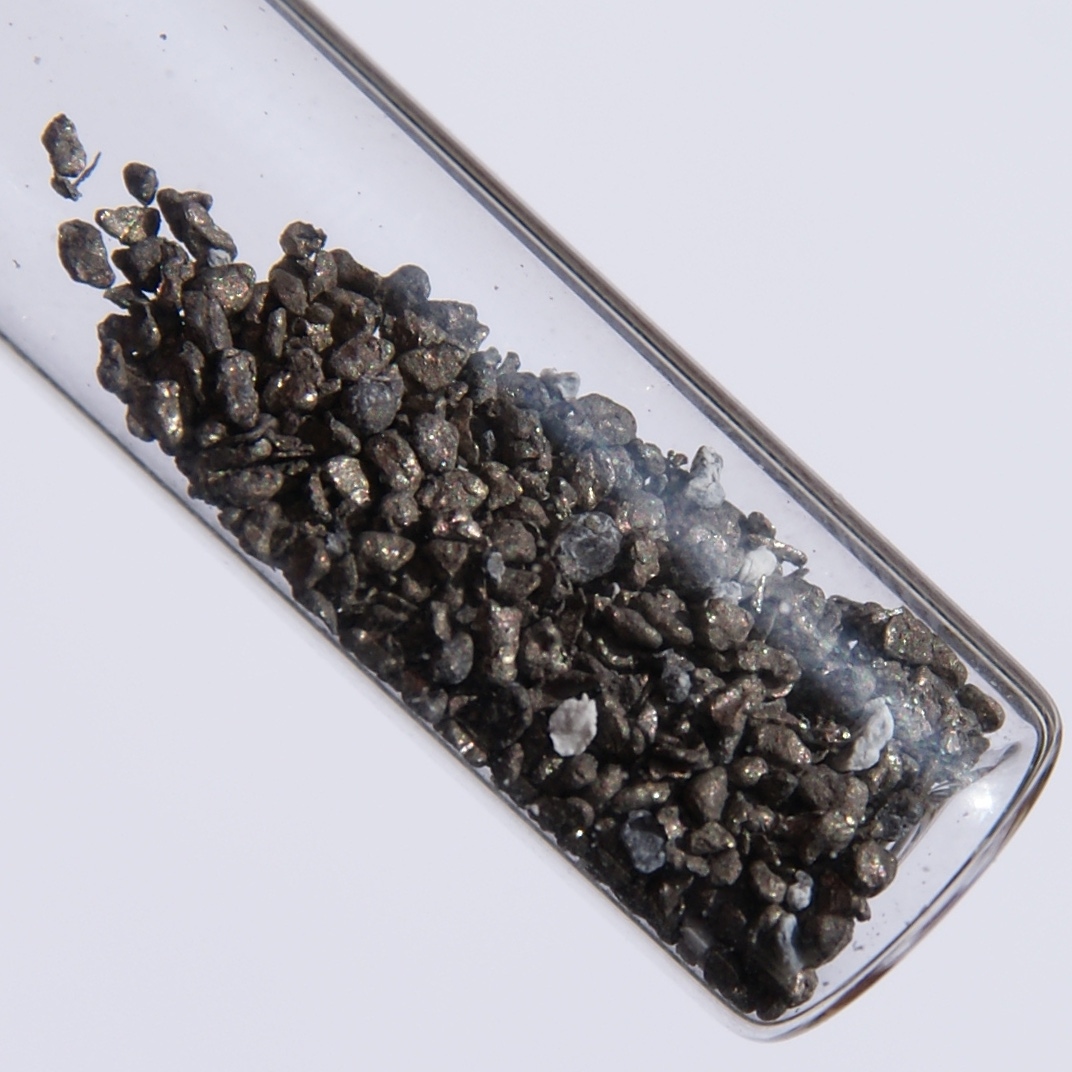
You are carrying about a kilogram of calcium, almost all of it in your bones and teeth. Yet calcium the metal is something few people ever see: a soft, silvery solid that fizzes gently in water and dulls quickly in air. The metal is a curiosity. Its compounds are everywhere, in chalk, limestone, marble, seashells, cement, plaster and indigestion tablets.
The name comes from calx, the Latin word for lime, the white powder made by roasting limestone. The Romans used it to make concrete that still stands, and builders use the same chemistry today.
Where it is found
Calcium is the fifth most abundant element in the Earth's crust. Most of it is calcium carbonate, which forms limestone and chalk, both built from the shells and skeletons of tiny sea creatures laid down over millions of years. The White Cliffs of Dover are compressed plankton. Marble is limestone that has been heated and squeezed deep underground. Gypsum, or calcium sulfate, forms in evaporating lakes, and fluorite and apatite are other important calcium minerals.
Dissolved calcium is what makes tap water hard. Rain trickling through limestone picks up calcium hydrogencarbonate, and when that water is boiled the carbonate drops out as kettle scale. The same chemistry builds stalactites in caves. In the sea, corals, molluscs and plankton pull calcium out of the water to build shells and reefs, and when they die the cycle starts again.
How it was discovered
Lime and gypsum have been used since prehistory, but calcium itself resisted isolation because its compounds are so stable. Humphry Davy managed it in 1808, shortly after his potassium and sodium successes. He electrolysed a moist mixture of lime and mercury oxide, producing a calcium-mercury amalgam, then distilled off the mercury. The metal he obtained was impure, and reasonably pure calcium was not made until the twentieth century, but it was enough to prove that lime was the oxide of a new metal. Davy isolated magnesium, strontium and barium the same year using the same trick.
What we use it for
Calcium compounds are used in staggering quantities. Limestone is heated to make lime, which is combined with clay and heated again to make cement, and concrete is the most used manufactured material on Earth. Lime also neutralises acidic soils, treats drinking water and scrubs sulfur dioxide from power station chimneys. Gypsum becomes plasterboard and plaster of Paris. Calcium carbonate is the filler in paper, paint and plastics, and the active ingredient in many antacids.
The metal has niche uses as a reducing agent for extracting other metals, including uranium and thorium, and as a deoxidiser in steelmaking. Calcium in the diet, from dairy products, leafy greens, tinned fish and fortified foods, is essential for bones, blood clotting, muscle contraction and the signalling that goes on inside every cell.
Reading the numbers
Calcium melts at about 842 °C and boils at about 1484 °C, far higher than potassium beside it, because each calcium atom contributes two electrons to the metallic bonding rather than one. Its density is 1.55 g/cm³, one and a half times water and only a fifth of iron, making it one of the lightest metals, though far too reactive to build with. The configuration [Ar] 4s2 means two electrons outside a full shell. The first two ionisation energies are modest, 590 and 1145 kJ per mole, but the third jumps to over 4900, so calcium always forms Ca2+ and never Ca3+. That pattern is the signature of group 2, the alkaline earth metals. Calcium sits directly below magnesium and shares its chemistry, but is more reactive because its larger atom holds the outer electrons more loosely. Its electronegativity of exactly 1.0 marks it as a strongly electron-giving metal.
Safety and the environment
Calcium metal reacts with water to release hydrogen and heat, and powdered calcium can ignite, but it is much tamer than sodium or potassium. Lime is caustic and burns skin and eyes, a real hazard in building work. In the environment calcium is benign and often helpful: lime is spread on acidified lakes and fields to restore them. The environmental cost is indirect. Making cement releases carbon dioxide both from the fuel and from the limestone itself, and accounts for around seven to eight per cent of global emissions. Ocean acidification, driven by that same carbon dioxide, makes it harder for shellfish and corals to build their calcium carbonate skeletons.
Did you know?
- Cement manufacture is one of the largest single industrial sources of carbon dioxide, because heating limestone drives off the gas chemically as well as burning fuel.
- Calcium colours a flame brick red, which is how it shows up in a flame test and in some fireworks.
- Your skeleton is not fixed: bone is constantly dissolved and rebuilt, so the calcium in it is replaced over a period of years.
- Humphry Davy isolated six metals in two years, calcium among them, using the new voltaic battery.
- An eggshell is roughly 95 per cent calcium carbonate, in effect the same substance as chalk and marble.
- Cave stalactites grow from dripping calcium-rich water at rates typically well under a millimetre a year.
More in the alkaline earth metals
These share a column with calcium, so their outer electrons are arranged in a similar way and they tend to behave alike.
See all 6 alkaline earth metals on one page, or browse all 118 elements.
Compare Calcium with another element
Each comparison has a side-by-side data table and a plain-English summary of the differences.
Frequently asked questions
Is calcium a metal?
Yes. Pure calcium is a soft, silvery-white metal in group 2, the alkaline earth metals. It reacts with water and air, so it is never found as a metal in nature; the calcium in bones, milk and rocks is present as compounds and ions.
What foods are high in calcium?
Milk, cheese and yoghurt are the best known sources. Leafy greens such as kale, tinned fish eaten with the bones, tofu set with calcium, almonds and fortified plant milks and breakfast cereals also provide plenty.
Why is calcium good for your bones?
Bone is a composite of protein fibres and crystals of calcium phosphate, and the crystals give it stiffness and strength. Your body also draws on bone as a calcium reserve for nerves and muscles, so a steady dietary supply stops that reserve being run down.
Does calcium react with water?
Yes, though gently compared with sodium or potassium. Calcium sinks, fizzes and slowly releases hydrogen gas, leaving a cloudy solution of calcium hydroxide, which is limewater.
Read next
Guess the mystery element in six tries. A new one every day, free, no sign-up.
Written by Anthony. Updated September 2026. Numerical data from Periodic-Table-JSON (CC BY-SA), cross-checked against the Calcium reference article. Spotted an error? Tell us.