Gallium · element 31
A metal that melts in your hand, then stays liquid for another two thousand degrees
Key facts
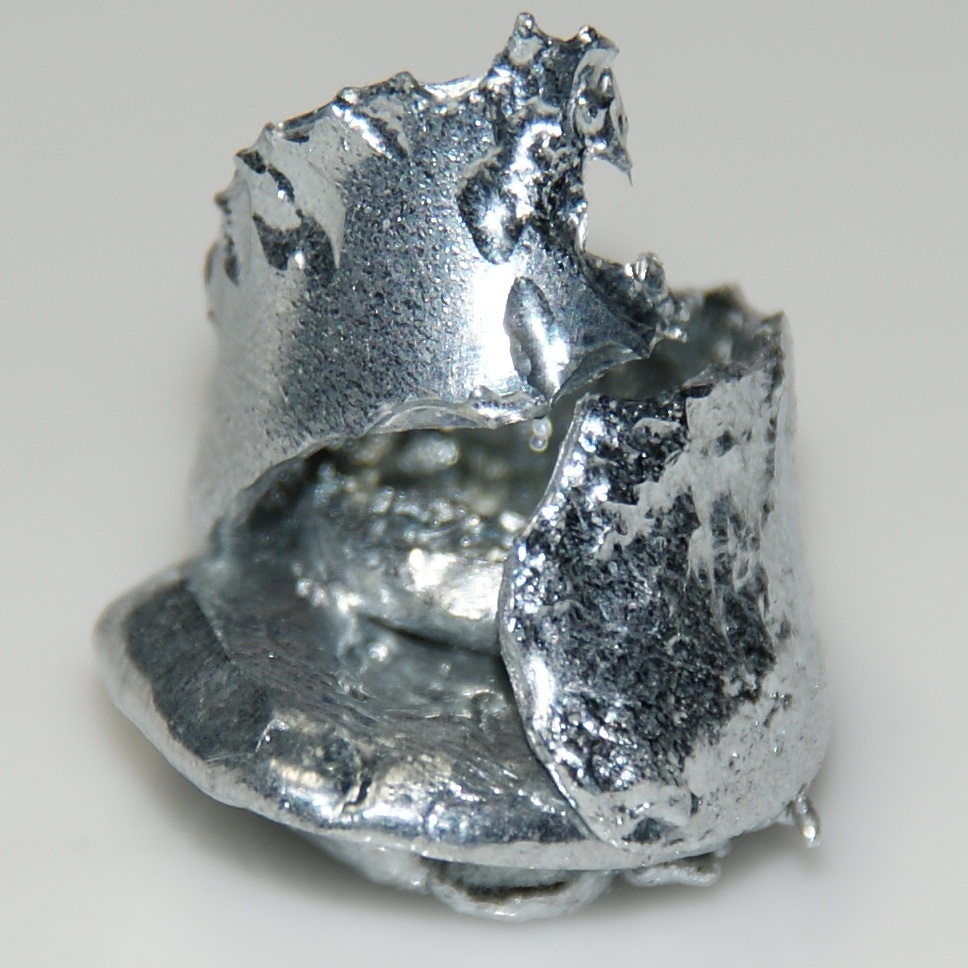
Gallium is a soft, silver-white metal that melts at about 30 °C, a few degrees below body temperature. Hold a lump in a warm palm and it slowly turns into a shiny puddle. That trick made it famous, but its real importance is hidden inside electronics: the LEDs that light your home, the amplifier chips in your phone and the solar cells on satellites.
It belongs to group 13, directly beneath aluminium, and its chemistry follows aluminium closely. Both form a +3 ion and both are protected by a thin skin of oxide. Unlike aluminium, gallium is never mined for its own sake. It is recovered in small amounts while other metals are being refined.
Where it is found
Gallium does not form ores of its own in any useful quantity. It is roughly as common as lead in the crust, but spread thinly. Gallium ions are a similar size to aluminium and zinc ions, so they slip into the crystal structures of bauxite (the ore of aluminium) and sphalerite (the main ore of zinc) at a few parts per million.
Almost all commercial gallium is pulled out of the caustic liquor used in the Bayer process, the first stage of turning bauxite into aluminium. A smaller amount comes from zinc smelting residues. China produces the great majority of the world's primary gallium, and recycling of scrap from semiconductor manufacturing adds a useful extra share.
How it was discovered
In 1871 Dmitri Mendeleev left a gap in his periodic table below aluminium and predicted the properties of the missing element, which he called eka-aluminium. Four years later the French chemist Paul-Émile Lecoq de Boisbaudran, examining zinc ore from the Pyrenees with a spectroscope, spotted two violet lines that belonged to no known element. He isolated the new metal and named it gallium after Gallia, the Latin name for France.
His first measurement of its density came out lower than Mendeleev had predicted. Mendeleev wrote to suggest the sample was impure, and a purer sample gave a value close to the prediction. Gallium was the first element discovered after the periodic table had forecast it, and it did much to convince chemists that the table was more than a filing system.
What we use it for
The biggest use is gallium arsenide, a semiconductor that handles high-frequency signals better than silicon. It appears in the radio amplifiers of mobile phones, in radar, and in the efficient multi-layer solar cells fitted to spacecraft. Gallium nitride is the material behind bright blue LEDs, which made white LED lighting possible and earned the 2014 Nobel Prize in Physics. It is also used in Blu-ray lasers and in compact fast chargers.
Liquid gallium has its own niches. An alloy with indium and tin, called galinstan, stays liquid well below freezing and is used in some thermometers as a non-toxic replacement for mercury. Gallium wets glass, leaving a bright reflective film that has been used for mirrors. In medicine, the radioactive isotope gallium-68 is used in PET scans to locate certain tumours.
Reading the numbers
Gallium melts at 29.8 °C but does not boil until about 2400 °C. No other element stays liquid across such a wide span relative to its melting point, which is why it is used in high-temperature thermometers. Its density of 5.91 grams per cubic centimetre makes it nearly six times heavier than water and about three quarters as dense as iron. Like water, it expands when it freezes, so it is stored in flexible containers rather than glass.
The electron configuration [Ar] 3d10 4s2 4p1 shows a full set of ten d electrons tucked underneath three outer electrons. Those three are what gallium gives up in reactions, so it forms Ga3+ just as aluminium forms Al3+. Its first ionisation energy, 578.8 kJ/mol, is almost identical to aluminium's, which explains why the two behave so alike. Gallium is the first p-block element in period 4, sitting immediately after the transition metals.
Safety and the environment
Gallium metal is considered low in toxicity and handling it briefly is safe, though it leaves a grey stain on skin. It has a nasty effect on aluminium: a drop of liquid gallium seeps into the metal and makes it crumbly, a process called liquid metal embrittlement. For that reason it is not allowed on aircraft. Gallium arsenide is a different matter, because arsenic-containing dust from cutting or grinding wafers is toxic and is handled under strict controls.
Because gallium is a by-product, its environmental footprint is mostly that of the aluminium and zinc industries, and recycling of semiconductor scrap is growing.
Did you know?
- Gallium was the first element to be discovered after Mendeleev's periodic table had predicted it, including a good estimate of its density.
- Like water, gallium expands as it freezes, so a sealed glass bottle of liquid gallium can crack in a cold room.
- A single drop of gallium placed on an aluminium drinks can will make the aluminium brittle enough to crumble within hours.
- The 2014 Nobel Prize in Physics went to the inventors of the blue gallium nitride LED, the component that made energy-saving white LED bulbs possible.
- Gallium has no known role in living things, yet radioactive gallium-68 is injected into patients to make tumours show up on PET scans.
- Liquid gallium clings to glass and leaves a mirror-like coating behind.
More in the post-transition metals
Column-mates come first, since elements in one column have outer electrons arranged in a similar way and tend to behave alike; the rest are the nearest neighbours in the family.
See all 12 post-transition metals on one page, or browse all 118 elements.
Frequently asked questions
Is gallium safe to touch?
Holding pure gallium for a short time is generally considered safe, and it is far less hazardous than mercury. It does stain the skin grey and can be tricky to wash off. Gallium compounds such as gallium arsenide should not be handled without protection.
Why does gallium melt in your hand?
Gallium's melting point is 29.8 °C, and skin temperature is usually a little above that. The bonds between gallium atoms in the solid are unusually weak for a metal, partly because the atoms pair up rather than packing into a simple lattice. Once melted it stays liquid until about 2400 °C.
Where does gallium come from?
Gallium is not mined directly. It is extracted from the process liquor left over when bauxite is refined into aluminium, and to a lesser extent from zinc smelting. China supplies most of the world's primary gallium.
Is gallium magnetic?
No. Gallium is weakly diamagnetic, which means it is very slightly repelled by a magnet rather than attracted. It will not stick to a fridge magnet and is not used in magnetic materials.
Read next
Guess the mystery element in six tries. A new one every day, free, no sign-up.
Written by Anthony. Updated September 2026. Numerical data from Periodic-Table-JSON (CC BY-SA), cross-checked against the Gallium reference article. Spotted an error? Tell us.