Iridium · element 77
The metal that resists every acid, and left a thin worldwide fingerprint when the dinosaurs died
Key facts
Ask a geologist about iridium and they will tell you about a layer of clay. Found in rocks all over the world and dated to about 66 million years ago, it contains far more iridium than normal crustal rock. Its discovery in 1980 gave the first hard evidence that a giant asteroid struck the Earth at the moment the dinosaurs vanished.
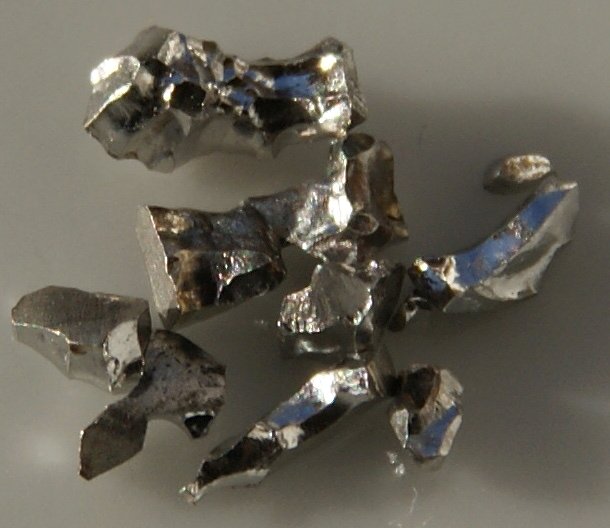
Chemists know iridium for something else: it is the most corrosion resistant metal known. Hard, brittle and silvery white, it shrugs off acids that dissolve gold and platinum. It is also, by a tiny margin, the second densest element after osmium.
Why there is so little of it on Earth
Iridium is one of the scarcest elements in the Earth's crust, present at roughly one part per billion. The reason is chemical. When the young Earth was molten, iridium dissolved readily into liquid iron and sank with it to form the core. What remains near the surface is a thin leftover. Meteorites, which never went through that sorting, contain hundreds of times more iridium, which is why an asteroid impact leaves an iridium-rich layer.
Mined iridium comes from the same deposits as platinum: the Bushveld complex in South Africa, Norilsk in Russia and Sudbury in Canada. It is recovered as a by-product, and world production is only a few tonnes each year. Grains of natural iridium-osmium alloy also occur in river gravels.
How it was discovered
Smithson Tennant found iridium in 1803 in London, in the same experiment that revealed osmium. When he dissolved impure platinum in aqua regia, a black powder refused to dissolve. Patient treatment with alkali and acid split this powder into two new metals. He named this one after Iris, the Greek goddess of the rainbow, because its salts came in a striking range of colours, from deep red and green to yellow and blue.
For a century afterwards iridium was mainly a curiosity. It was so hard to melt and shape that useful objects were almost impossible to make until high temperature furnaces improved in the late 1800s.
What we use it for
Iridium's ability to survive heat and corrosion gives it a set of specialised jobs. Spark plug electrodes tipped with iridium last far longer than ordinary ones because they barely erode in the hot, corrosive environment of an engine. Crucibles made of iridium are used to grow large single crystals of sapphire and other oxides for lasers, LEDs and smartphone screens, since the crucible must sit at over 2000 °C without contaminating the melt.
Iridium compounds glow when excited by electricity, and they are the phosphorescent emitters in many OLED displays. Iridium oxide coats the anodes used to make chlorine and hydrogen electrolysers. In medicine, the radioactive isotope iridium-192 is placed inside tumours as a gamma source, and platinum-iridium wires carry signals in pacemakers. The same alloy, 90 per cent platinum and 10 per cent iridium, was chosen for the international prototype kilogram and metre because it does not corrode or wear.
Reading the numbers
Iridium melts at about 2450 °C and boils near 4130 °C. That melting point is well above the temperatures reached in a steel furnace, which is exactly why it makes good crucibles. Its density, 22.56 grams per cubic centimetre, is only about one part in a thousand less than osmium, so it is more than 22 times denser than water and almost three times denser than iron.
Its electron configuration, [Xe] 4f14 5d7 6s2, gives nine electrons outside the xenon core. That puts it in group 9 with cobalt and rhodium. It usually settles for oxidation states of +3 and +4, but in 2014 chemists detected an iridium ion in the +9 state, the highest ever observed for any element. The first ionisation energy of 880 kJ/mol is high for a metal, and electronegativity of 2.2 tells the same story: iridium holds its electrons tightly, which is the root of its nobility.
Safety and the environment
Bulk iridium is chemically inert and harmless, which is why it can be implanted in the body. Fine iridium powder can irritate the skin and eyes and, like most metal dusts, should not be inhaled. The real hazard is iridium-192, a strong gamma emitter used in industrial radiography to check welds. Lost or mishandled sources have caused serious radiation injuries, so they are tightly regulated.
Environmentally, iridium is too scarce to be a pollutant. Its footprint is that of platinum mining. Because it is one of the most expensive metals, used spark plugs, crucibles and catalysts are routinely collected and refined.
Did you know?
- The worldwide iridium-rich clay layer, identified by Luis and Walter Alvarez and colleagues in 1980, is key evidence for the asteroid impact linked to the extinction of the dinosaurs.
- A cylinder of platinum-iridium alloy kept near Paris defined the kilogram from 1889 until 2019.
- Iridium is not attacked by any single acid or by aqua regia at room temperature, making it the most corrosion resistant metal known.
- In 2014 researchers observed iridium in the +9 oxidation state, the highest recorded for any element.
- Most of the Earth's iridium is thought to lie in the planet's iron core, out of reach, which is why meteorites are far richer in it than surface rocks.
- Iridium takes its name from Iris, the Greek goddess of the rainbow, because its compounds come in many colours.
More in the transition metals
Column-mates come first, since elements in one column have outer electrons arranged in a similar way and tend to behave alike; the rest are the nearest neighbours in the family.
See all 38 transition metals on one page, or browse all 118 elements.
Compare Iridium with another element
Each comparison has a side-by-side data table and a plain-English summary of the differences.
Frequently asked questions
Why is iridium so rare on Earth?
Iridium dissolves easily in molten iron, so when the early Earth was molten most of it sank into the core along with the iron. The crust was left with only about one part per billion. Meteorites, which never separated in this way, contain far more.
Is iridium more expensive than gold?
Usually, yes. Iridium is produced in only a few tonnes a year and demand from electronics and electrolysers is strong, so in recent years it has traded at several times the price of gold. Prices are volatile because the market is so small.
What are iridium spark plugs?
They are spark plugs whose central electrode is tipped with a tiny piece of iridium. Because iridium melts at about 2450 °C and hardly corrodes, the tip can be made very fine and still last tens of thousands of miles.
Is iridium magnetic?
No. Iridium is weakly paramagnetic, meaning it is only very slightly attracted to a strong magnetic field. A fridge magnet will not stick to it.
Read next
Guess the mystery element in six tries. A new one every day, free, no sign-up.
Written by Anthony. Updated September 2026. Numerical data from Periodic-Table-JSON (CC BY-SA), cross-checked against the Iridium reference article. Spotted an error? Tell us.