Krypton · element 36
The hidden gas that once defined the metre, etches computer chips and has nothing to do with Superman
Key facts
Every breath you take contains about one part per million of krypton. It is colourless, odourless and almost entirely unreactive, which is why it escaped notice until 1898 and why its discoverers named it from the Greek kryptos, meaning hidden. Forty years later a comic book borrowed the name for Superman's home planet, and the fictional planet has been better known than the real gas ever since.
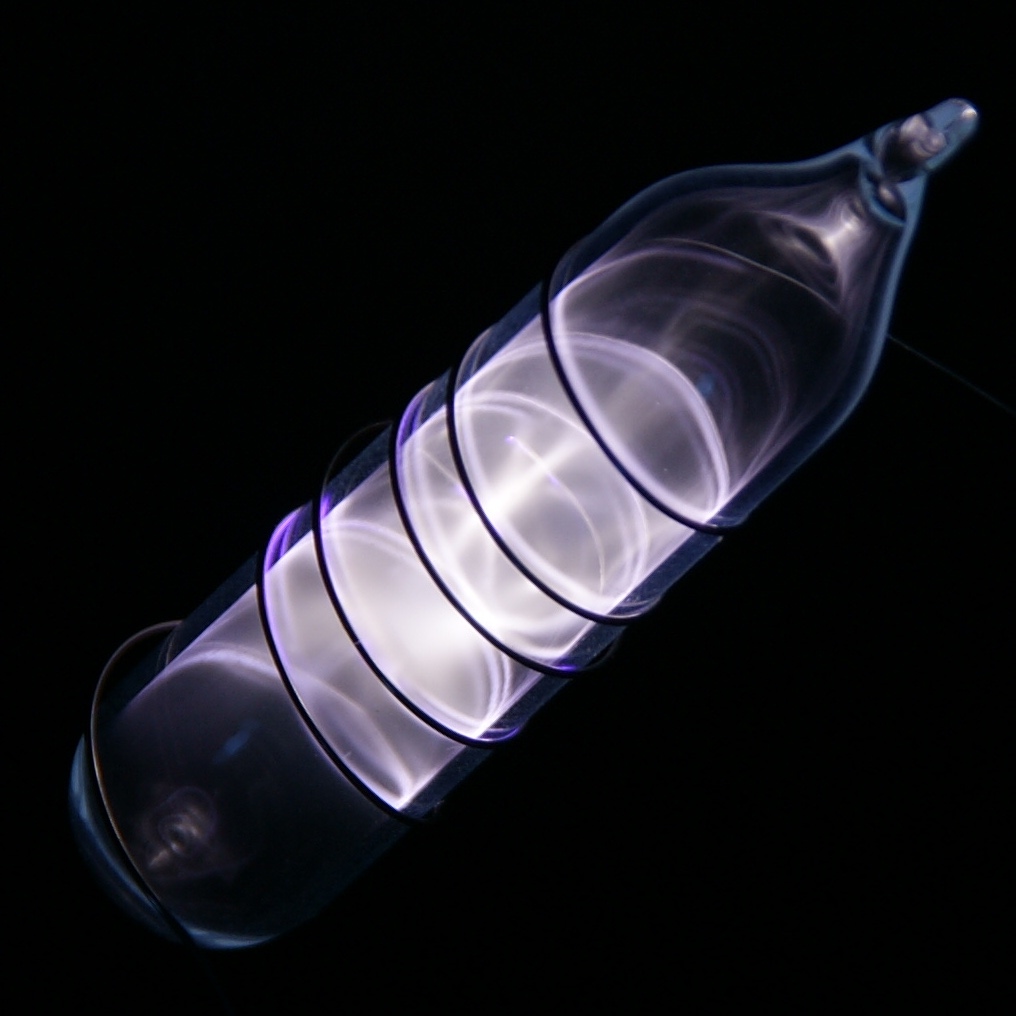
Krypton is a noble gas in group 18, below argon and above xenon. Its practical value comes from two things: it glows a pale violet-white when electricity passes through it, and its atoms are heavy and slow, which makes it a superb insulator and a gentle filler for light bulbs.
Where it is found
The air is the only practical source. Krypton makes up about 1.1 parts per million of the atmosphere by volume, so a large room contains only a few cubic centimetres of it. It is separated as a by-product when air is liquefied and distilled to produce oxygen and nitrogen, and it is collected together with xenon from the oxygen-rich fraction.
Krypton is also created inside nuclear reactors when uranium splits. The radioactive isotope krypton-85 leaks into the air from reprocessing plants, and monitoring stations measure it to detect undeclared plutonium separation. Krypton-81, made in the upper atmosphere by cosmic rays, has a half-life of over two hundred thousand years and is used to date very old groundwater and Antarctic ice.
How it was discovered
After argon was found in 1894, William Ramsay and his assistant Morris Travers at University College London reasoned that other inert gases might be hiding in the air. In May 1898 they boiled away a large sample of liquefied air almost to nothing and examined the heavy residue in a spectroscope. Bright yellow and green lines appeared that belonged to no known element.
That residue was krypton. Within weeks the same technique yielded neon, and xenon followed later in the summer. Ramsay received the 1904 Nobel Prize in Chemistry for discovering the noble gases and showing where they belonged in the periodic table, an entire new column that Mendeleev had not foreseen.
What we use it for
Lighting is the traditional market. Krypton-filled incandescent bulbs run brighter and last longer than argon-filled ones because the heavy atoms slow the evaporation of the tungsten filament. It fills the high-intensity flash lamps that guide aircraft onto runways and the tubes of some fluorescent lights. In so-called neon signs, krypton gives a soft whitish glow.
Its most technologically important use is invisible. Krypton fluoride excimer lasers produce ultraviolet light at 248 nanometres, and for years these lasers printed the circuit patterns onto silicon chips in photolithography machines. Krypton is also sealed between the panes of high-performance windows, where it insulates better than argon. In hospitals the short-lived isotope krypton-81m is inhaled by patients so that gamma cameras can image how air moves through the lungs.
Reading the numbers
Krypton melts at about minus 157 °C and boils at minus 153 °C, a liquid range of only four degrees. Its density as a gas, 3.75 grams per litre, is almost three times that of air, so a krypton-filled balloon sinks to the floor. That heaviness is why it cuts heat flow through windows and slows filament wear in bulbs.
The configuration [Ar] 3d10 4s2 4p6 completes the fourth shell with eight electrons, the classic sealed arrangement of a noble gas. The list of ionisation energies tells the story in numbers: the first is 1350.8 kJ/mol, the highest in period 4, and there is a huge leap between the eighth and ninth values because the ninth electron must come from the tightly bound shell below. Krypton's first ionisation energy is noticeably lower than argon's, which is why chemists can force krypton to form a compound, krypton difluoride, while argon barely reacts at all.
Safety and the environment
Krypton is not toxic and does not react in the body. The only hazard is asphyxiation if it displaces oxygen in an enclosed space, a risk shared with every other inert gas. Radioactive krypton-85 from the nuclear industry adds a tiny amount to background radiation and is tracked but not considered a significant health concern.
Environmentally, krypton is inert and does not act as a greenhouse gas. The main footprint comes from the energy used to liquefy and distil air, and from the fact that krypton in windows or lamps is eventually released back to the atmosphere it came from.
Did you know?
- From 1960 to 1983 the metre was officially defined as a fixed number of wavelengths of orange-red light emitted by krypton-86 atoms.
- Krypton was discovered in May 1898, and the same two scientists found neon within weeks and xenon a few weeks after that.
- Krypton fluoride lasers, glowing in deep ultraviolet, printed the circuits of many generations of computer chips.
- Superman's planet Krypton first appeared in 1938, forty years after the element was named.
- Krypton is not completely inert: krypton difluoride was first made in 1963 and decomposes slowly at room temperature.
- Measuring krypton-85 in the air can reveal secret nuclear fuel reprocessing anywhere on Earth.
More in the noble gases
These share a column with krypton, so their outer electrons are arranged in a similar way and they tend to behave alike.
See all 7 noble gases on one page, or browse all 118 elements.
Compare Krypton with another element
Each comparison has a side-by-side data table and a plain-English summary of the differences.
Frequently asked questions
Is krypton dangerous?
Ordinary krypton is harmless: it is non-toxic, non-flammable and does not react with the body. The only risk is suffocation if a large amount fills a confined space and pushes out the oxygen. The radioactive isotope krypton-85 exists in trace amounts from nuclear activity but at levels far too low to matter.
Does krypton glow?
Yes, when an electric current passes through krypton at low pressure it emits a pale violet-white light. Neon gives red, argon gives blue-purple and krypton fills in the whitish tones in illuminated signs. Its spectrum has distinct green and yellow lines, which is how it was first identified.
Is krypton a real element?
It is. Krypton is element 36, a noble gas found in tiny amounts in the air we breathe. The fictional planet in Superman comics was named after the element, not the other way round. Real krypton is a gas, not a rock, and kryptonite does not exist.
What is the difference between krypton and argon in windows?
Both are inert gases sealed between window panes to slow heat loss. Krypton atoms are heavier and conduct heat less well, so krypton-filled windows insulate better, especially when the gap between panes is narrow. Krypton costs far more, so argon is the usual choice and krypton is reserved for premium glazing.
Read next
Guess the mystery element in six tries. A new one every day, free, no sign-up.
Written by Anthony. Updated September 2026. Numerical data from Periodic-Table-JSON (CC BY-SA), cross-checked against the Krypton reference article. Spotted an error? Tell us.