Mercury · element 80
The only metal that is liquid at room temperature, once swallowed as medicine and now being phased out worldwide
Key facts
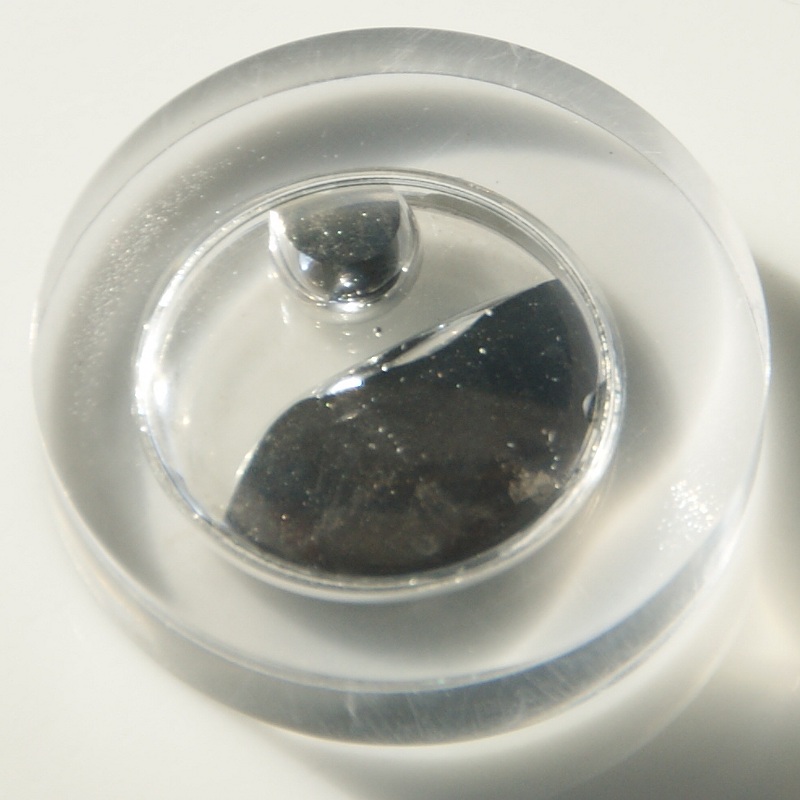
Tip a bottle of mercury and a bright silver liquid pours out, so heavy that a steel ball bearing, or even a lump of lead, floats on it. It is the only metal that stays liquid at ordinary temperatures, and its old English name, quicksilver, means living silver. Its symbol Hg comes from the Latin hydrargyrum, water-silver.
Mercury has been a thermometer fluid, a cure-all, a pigment, a way to extract gold and a component of every fluorescent lamp. It is also a potent nerve poison, and a global treaty now aims to remove it from everyday life.
Where it is found
Mercury's main ore is cinnabar, a striking red mineral of mercury sulfide. Heat cinnabar in air and the sulfur burns off while mercury boils away as vapour, which is condensed and collected. This simple process is why mercury was known so early.
The Almadén mine in Spain produced mercury for over two thousand years, from Roman times until the early 2000s, and Idrija in Slovenia and Monte Amiata in Italy were other great historic sources. Today China is by far the largest producer. Mercury is also present in traces in coal, and burning coal releases it into the atmosphere, now one of the main ways it reaches the environment.
How it was discovered
Mercury has no discoverer. It has been found in Egyptian tombs more than three thousand years old, and Chinese, Indian, Greek and Roman writers all describe it. The Romans mined cinnabar for the pigment vermilion, and the first emperor of China is said to have taken mercury pills in the hope of living forever, which almost certainly hastened his death.
Alchemists believed all metals contained mercury in some form and named it after the swift-moving planet and the messenger god. Its scientific career began in 1643 when Evangelista Torricelli filled a glass tube with mercury and invented the barometer, and in the early 1700s Daniel Fahrenheit made the mercury thermometer a reliable instrument.
What we use it for, and used to
For three centuries mercury filled thermometers, barometers and blood pressure gauges because it expands smoothly with temperature and is easy to see. It went into dental fillings as amalgam, into tilt switches, batteries, felt hats and the electrodes of chlorine factories. Mercury vapour in fluorescent tubes and energy saving bulbs produces the ultraviolet light that makes the phosphor coating glow.
Most of these uses are now banned or fading. Digital thermometers have replaced mercury ones, and the European Union has ended the use of dental amalgam. The biggest remaining use is a troubling one: small scale gold miners use mercury to dissolve gold from sediment, then burn it off. Legitimate uses today include some laboratory instruments, specialist lamps, and a preservative in a few multi-dose vaccine vials.
Reading the numbers
Mercury freezes at minus 39 °C and boils at 357 °C. That liquid range straddles every temperature humans live in, though a mercury thermometer becomes useless in an Antarctic winter. Its density of 13.5 grams per cubic centimetre means a one litre bottle weighs 13.5 kilograms, heavier than iron and lead, which both float on it.
The electron configuration [Xe] 4f14 5d10 6s2 is the key to why it is a liquid. Every shell is completely filled, and relativistic effects in such a heavy atom pull the 6s electrons in tightly. Those electrons are so reluctant to be shared that mercury atoms bond weakly to each other, and the metal falls apart into a liquid at room temperature. The same tightly held electrons give mercury a first ionisation energy of 1007 kJ/mol, the highest of any metal. Mercury sits in group 12 with zinc and cadmium, which also have unusually low melting points for metals.
Safety and the environment
Liquid mercury is barely absorbed through skin, but it evaporates slowly at room temperature and the vapour is toxic when breathed in, damaging the nervous system and kidneys. A broken thermometer should be cleaned up carefully with tape or card, never with a vacuum cleaner, which spreads the vapour.
The greater danger is methylmercury, formed when bacteria in water act on mercury pollution. It builds up in fish, concentrating most in long lived predators such as tuna, swordfish and shark, which is why pregnant women are advised to limit them. In the 1950s industrial discharge into Minamata Bay in Japan poisoned thousands of people, and the Minamata Convention, agreed in 2013, commits over a hundred countries to cutting mercury use and emissions.
Did you know?
- Mercury is so dense that iron, lead and even a cannonball will float on it.
- The chemical symbol Hg comes from the Latin hydrargyrum, meaning water-silver.
- The phrase mad as a hatter is linked to mercury poisoning among workers who used mercury compounds to make felt hats.
- Mercury attacks aluminium, eating through it by forming an amalgam, which is one reason it is banned from aircraft.
- The Almadén mine in Spain supplied mercury for around two thousand years and is now a World Heritage Site.
- Mercury is one of only two elements that are liquid at room temperature; the other is the non-metal bromine.
More in the transition metals
Column-mates come first, since elements in one column have outer electrons arranged in a similar way and tend to behave alike; the rest are the nearest neighbours in the family.
See all 38 transition metals on one page, or browse all 118 elements.
Compare Mercury with another element
Each comparison has a side-by-side data table and a plain-English summary of the differences.
Frequently asked questions
Why is mercury a liquid at room temperature?
Its atoms have completely filled electron shells and hold their outer electrons unusually tightly, partly because of relativistic effects in such a heavy atom. They therefore share electrons poorly with their neighbours, the metallic bonds are weak, and the solid melts at minus 39 °C.
Is it dangerous to touch mercury?
Brief skin contact with liquid mercury absorbs very little, but it is still not safe to handle. The real risk is breathing the vapour it gives off, especially in a warm, enclosed room. Spills should be cleaned up carefully and never vacuumed.
Are mercury thermometers still used?
Rarely. The sale of mercury thermometers to the public has been banned in the UK and EU since 2009, and hospitals have switched to digital and infrared devices. Old ones still exist in homes and should be disposed of at a recycling centre.
Why is there mercury in fish?
Mercury from coal burning, mining and industry settles into oceans and lakes, where bacteria convert it into methylmercury. Small organisms absorb it, and it becomes more concentrated at each step up the food chain, so large predatory fish contain the most.
Read next
Guess the mystery element in six tries. A new one every day, free, no sign-up.
Written by Anthony. Updated September 2026. Numerical data from Periodic-Table-JSON (CC BY-SA), cross-checked against the Mercury reference article. Spotted an error? Tell us.