Molybdenum · element 42
Mistaken for lead for centuries, it now toughens steel, cleans fuel and powers an enzyme in nearly every living thing
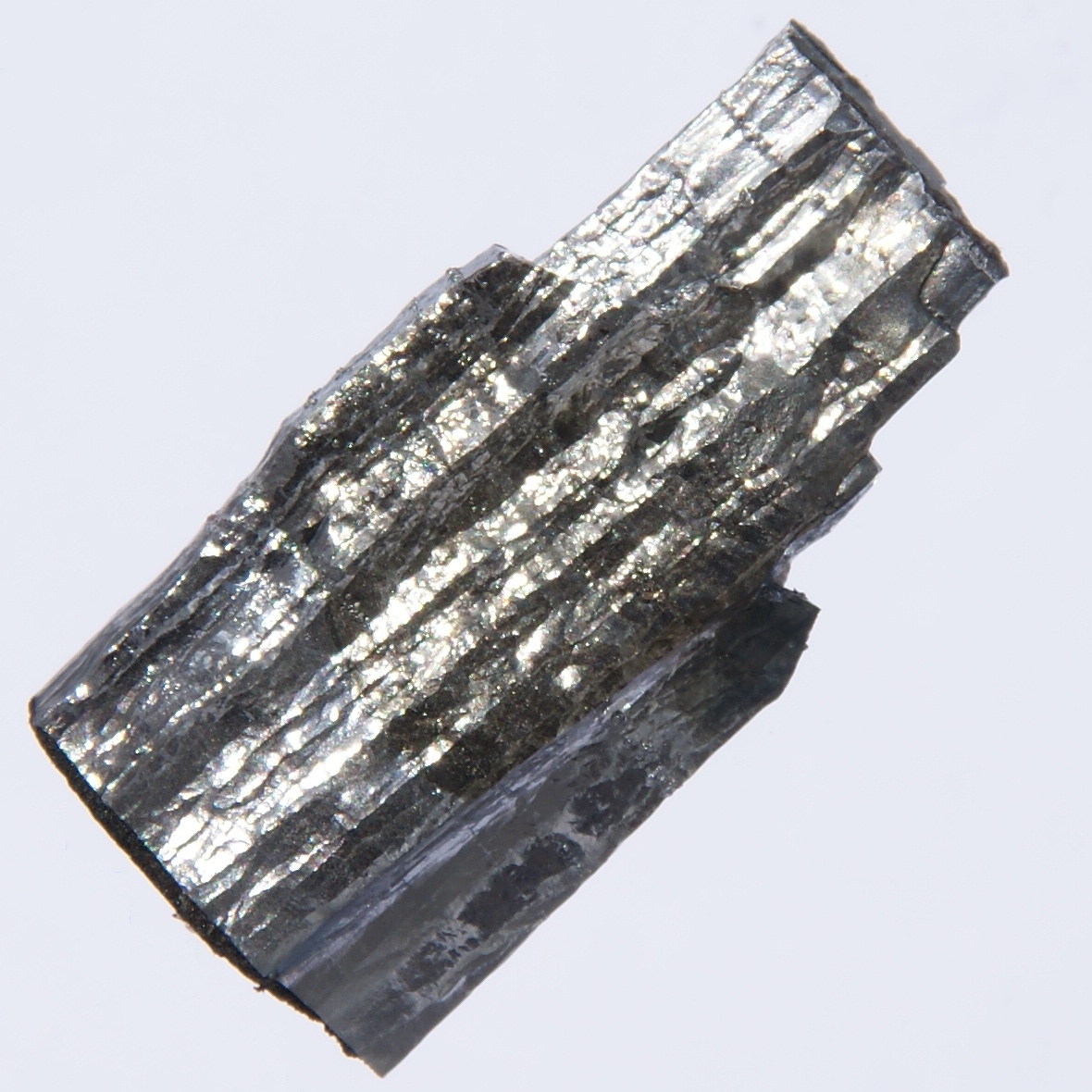
Key facts
Nearly every living thing needs molybdenum, and it is the heaviest element with a role in the human body. Soil and ocean bacteria use a molybdenum enzyme to break the tough bond in nitrogen gas and make ammonia, the process on which most of the world's protein depends. Yet for most of history nobody knew molybdenum existed, because its main mineral looked exactly like lead ore or graphite.
Molybdenum is a silvery-grey transition metal in group 6, beneath chromium and above tungsten. It has one of the highest melting points of any element and a knack for making steel hard, heat resistant and immune to seawater. Its name comes from molybdos, Greek for lead.
Where it is found
The principal ore is molybdenite, molybdenum disulfide, a soft, grey, flaky mineral that leaves a mark on paper like a pencil. It occurs alongside copper in the huge low-grade porphyry deposits of the Andes and North America, so much molybdenum is a by-product of copper mining. China, Chile, the United States and Peru are the main producers.
Molybdenum is also the most abundant transition metal dissolved in seawater, present as the molybdate ion at around 10 micrograms per litre. That is why marine microbes evolved to use it, and its traces in ancient sediments tell geologists how much oxygen the early oceans held.
How it was discovered
The Swedish chemist Carl Wilhelm Scheele was the first to see through the disguise. In 1778 he treated molybdenite with nitric acid and obtained a white powder that was clearly not lead or graphite but the oxide of something new. He lacked a furnace hot enough to reduce it, so in 1781 his friend Peter Jacob Hjelm heated the oxide with carbon and produced the first metallic molybdenum.
For more than a century it remained a curiosity. Around 1900 metallurgists found that small additions toughened steel, and demand soared in the First World War for armour plate and gun barrels. Colorado's Climax mine opened in 1918 to meet it and was for decades the world's largest source.
What we use it for
About four fifths of all molybdenum goes into iron and steel. A few per cent in stainless steel, as in the widely used grade 316, stops chloride pitting and makes the steel suitable for boats, chemical plants and surgical implants. Chrome-molybdenum steels build bicycle frames and pressure vessels, high-speed tool steels keep drills sharp when hot, and turbine superalloys contain it too.
Pure molybdenum is used for furnace heating elements, glass-melting electrodes and the anodes of the X-ray tubes in mammography machines. Molybdenum disulfide is a slippery solid lubricant, and single layers of it are studied as a two-dimensional semiconductor. Molybdenum catalysts remove sulfur from petrol and diesel at oil refineries, which is why modern fuels burn so much cleaner. Farmers add molybdate to soil for beans and clover, and molybdenum-99 made in reactors decays into technetium-99m, the workhorse isotope of hospital imaging.
Reading the numbers
Molybdenum melts at 2623 °C and boils at about 4639 °C. Only a handful of elements, including tungsten and tantalum, melt at higher temperatures, which is why molybdenum lines furnaces and survives in rocket nozzles. Its density of 10.28 grams per cubic centimetre is over ten times that of water, noticeably denser than iron and close to silver, yet only about half that of tungsten below it.
The configuration [Kr] 4d5 5s1 mirrors chromium's 3d5 4s1 above it: a half-filled d shell plus one s electron, an arrangement that is unusually stable. Six electrons sit outside the krypton core, and molybdenum reaches the +6 state in molybdate ions, while the +4 state appears in molybdenite. The six ionisation energies climb from 684 to 6641 kJ/mol and then nearly double to 12125, matching the six valence electrons. Its electronegativity of 2.16 is high for a metal, part of the reason it resists many acids. Group 6 membership links its colourful oxo compounds to those of chromium and its heat resistance to tungsten.
Safety and the environment
Molybdenum metal and molybdenite are low in toxicity, though molybdenum trioxide dust and fumes irritate the lungs and are controlled in the workplace. Adults need around 45 micrograms a day and get it easily from pulses, grains and nuts. Deficiency is almost unknown. Excess is a problem mainly for cattle: pastures on molybdenum-rich soils, such as the teart pastures of Somerset, cause copper deficiency in grazing animals.
Environmental concerns centre on mining waste, since molybdate is soluble and can move through groundwater. As a counterweight, molybdenum refinery catalysts have removed vast amounts of sulfur that would otherwise have become acid rain.
Did you know?
- Molybdenum is the most abundant transition metal dissolved in the oceans, which is why marine microbes evolved to depend on it.
- The enzyme nitrogenase, which lets bacteria turn nitrogen gas into ammonia, has molybdenum at its heart, and most of the protein on Earth passes through it.
- Only a handful of elements melt at a higher temperature than molybdenum's 2623 °C.
- The seawater resistance of grade 316 stainless steel, used for boat fittings and surgical implants, comes from a few per cent of molybdenum.
- Technetium-99m, used in tens of millions of medical scans a year, is produced by the decay of molybdenum-99.
- Cattle grazing the teart pastures of Somerset develop copper deficiency because the soil is unusually rich in molybdenum.
More in the transition metals
Column-mates come first, since elements in one column have outer electrons arranged in a similar way and tend to behave alike; the rest are the nearest neighbours in the family.
See all 38 transition metals on one page, or browse all 118 elements.
Compare Molybdenum with another element
Each comparison has a side-by-side data table and a plain-English summary of the differences.
Frequently asked questions
Is molybdenum essential for humans?
Yes. It is part of several enzymes, including ones that break down purines to uric acid and detoxify sulfites. Adults need only about 45 micrograms a day, and a normal diet supplies plenty. Deficiency has been seen only in people on artificial feeding without molybdenum and in a very rare genetic disorder.
What foods contain molybdenum?
Legumes such as lentils, beans and peas are the richest sources, followed by whole grains, nuts and liver. Leafy vegetables contribute smaller amounts. Because the body needs so little, almost any varied diet provides enough.
Why is molybdenum added to steel?
Molybdenum dissolves into the iron and forms hard carbides, which raise strength and let the steel keep its hardness at high temperatures. In stainless steel it specifically prevents pitting corrosion caused by chloride, so it is vital for marine and chemical uses. A few per cent is usually enough.
Is molybdenum magnetic?
No. Molybdenum is only weakly paramagnetic and is not attracted to a magnet in any noticeable way. Steels that contain molybdenum may still be magnetic, but that comes from the iron, not the molybdenum.
Read next
Guess the mystery element in six tries. A new one every day, free, no sign-up.
Written by Anthony. Updated September 2026. Numerical data from Periodic-Table-JSON (CC BY-SA), cross-checked against the Molybdenum reference article. Spotted an error? Tell us.