Praseodymium · element 59
The green half of a twin that took forty years to split, now hiding in welders' goggles and jet engines
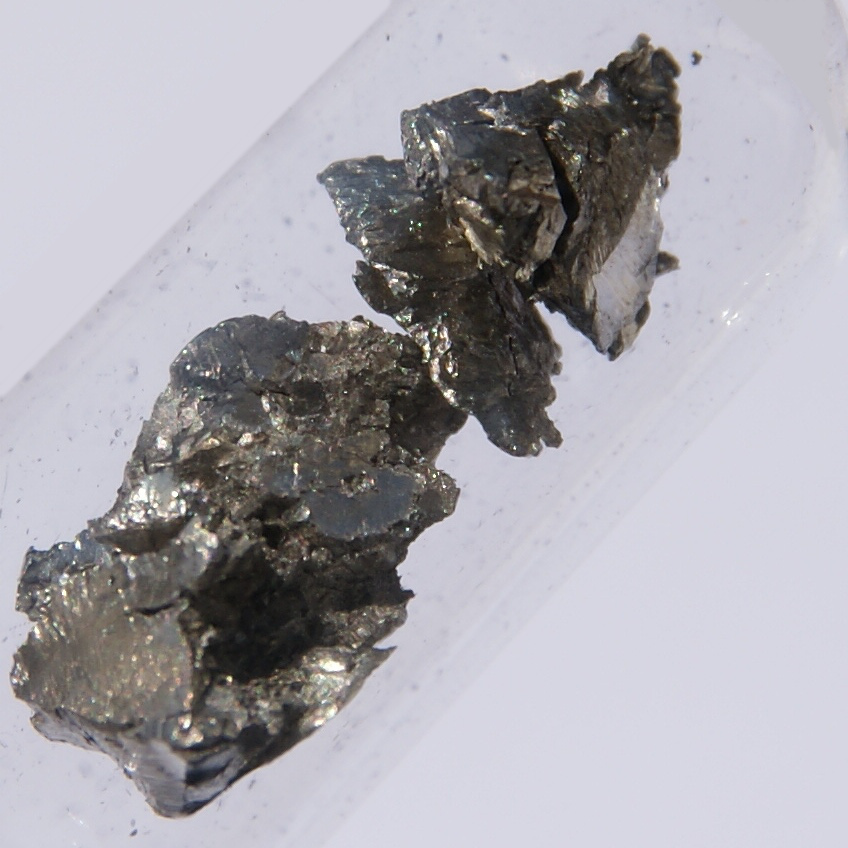
Key facts
Praseodymium was, for a long time, half of something else. In 1841 chemists thought they had found an element called didymium, the twin, because it seemed always to appear alongside lanthanum. It took until 1885 to prove that didymium was itself two elements. The one whose salts were green became praseodymium, from the Greek for leek-green twin.
Today it is one of the less talked-about rare earths, but it turns up in surprising places: in the yellow-green glass that protects a glassblower's eyes, in high-strength magnesium alloys for aircraft engines, and, increasingly, alongside neodymium in the magnets that drive electric vehicles.
Where it is found
Praseodymium is found in the same rare earth minerals as its neighbours, mainly bastnäsite and monazite, where it makes up a small percentage of the total rare earth content. Southern Chinese ion-adsorption clays also contain it. Its abundance in the crust is a few parts per million, more than tin, but it never concentrates on its own.
Because praseodymium and neodymium sit next to each other and behave almost identically, they are often extracted together as a mixed product called PrNd or didymium oxide. Separating the two further requires many stages of solvent extraction. China leads production, with Australia, the United States and Myanmar contributing raw material.
How it was discovered
Carl Gustaf Mosander, who had found lanthanum in 1839, separated another fraction from his lanthanum compounds in 1841 and called it didymium. For four decades didymium was listed as an element.
In 1885 the Austrian chemist Carl Auer von Welsbach, working in Vienna, spent months repeatedly crystallising didymium ammonium nitrate. He noticed that the crystals separated into two fractions with slightly different colours and spectra. One gave green salts, the other rose-pink. He named them praseodymium and neodymium, the green twin and the new twin. Welsbach later became famous for inventing the gas mantle used in street lighting, an early metal filament lamp, and the ferrocerium lighter flint.
What we use it for
Praseodymium's oldest use is in didymium glass, which still contains both praseodymium and neodymium. This glass absorbs the intense yellow light given off by hot sodium in molten glass and by welding flux, so glassblowers and welders wear it to see their work without glare. Praseodymium on its own colours glass and ceramic glazes a clean yellow, and praseodymium-doped zirconia is a stable yellow ceramic pigment.
Its most important modern role is in magnets. Praseodymium can replace part of the neodymium in neodymium-iron-boron magnets without much loss of performance, and since the two are extracted together, many magnets are made with the PrNd mixture directly. These magnets drive electric vehicle motors, wind turbine generators and countless small motors and speakers. Praseodymium also strengthens magnesium alloys used in aircraft engines, is a component of mischmetal in lighter flints, and is used in fibre optic signal amplifiers and in some lasers.
Reading the numbers
Praseodymium melts at about 935 °C and boils at about 3130 °C, values in the same range as its lanthanide neighbours. Its density is 6.77 grams per cubic centimetre, the same figure as cerium and slightly less than iron. Like the other lanthanides it is a soft, malleable metal that can be cut and shaped without difficulty.
The configuration [Xe] 4f3 6s2 shows three electrons in the 4f subshell. Because 4f electrons sit deep inside the atom, shielded by the outer shells, they rarely take part in bonding, and praseodymium behaves like its neighbours by losing three electrons to form Pr3+. Those partly filled 4f orbitals are also what give the element its colour: they absorb specific wavelengths of light, producing green salts and the yellow tint in glass. Its electronegativity of 1.13 and first ionisation energy of 527 kilojoules per mole mark it as a strongly electropositive, reactive metal. Praseodymium can also form Pr4+ in a few compounds, though far less easily than cerium.
Safety and the environment
Praseodymium is not especially toxic, and its compounds are poorly absorbed by the body, but there is limited data and it should be handled with care. The metal tarnishes in air, forming a green oxide coating that flakes off and exposes fresh metal, so it is stored under oil or inert gas. Fine powder can ignite.
Environmental concerns follow those of the whole rare earth industry: acidic waste, mildly radioactive tailings and the energy cost of separation. Because praseodymium is increasingly bound up in magnets, recycling magnets from scrapped motors and hard drives is an important way to reduce future mining.
Did you know?
- Praseodymium's name means leek-green twin, describing the colour of its salts and its long confusion with neodymium.
- Didymium was listed as an element for over forty years before being shown to be a mixture of praseodymium and neodymium.
- Glassblowers' safety glasses often contain praseodymium and neodymium, which filter out the glare of hot sodium.
- The chemist who separated praseodymium, Carl Auer von Welsbach, also invented the gas mantle and the ferrocerium lighter flint.
- Praseodymium can replace some of the neodymium in the powerful magnets used in electric car motors.
More in the lanthanides
The nearest neighbours of praseodymium in the family, by atomic number.
See all 15 lanthanides on one page, or browse all 118 elements.
Frequently asked questions
What is praseodymium used for?
Its largest use today is in neodymium-iron-boron magnets, where it substitutes for part of the neodymium in motors and generators. It also gives a yellow colour to glass and ceramics, filters glare in glassblowers' and welders' goggles, strengthens magnesium alloys for aircraft engines, and appears in lighter flints and fibre optic amplifiers.
Why is praseodymium called the green twin?
For forty years it was hidden inside didymium, a supposed element whose name means twin because it always accompanied lanthanum. When Carl Auer von Welsbach split didymium in 1885, the fraction with green salts was named praseodymium, from the Greek prasios for leek-green, and the other became neodymium, the new twin.
Is praseodymium magnetic?
On its own, only weakly. At room temperature praseodymium metal is paramagnetic, meaning it is faintly drawn to a magnetic field but will not hold a magnet. Alloyed with iron and boron alongside neodymium, however, it forms some of the strongest permanent magnets available.
Is praseodymium rare?
It is a rare earth element, but it is more abundant in the crust than tin or silver. The difficulty is not scarcity but separation: praseodymium occurs mixed with the other lanthanides in minerals such as monazite and bastnäsite, and splitting it from neodymium in particular takes many chemical stages.
Read next
Guess the mystery element in six tries. A new one every day, free, no sign-up.
Written by Anthony. Updated September 2026. Numerical data from Periodic-Table-JSON (CC BY-SA), cross-checked against the Praseodymium reference article. Spotted an error? Tell us.