Tin · element 50
The metal that started the Bronze Age and still seals every food can on the shelf
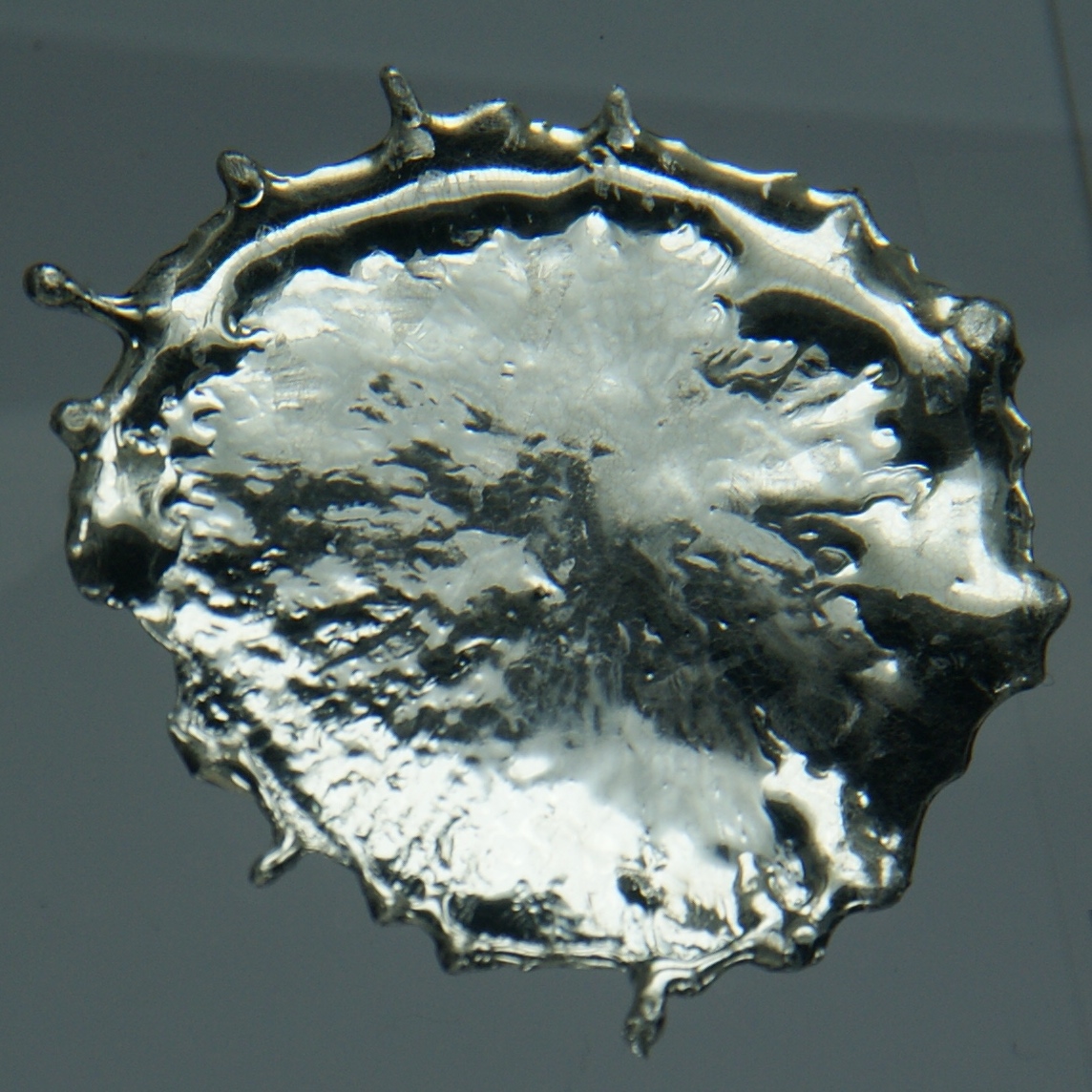
Key facts
Around five thousand years ago, someone in the ancient Near East mixed a little tin into molten copper and produced a metal harder and easier to cast than either. That alloy, bronze, gave its name to an entire age of human history. Tin has been in continuous use ever since, and it may be the least glamorous of the truly essential metals.
Tin resists corrosion, melts easily, is non-toxic in metallic form and bonds well to other metals. Those four qualities explain almost everything it does today, from the coating inside a can of beans to the solder joints holding together the circuit board in your phone.
Where it is found
Tin's main ore is cassiterite, a heavy brown or black oxide that resists weathering. Because it is dense and durable, cassiterite collects in river gravels and beach sands as the surrounding rock erodes, and much of the world's tin has been dredged or washed from such deposits rather than dug from hard rock. Tin is not abundant, making up only a couple of parts per million of the crust.
For most of the last century South East Asia has led production. Indonesia, Myanmar and Malaysia have rich alluvial deposits, and China is now the largest producer overall. Bolivia, Peru, Brazil and central Africa also contribute. Cornwall and Devon supplied Europe with tin from the Bronze Age until the last mine closed in 1998, and the engine houses that still dot the Cornish coast are a legacy of that trade.
How it was discovered
Tin belongs to the small group of metals known since prehistory, so it has no discoverer. Tin bronzes appear in archaeological sites in Mesopotamia and Anatolia from about 3500 BC onward, and by the second millennium BC tin was being traded over long distances because the places that had copper often did not have tin.
The symbol Sn comes from the Latin stannum. Roman writers first used the word for an alloy of silver and lead before it settled on tin itself. The English word tin is Germanic and of uncertain origin.
What we use it for
Solder is now the biggest use. Traditional solder was a tin-lead alloy that melted at a convenient temperature. Regulations on lead have pushed the electronics industry to tin-silver-copper alloys, which are mostly tin, so demand rose. Every soldered joint in modern electronics contains tin.
Tinplate, thin steel coated with tin, is what a tin can actually is. The steel gives strength and the tin gives a non-toxic surface that does not react with food. Tin is alloyed with copper to make bronze and with antimony and copper to make pewter. Molten tin is the bed on which float glass is made: molten glass poured onto a bath of tin spreads into a perfectly flat sheet. Tin compounds are used in glazes, in fire retardants and in coating glass to make it conductive.
Reading the numbers
Tin melts at about 232 °C, which a soldering iron reaches easily, and boils at roughly 2602 °C. That very wide liquid range is useful in the float glass process, where the tin bath is held at around 1000 °C without significant evaporation. Its density is 7.37 grams per cubic centimetre, similar to iron and a little more than seven times that of water.
The configuration [Kr] 4d10 5s2 5p2 gives tin four outer electrons, placing it in group 14 under silicon and germanium and above lead. Tin forms compounds in both the +2 and +4 states, sitting on the borderline between metallic and non-metallic behaviour that characterises this group. Its electronegativity of 1.96 is fairly high for a metal, which is why tin does not corrode easily. Remarkably, tin has ten stable isotopes, more than any other element, because its 50 protons form a particularly stable arrangement in the nucleus.
Safety and the environment
Metallic tin and its oxide are harmless, which is why tin can line food containers and was used for drinking vessels for centuries. Inorganic tin compounds are poorly absorbed by the body. The danger lies in organotin compounds, in which tin is bonded to carbon. Tributyltin, once painted onto ship hulls to prevent barnacles, proved severely toxic to marine life and has been banned internationally.
Tin mining has a heavy footprint. Dredging alluvial deposits destroys riverbeds and coastal habitats, and in some regions small-scale mining raises serious concerns about safety and labour. Because tin is easily recovered from scrap, recycling of solder and tinplate helps reduce the pressure.
Did you know?
- A bar of pure tin makes a crackling sound when bent, called tin cry, as its crystal structure deforms.
- Below about 13 °C, white metallic tin slowly transforms into a brittle grey powder, a change known as tin pest that can crumble old pewter and tin objects.
- Tin has ten stable isotopes, more than any other element.
- A modern tin can is more than 99 per cent steel; the tin is just a thin protective coating.
- Nearly all flat window glass is made by floating molten glass on a bath of molten tin.
- Classic bronze is roughly nine parts copper to one part tin.
More in the post-transition metals
Column-mates come first, since elements in one column have outer electrons arranged in a similar way and tend to behave alike; the rest are the nearest neighbours in the family.
See all 12 post-transition metals on one page, or browse all 118 elements.
Compare Tin with another element
Each comparison has a side-by-side data table and a plain-English summary of the differences.
Frequently asked questions
Is tin the same as aluminium foil?
No. Kitchen foil has been made of aluminium for about a century, but before that it really was made of tin, and the old name stuck. Genuine tin foil is heavier, stiffer and leaves a faint metallic taste, which is one reason aluminium replaced it.
Are tin cans really made of tin?
Only on the surface. A tin can is steel coated with a very thin layer of tin, which stops the steel rusting and keeps it from reacting with food. Many drinks cans are aluminium and contain no tin at all.
Is tin toxic?
Metallic tin and simple tin salts are very low in toxicity, which is why tin can safely coat food cans. Organotin compounds, where tin is bonded to carbon, are a different matter and can be highly toxic, which is why tributyltin ship paints were banned.
Why is the symbol for tin Sn?
It comes from stannum, the Latin word for tin. Several ancient metals keep symbols from their Latin names, such as Fe for iron from ferrum, Pb for lead from plumbum and Ag for silver from argentum.
Read next
Guess the mystery element in six tries. A new one every day, free, no sign-up.
Written by Anthony. Updated September 2026. Numerical data from Periodic-Table-JSON (CC BY-SA), cross-checked against the Tin reference article. Spotted an error? Tell us.