Aluminium · element 13
Once rarer than gold, now the most used metal after iron, and it never really wears out
Key facts
Aluminium is the most abundant metal in the Earth's crust, yet two hundred years ago nobody had seen a piece of it. It clings so tightly to oxygen that separating it needed chemistry that did not yet exist. Then cheap electricity changed everything, and today it is the second most used metal in the world.
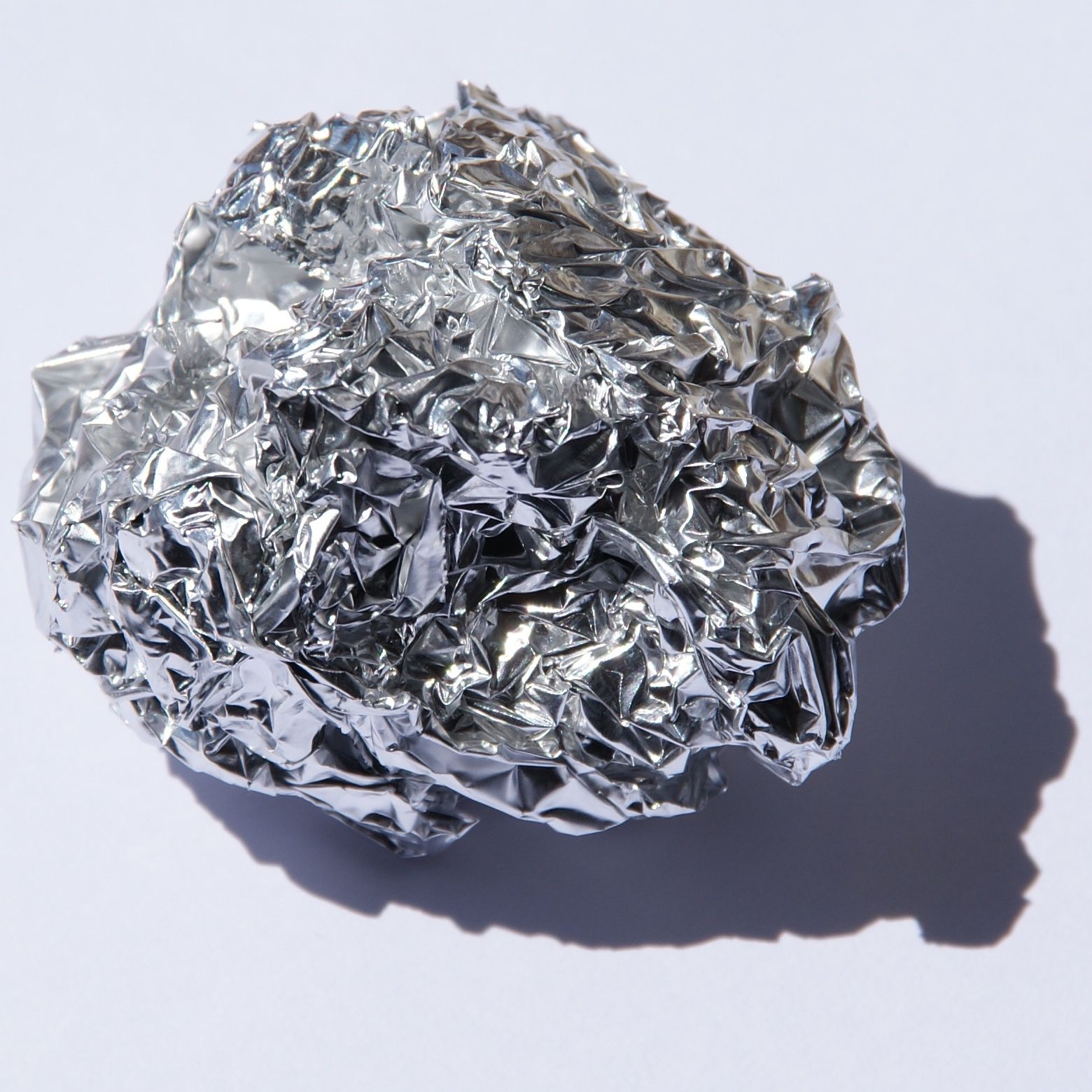
Aluminium is light, strong for its weight, easy to shape and does not rust. It protects itself with a thin skin of oxide that forms the instant a fresh surface meets air. From drinks cans and foil to aircraft and power lines, it is a metal of the modern age, and one of the few materials that can be recycled again and again with almost no loss.
Where it is found
About 8 per cent of the Earth's crust by mass is aluminium, making it the third most abundant element after oxygen and silicon. It is present in nearly every rock as feldspars, micas and clays, all of them aluminium silicates.
The only ore worth mining is bauxite, a reddish, earthy rock formed where tropical weathering has washed almost everything except aluminium and iron oxides out of the soil. Australia, Guinea, China and Brazil are the largest producers. Corundum, a pure crystalline aluminium oxide, is the second hardest natural mineral, and when traces of chromium or of iron and titanium colour it, it becomes ruby or sapphire.
How it was discovered
Alum, a compound of aluminium, has been used for dyeing and medicine since antiquity, and Humphry Davy suspected in 1808 that it contained a metal. He could not extract it, but he named it, first alumium, then aluminum, then aluminium. In 1825 the Danish physicist Hans Christian Orsted produced a few impure grains by heating aluminium chloride with potassium amalgam.
The breakthrough came in 1886 when Charles Martin Hall in the United States and Paul Heroult in France, both aged 22, independently found that aluminium oxide dissolved in molten cryolite could be split by electricity. Their process is still used today. Two years later Karl Bayer found an efficient way to purify aluminium oxide from bauxite, and the price collapsed.
What we use it for
Transport is the largest market. Aircraft bodies have been built from aluminium alloys since the 1930s, and cars use ever more of it to save weight and fuel. Buildings use aluminium for window frames, cladding and roofing because it is strong, light and needs little maintenance. Overhead power lines are aluminium because it carries electricity well for its weight and cost.
Packaging is the most visible use: drinks cans, foil, food trays and pharmaceutical blister packs. Aluminium powder is an ingredient in solid rocket propellant and produces the silver sparkle in fireworks. Aluminium oxide is the abrasive in sandpaper and the raw material for the synthetic sapphire used in watch faces and phone camera lenses.
Reading the numbers
Aluminium melts at about 660 degrees Celsius, low enough to be melted in a small workshop furnace, and boils at about 2470 degrees. That low melting point is one reason recycling is so cheap: remelting scrap uses about five per cent of the energy of making new metal from ore. Its density of 2.70 grams per cubic centimetre is roughly a third of iron's and steel's, which is why it appears wherever weight matters.
The configuration [Ne] 3s2 3p1 shows three outer electrons. Aluminium loses all three to form Al3+, and its first three ionisation energies, 578, 1817 and 2745 kilojoules per mole, are followed by a huge jump to 11577 for the fourth, marking the neon core. Its position in group 13 and period 3 places it just past the metal boundary in the p-block. It is a true metal, unlike boron above it, but the small, highly charged Al3+ ion gives some of its compounds a covalent character.
Safety and the environment
Aluminium metal is safe to handle and cook with. The oxide layer keeps it from reacting, though acidic or very salty foods can dissolve small amounts. Aluminium is not an essential nutrient and the body absorbs very little of what it swallows. Concerns about a link to Alzheimer's disease have been studied for decades and are not supported by current evidence.
The environmental cost of aluminium lies in production. Smelting consumes enormous amounts of electricity, and where that power comes from coal the carbon footprint is high. Bauxite refining produces red mud, a caustic waste that must be stored safely. Against this, aluminium is endlessly recyclable, and around three quarters of all the aluminium ever produced is believed to be still in use.
Did you know?
- In the 1850s aluminium cost more than gold, and Napoleon III is said to have served his most honoured guests with aluminium cutlery.
- The small pyramid on top of the Washington Monument, set in 1884, is made of aluminium, then a showpiece metal.
- Rubies and sapphires are crystals of aluminium oxide coloured by tiny amounts of other elements.
- Recycling aluminium uses about five per cent of the energy needed to produce it from ore.
- Charles Martin Hall and Paul Heroult independently discovered the same smelting process in 1886, both at the age of 22.
- IUPAC settled on the spelling aluminium, but aluminum remains standard in the United States and Canada.
More in the post-transition metals
Column-mates come first, since elements in one column have outer electrons arranged in a similar way and tend to behave alike; the rest are the nearest neighbours in the family.
See all 12 post-transition metals on one page, or browse all 118 elements.
Compare Aluminium with another element
Each comparison has a side-by-side data table and a plain-English summary of the differences.
Frequently asked questions
Is it aluminium or aluminum?
Both are correct. Humphry Davy used several spellings, and the two survived on different sides of the Atlantic. IUPAC adopted aluminium as the international standard in 1990 while accepting aluminum as a variant, which is the spelling used in the United States and Canada.
Why doesn't aluminium rust?
It does react with oxygen, but the product is a thin, hard, transparent layer of aluminium oxide that seals the surface and stops further attack. Iron's rust is flaky and porous, so it keeps letting oxygen through. Aluminium's oxide skin heals itself within seconds if scratched.
Is aluminium foil safe for cooking?
Yes for normal use. Very acidic or salty foods, such as tomatoes or pickles, can dissolve small amounts of aluminium, especially over long periods or at high heat, so a barrier such as baking paper is sometimes recommended. The amounts involved are far below levels considered harmful.
Why was aluminium once so expensive?
Aluminium bonds extremely strongly to oxygen, and until the 1880s the only way to free it involved costly reactive metals such as potassium or sodium. The Hall-Heroult electrolysis process of 1886, combined with cheap hydroelectric power, cut the price dramatically within a few years.
Read next
Guess the mystery element in six tries. A new one every day, free, no sign-up.
Written by Anthony. Updated September 2026. Numerical data from Periodic-Table-JSON (CC BY-SA), cross-checked against the Aluminium reference article. Spotted an error? Tell us.