Magnesium · element 12
The metal that burns with a blinding white light and sits at the heart of every green leaf
Key facts
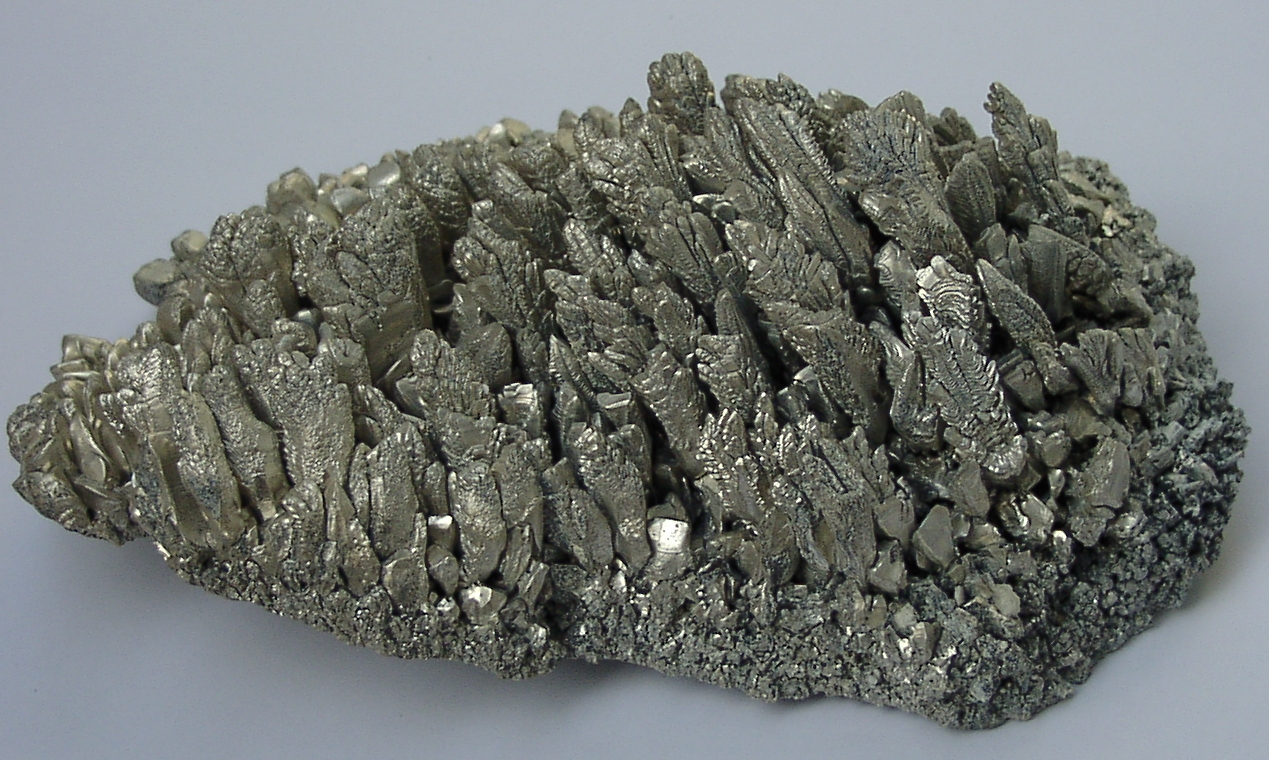
Magnesium is a light, silvery metal best known for the dazzling white flame it produces when it burns. Yet the same element, in a gentler form, sits at the centre of the chlorophyll molecule that lets plants capture sunlight. Without it there would be no photosynthesis, and so no food.
Magnesium is the lightest metal that can be used for structural parts, and it is abundant in rock and seawater. Engineers use it in car and aircraft components, laptops and cameras. Doctors prescribe it as Epsom salts and antacids. Your own body contains roughly 25 grams of it, most in your bones, and hundreds of your enzymes cannot work without it.
Where it is found
Magnesium is the eighth most abundant element in the Earth's crust, roughly 2 per cent by mass, and it is a major component of the mantle beneath. The minerals dolomite, magnesite and carnallite are the main ores, and olivine, the green mineral common in volcanic rock, is a magnesium iron silicate.
The sea is an even larger store. Magnesium is the third most abundant dissolved element in seawater after chlorine and sodium, at about 1.3 grams per litre. Salt lake brines, such as those of the Dead Sea and the Great Salt Lake, are richer still. China produces the great majority of the world's magnesium metal, mostly by heating dolomite with ferrosilicon.
How it was discovered
In 1755 the Scottish chemist Joseph Black showed that magnesia, a white powder used as a laxative, was a different substance from lime, the product of burning limestone. Until then the two had been confused. Black's careful weighing experiments distinguished the earths of magnesium and calcium, though he did not isolate either metal. The name comes from Magnesia, a district in Greece where magnesium-rich minerals were found.
Humphry Davy produced an impure form of magnesium in 1808 by electrolysis, using the same method that had given him sodium and potassium. In 1831 the French chemist Antoine Bussy prepared it more cleanly by heating magnesium chloride with potassium.
What we use it for
Most magnesium metal is added to aluminium to make alloys that are stronger and more corrosion resistant, including the alloy used in drinks cans. Magnesium alloys in their own right are used for car seat frames, steering wheels, gearbox casings, laptop and camera bodies and aircraft parts, wherever saving weight matters. Magnesium is also used to remove sulfur from steel and to produce titanium metal.
Magnesium compounds have their own long list. Magnesium oxide lines furnaces because it withstands enormous heat. Magnesium hydroxide is milk of magnesia, an antacid and laxative. Magnesium sulfate is Epsom salts and is also given by injection to treat pre-eclampsia in pregnancy. In organic chemistry, Grignard reagents based on magnesium have been building carbon-carbon bonds since 1900.
Reading the numbers
Magnesium melts at 650 degrees Celsius and boils at about 1090 degrees, moderate figures for a metal and low enough that it can be cast easily. Its density of 1.74 grams per cubic centimetre is about two thirds that of aluminium and less than a quarter that of iron, which is the whole point of magnesium as an engineering material. It is roughly 1.7 times as dense as water, so it sinks, but only just.
The configuration [Ne] 3s2 shows two electrons outside a stable neon core. Both are given up to form Mg2+, and the first two ionisation energies, 738 and 1451 kilojoules per mole, are modest, while the third jumps to 7733. Magnesium is therefore always doubly charged in its compounds. It belongs to group 2 in period 3, and it is less reactive than sodium beside it because the extra proton holds the outer electrons more tightly. Its electronegativity of 1.31 marks it as a clear metal.
Safety and the environment
Solid magnesium in bulk is difficult to ignite, but as ribbon, powder or shavings it burns fiercely at over 3000 degrees Celsius with an intense white light that can damage eyes. Once alight it cannot be put out with water, which it splits to make hydrogen, or with carbon dioxide, which it also strips of oxygen. Only dry powder extinguishers or sand work.
Magnesium compounds are generally low in toxicity, and magnesium is an essential nutrient found in leafy greens, nuts and whole grains. Excess intake causes diarrhoea rather than serious harm in healthy people. Producing magnesium metal by the dolomite process is energy hungry and carbon intensive, though electrolysis from brine can be cleaner.
Did you know?
- Every chlorophyll molecule has a magnesium ion at its centre, so photosynthesis depends on magnesium.
- Burning magnesium cannot be extinguished with water or carbon dioxide because it reacts with both.
- Magnesium is the third most abundant element dissolved in seawater, after chlorine and sodium.
- Early photographic flashes used magnesium powder, which produced an intense white light.
- An adult body contains roughly 25 grams of magnesium, more than half of it in the bones.
- The element is named after Magnesia, a region of Greece, which also gave its name to the mineral magnetite and the word magnet.
More in the alkaline earth metals
These share a column with magnesium, so their outer electrons are arranged in a similar way and they tend to behave alike.
See all 6 alkaline earth metals on one page, or browse all 118 elements.
Compare Magnesium with another element
Each comparison has a side-by-side data table and a plain-English summary of the differences.
Frequently asked questions
Why does magnesium burn so brightly?
Magnesium reacts with oxygen very energetically, and the reaction releases so much heat that the magnesium oxide produced glows white hot. The flame reaches over 3000 degrees Celsius and emits intense light, including ultraviolet, so it should never be looked at directly.
What does magnesium do in the body?
It is needed by hundreds of enzymes, including those that handle energy in the form of ATP, and it helps muscles and nerves work properly. Most of the body's magnesium is stored in bone. Leafy greens, nuts, seeds and whole grains are good sources.
Is magnesium a metal?
Yes. It is a silvery, lightweight alkaline earth metal in group 2 of the periodic table. It conducts electricity, can be cast and machined, and is used in alloys for cars, aircraft and electronics.
Why can't you put out a magnesium fire with water?
Burning magnesium is hot enough to split water into hydrogen and oxygen, so adding water feeds the fire and can cause an explosion. It even strips oxygen from carbon dioxide, so CO2 extinguishers fail too. Dry sand or special powder extinguishers are the only safe options.
Read next
Guess the mystery element in six tries. A new one every day, free, no sign-up.
Written by Anthony. Updated September 2026. Numerical data from Periodic-Table-JSON (CC BY-SA), cross-checked against the Magnesium reference article. Spotted an error? Tell us.