Sodium · element 11
The soft metal that bursts into flame in water, and the ion your nerves cannot fire without
Key facts
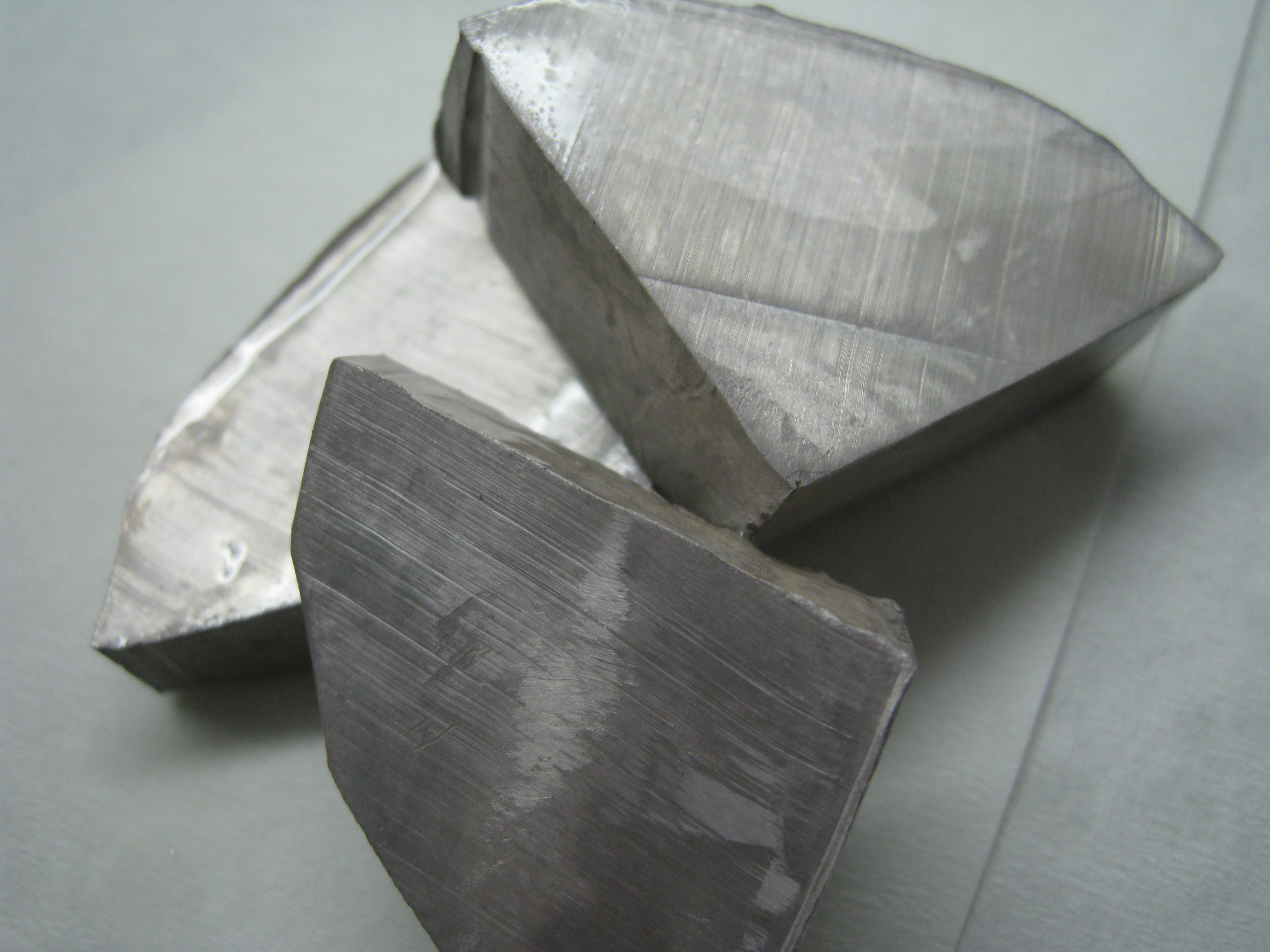
Sodium is a metal so soft that it can be cut with a butter knife, and so reactive that a small piece dropped into water fizzes, melts and often bursts into flame. Freshly cut, it is bright silver. Within seconds the surface dulls as it reacts with the air. Nobody meets sodium metal outside a laboratory, but everyone meets its compounds, because one of them is table salt.
The sodium ion is essential to life. It carries the electrical signals that run along nerves, controls the water balance of every cell, and gives seawater its taste. Too little in the diet is rare; too much is one of the most common health problems on Earth. Sodium is also cheap, abundant and useful in everything from street lamps to soap.
Where it is found
Sodium is the sixth most abundant element in the Earth's crust, about 2.6 per cent by mass. It is never found as a metal, only in compounds. Feldspars, the most common minerals in the crust, contain it. When rock weathers, sodium washes into rivers and eventually into the sea, where it has been accumulating for billions of years. Seawater is about 1.1 per cent sodium by mass, and evaporating it leaves halite, or rock salt.
Ancient seas that dried up left vast salt beds, now mined in places such as Cheshire in England, Poland and Pakistan. Sodium carbonate occurs naturally as trona in Wyoming and as natron in Egyptian lake beds, where it was used for mummification.
How it was discovered
Salt and soda have been used for thousands of years, but the metal inside them was unknown until 1807. That year, Humphry Davy at the Royal Institution in London used a powerful battery to pass electricity through molten caustic soda, sodium hydroxide. Small globules of silvery metal appeared at the negative electrode, caught fire and burned with a yellow flame. A few days earlier he had isolated potassium the same way.
Davy named the metal after soda. The symbol Na comes from natrium, the Latin form of natron, and was adopted by Berzelius when he devised the modern system of chemical symbols.
What we use it for
By far the biggest use of sodium is as sodium chloride, not as the metal. Salt seasons and preserves food, softens water, de-ices roads and is the raw material of the chlor-alkali industry, which produces chlorine, sodium hydroxide and hydrogen. Sodium hydroxide, or caustic soda, makes soap, paper and aluminium. Sodium carbonate, or soda ash, is the flux that lets sand melt into glass at a workable temperature.
Sodium metal itself has narrower roles. It is used to make organic chemicals, pharmaceuticals and titanium. Liquid sodium carries heat away from the core of some fast nuclear reactors because it conducts heat superbly and does not slow neutrons. Sodium-ion batteries, which use cheap salt instead of scarce lithium, are beginning to reach the market.
Reading the numbers
Sodium melts at about 98 degrees Celsius, just below the boiling point of water, and boils at about 883 degrees. It is soft and low-melting because its single outer electron gives only weak metallic bonding. Its density of 0.97 grams per cubic centimetre is slightly less than water's, so sodium floats as it reacts. It is about eight times lighter than iron.
The configuration [Ne] 3s1 says everything about sodium's chemistry. Ten electrons are tucked into the stable neon core, and one electron sits alone in a new, larger third shell. Removing it costs just 496 kilojoules per mole, while the second would cost more than nine times as much. Sodium therefore always forms Na+ and nothing else. It sits in group 1 and starts period 3, which is why it resembles lithium but is more reactive: the outer electron is further from the nucleus and more easily lost.
Safety and the environment
Sodium metal is dangerous to handle. It reacts with moisture on the skin to form caustic sodium hydroxide, and with water it releases hydrogen that the heat of reaction can ignite. It is stored under oil and disposed of carefully. Sodium hydroxide is a strong alkali that causes severe chemical burns. Table salt is safe in normal quantities, but health authorities recommend adults consume no more than about 6 grams a day, and most people eat more.
In the environment, sodium is not a pollutant in itself, but road salt damages roadside plants, corrodes vehicles and bridges and can raise the salinity of streams. Irrigation in dry regions gradually salts the soil, ruining farmland.
Did you know?
- Sodium is soft enough to cut with a knife and floats on water, where it fizzes and often catches fire.
- Sodium street lamps glow orange because excited sodium atoms emit light at a wavelength close to 589 nanometres.
- The symbol Na comes from natrium, after natron, the mineral the ancient Egyptians used to dry out mummies.
- Sprinkling salt into a gas flame turns it yellow, the same colour seen in a sodium flame test.
- Nerve signals depend on sodium ions rushing into cells through channels in the cell membrane.
- Humphry Davy discovered potassium and sodium within a few days of each other in 1807 using electrolysis.
More in the alkali metals
These share a column with sodium, so their outer electrons are arranged in a similar way and they tend to behave alike.
See all 6 alkali metals on one page, or browse all 118 elements.
Compare Sodium with another element
Each comparison has a side-by-side data table and a plain-English summary of the differences.
Frequently asked questions
Is sodium the same as salt?
No. Salt is sodium chloride, a compound of sodium and chlorine. Pure sodium is a soft, highly reactive metal that you would never put on food. Food labels sometimes list sodium rather than salt; 1 gram of sodium corresponds to about 2.5 grams of salt.
Why does sodium explode in water?
Sodium gives up its outer electron very easily, so it rips water molecules apart, releasing hydrogen gas and a lot of heat. The heat melts the metal and can ignite the hydrogen. With larger pieces the reaction runs away fast enough to throw molten sodium outwards, which looks like an explosion.
How much sodium should I eat a day?
UK health advice is for adults to eat no more than 6 grams of salt a day, which is about 2.4 grams of sodium. Most people in the UK eat more than this, largely from processed foods rather than the salt cellar.
Why is the symbol for sodium Na?
It comes from natrium, a Latin word derived from natron, the name for naturally occurring sodium carbonate. Berzelius chose Latin-based symbols when he set up the modern system, and the German and Scandinavian name for the element is still natrium.
Read next
Guess the mystery element in six tries. A new one every day, free, no sign-up.
Written by Anthony. Updated September 2026. Numerical data from Periodic-Table-JSON (CC BY-SA), cross-checked against the Sodium reference article. Spotted an error? Tell us.