Neon · element 10
The gas that glows red-orange in a spark and lent its name to every glowing sign since
Key facts
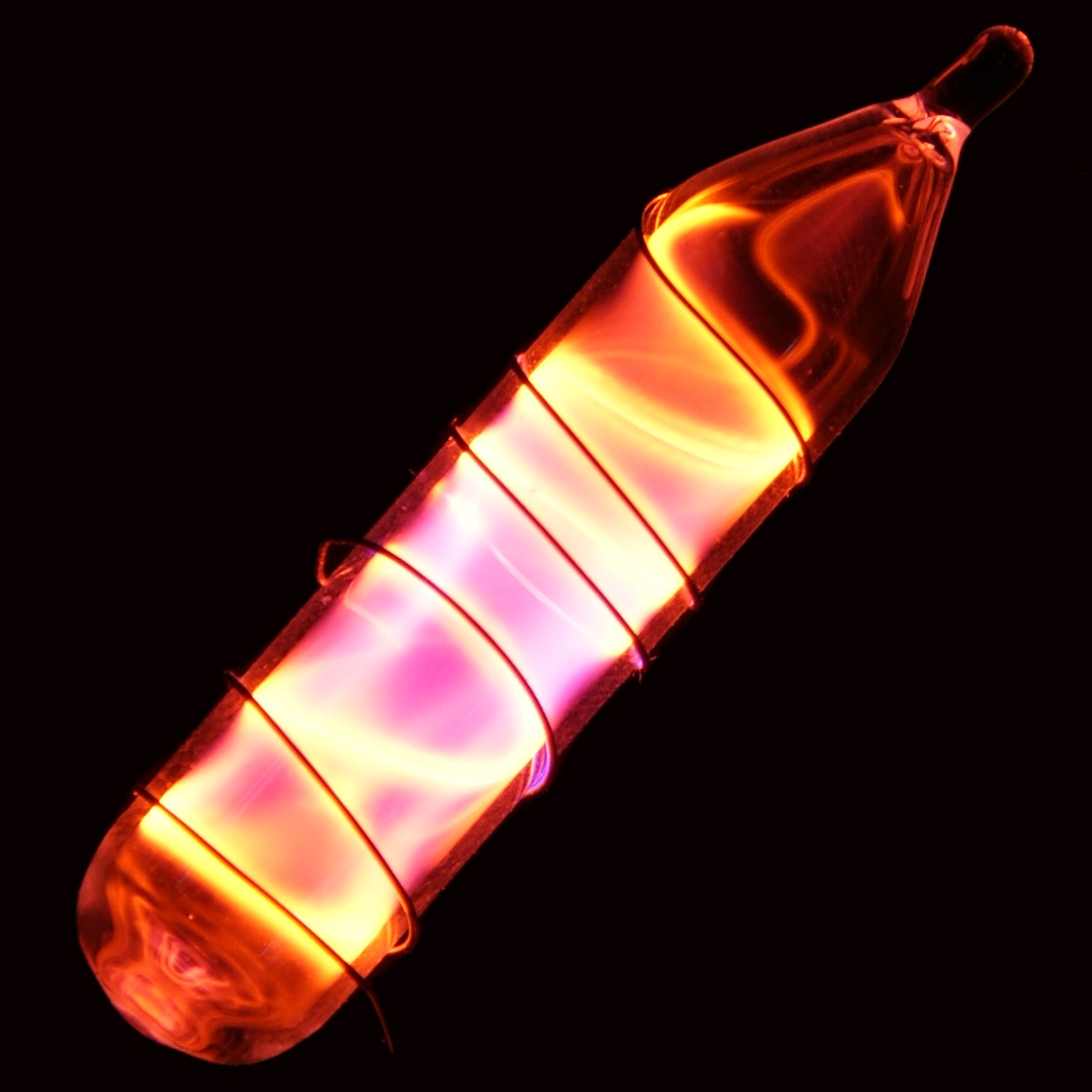
Neon is a noble gas so unreactive that in more than a century nobody has made a stable compound of it. It is colourless, odourless and invisible, until you pass an electric current through it. Then it shines with a red-orange light that is unmistakable and has been drawing eyes to shop windows since 1910.
Neon is the fifth most abundant element in the universe, yet on Earth it is scarce. Air contains only about eighteen parts per million. All the neon we use is skimmed off when air is liquefied for its oxygen and nitrogen, and its price swings sharply with the fortunes of the steel and electronics industries.
Where it is found
Neon is made inside massive stars as a by-product of burning carbon and oxygen, and it is scattered through space when those stars explode. In the universe as a whole it ranks fifth by abundance after hydrogen, helium, oxygen and carbon. But neon is light and inert, so when the Earth formed it did not stick to rocks or dissolve in the oceans.
What remains is a trace in the atmosphere, about 18 parts per million by volume. There is no neon mine. Air separation plants, many of them attached to large steelworks, cool air to a liquid and distil it. Neon is one of the gases collected from the top of the column. Before 2022 a large share of the world's purified neon came from plants in Ukraine, and the war there disrupted supply to chip makers.
How it was discovered
In 1894 William Ramsay and Lord Rayleigh discovered argon in air. Ramsay realised that the periodic table had room for a whole family of similar gases, and in 1898, working with Morris Travers in London, he set out to find them. They liquefied a sample of argon, let it slowly evaporate and examined each fraction with a spectroscope. Krypton came first. Then, in June 1898, a fraction lit up with a brilliant crimson glow.
Travers later wrote that the sight was one he would never forget. Ramsay's thirteen-year-old son suggested calling it novum, Latin for new, and Ramsay chose the Greek equivalent, neon. Xenon followed a few weeks later. Three noble gases in a single summer helped earn Ramsay the Nobel Prize in Chemistry in 1904.
What we use it for
The famous neon sign was invented by the French engineer Georges Claude, who showed the first ones in Paris in 1910. A glass tube filled with low-pressure neon glows red-orange when a high voltage is applied. Other colours in so-called neon signs come from other gases or from fluorescent coatings, not from neon.
Today the largest user of neon is the semiconductor industry. Excimer lasers that print microscopic circuits onto silicon wafers use a mixture of neon with argon or krypton and fluorine. Helium-neon lasers, once common in barcode scanners and laboratories, give a pure red beam. Liquid neon is a compact cryogenic refrigerant, storing far more cooling capacity per litre than liquid helium.
Reading the numbers
Neon boils at about minus 246 degrees Celsius and freezes at about minus 249. That gap of under three degrees is the narrowest liquid range of any element. Its gas density of 0.90 grams per litre is about two thirds that of air, so a neon balloon would float, though more sluggishly than a helium one.
The configuration [He] 2s2 2p6 shows a full outer shell of eight electrons. Neon has no reason to gain, lose or share, so it has no electronegativity value and its first ionisation energy of 2081 kilojoules per mole is second only to helium's. Neon closes period 2 and sits in group 18. The characteristic glow is produced when electrons in the discharge knock neon's own electrons up to higher energy levels; as they fall back they release red and orange light.
Safety and the environment
Neon is not toxic, not flammable and does not react with anything in the body. The only hazard is the one shared by all inert gases: in a confined space it can displace oxygen and cause suffocation without warning. Liquid neon is extremely cold and causes frostbite on contact.
Environmentally, neon has no known impact. It does not react in the atmosphere, contributes nothing to warming or ozone loss, and simply returns to the air from which it came. Its only footprint is the energy used to liquefy and distil air.
Did you know?
- Neon is the fifth most abundant element in the universe, but only about 18 parts per million of Earth's air.
- Only the red-orange colour in a neon sign actually comes from neon. Other colours use different gases or coated glass.
- Neon has the narrowest liquid range of any element, less than three degrees between melting and boiling.
- Ramsay's young son suggested the Latin name novum. His father preferred the Greek, neon.
- No stable chemical compound of neon has ever been made.
- The first neon signs were demonstrated in Paris in 1910 by Georges Claude.
More in the noble gases
These share a column with neon, so their outer electrons are arranged in a similar way and they tend to behave alike.
See all 7 noble gases on one page, or browse all 118 elements.
Compare Neon with another element
Each comparison has a side-by-side data table and a plain-English summary of the differences.
Frequently asked questions
Why does neon glow?
A high voltage across a tube of low-pressure neon rips electrons from some atoms and sends them crashing into others. The collisions push electrons in neon atoms to higher energy levels, and when they drop back they release light. For neon those energy jumps happen to produce red and orange wavelengths.
Is neon dangerous?
The gas itself is harmless and does not react with the body. Like any inert gas, it can suffocate someone if it fills an enclosed space and pushes out the oxygen. Liquid neon is cold enough to cause severe frostbite.
Where does neon come from?
Entirely from the air. Large plants cool air until it becomes liquid and then separate it by distillation, and the small amount of neon is collected along the way. There are no neon deposits or mines.
Are all neon signs made with neon?
No. Only the classic red-orange tubes contain pure neon. Blue tubes usually contain argon with a trace of mercury, and other colours come from fluorescent coatings inside the glass or from tinted glass. The word neon has become a general term for the whole style.
Read next
Guess the mystery element in six tries. A new one every day, free, no sign-up.
Written by Anthony. Updated September 2026. Numerical data from Periodic-Table-JSON (CC BY-SA), cross-checked against the Neon reference article. Spotted an error? Tell us.