Fluorine · element 9
The most reactive element of all, somehow tamed into toothpaste and non-stick pans
Key facts
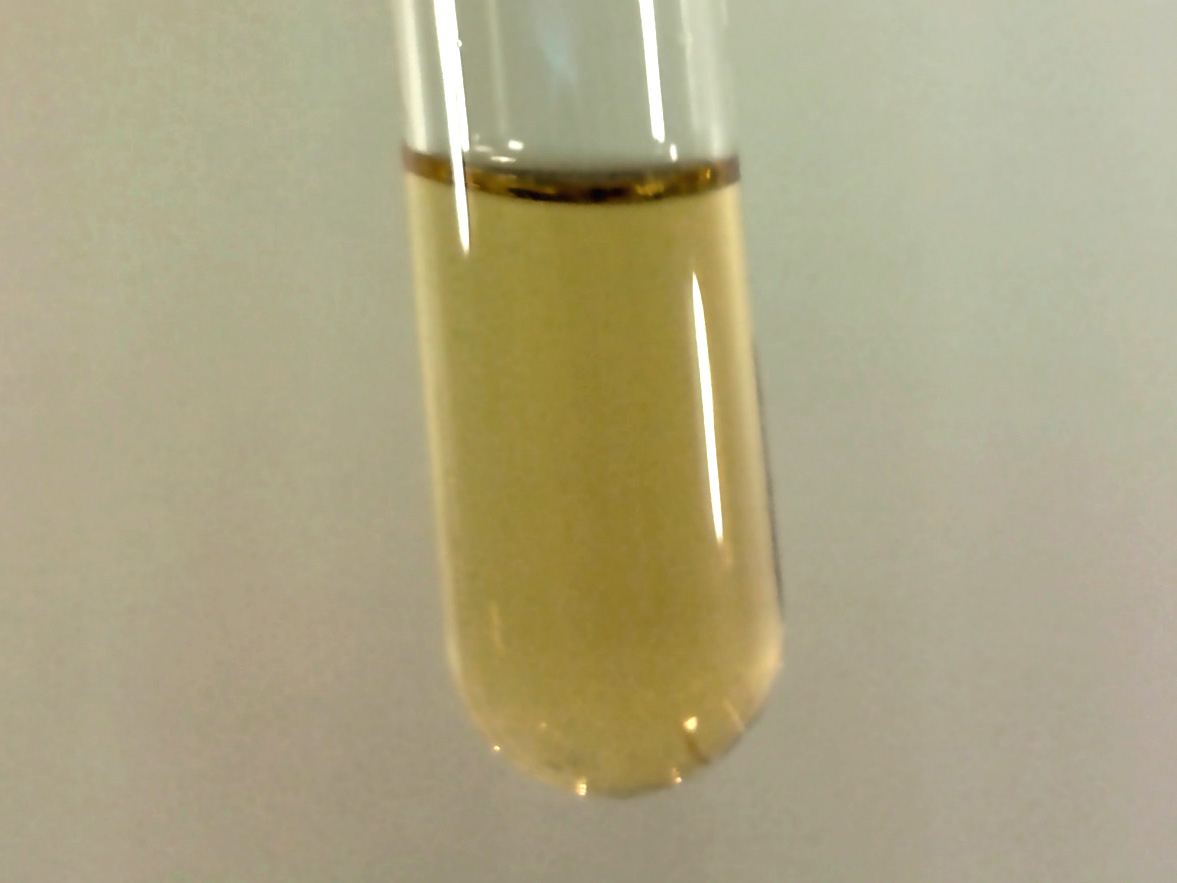
Fluorine is the element that attacks almost everything. It is a pale yellow gas that reacts with glass, sets fire to steel wool and even combines with some of the noble gases. Its pull on electrons is the strongest of any element. For more than seventy years chemists tried to isolate it, and several were injured or killed in the attempt.
Once fluorine has grabbed an electron, though, it settles down completely. Fluoride ions and carbon-fluorine bonds are among the most stable in chemistry. That is why the most reactive element is also found in some of the most inert materials we make, from non-stick coatings to refrigerants, and in the toothpaste that protects billions of teeth.
Where it is found
Fluorine never occurs free in nature. It is far too reactive. Its main mineral is fluorite, or fluorspar, which is calcium fluoride and forms beautiful cubic crystals in shades of purple, green and blue. Large deposits are mined in China, Mexico, Mongolia and South Africa. Fluorine is also present in fluorapatite, a phosphate rock processed for fertiliser.
Fluorine is about the thirteenth most abundant element in the Earth's crust, more common than chlorine. Small quantities occur in seawater and in most soils, and some groundwater carries enough fluoride to strengthen teeth or, in excess, to mottle them.
How it was discovered
Fluorite gave the element its name long before anyone saw it. Medieval metalworkers added the mineral to ores to help them melt and flow, and the Latin fluere, to flow, gave us fluorspar. By about 1810 Andre-Marie Ampere had argued that the acid contained an unknown element similar to chlorine, and Humphry Davy, who agreed, proposed the name fluorine.
Isolating it proved brutal. Fluorine reacts with almost every container and every chemical used to free it, and hydrofluoric acid poisoned several of the chemists who tried. Success came in 1886 when Henri Moissan in Paris passed electricity through a cold solution of potassium fluoride in liquid hydrogen fluoride, using equipment made of platinum. He received the Nobel Prize in Chemistry in 1906.
What we use it for
Most mined fluorite goes into steelmaking and aluminium smelting, where it lowers melting points and removes impurities. The rest becomes hydrofluoric acid, the starting point for fluorine chemistry. From it come fluoropolymers such as PTFE, better known by the trade name Teflon, which coats cookware and appears in waterproof clothing and plumber's tape. Fluorinated gases serve as refrigerants and as the insulating gas in high-voltage switchgear.
A tiny amount of fluoride in toothpaste and in some water supplies hardens tooth enamel and has cut tooth decay dramatically since the 1950s. Around a fifth of all medicines and many pesticides contain fluorine atoms, because they make molecules more stable and better at crossing cell membranes. Uranium hexafluoride is the gas used to enrich uranium for nuclear fuel.
Reading the numbers
Fluorine boils at about minus 188 degrees Celsius and freezes at about minus 220, similar to oxygen. Its gas density of 1.70 grams per litre makes it somewhat heavier than air. These physical properties are unremarkable; it is the chemistry that is extreme.
The configuration [He] 2s2 2p5 shows seven outer electrons, one short of a full shell. Fluorine is a small atom, so its nucleus pulls very strongly on that missing electron. Its electronegativity of 3.98 is the highest on the Pauling scale, and its electron affinity is also the largest of any element. Once it gains an electron it becomes the fluoride ion, F-, which has the same stable configuration as neon and reacts with almost nothing. Fluorine heads group 17, the halogens, and its first ionisation energy of 1681 kilojoules per mole shows how reluctant it is to give an electron up.
Safety and the environment
Fluorine gas is extremely toxic and corrosive. It burns skin and lungs on contact and reacts violently with water, organic material and many metals. Hydrofluoric acid is a particular hazard because it soaks through skin painlessly and attacks bone and nerves beneath. Fluoride in small doses strengthens teeth, but larger doses are toxic, which is why toothpaste carries warnings about swallowing.
Fluorine compounds have caused two of the biggest environmental headaches of recent decades. Chlorofluorocarbons, once used in fridges and aerosols, destroyed ozone in the upper atmosphere until they were banned by the Montreal Protocol. Their replacements are strong greenhouse gases and are now being phased down too. Some fluorinated chemicals, known as PFAS, persist in the environment for centuries and have been found in water supplies worldwide.
Did you know?
- Fluorine is the most electronegative element, with a Pauling value of 3.98.
- Henri Moissan, who first isolated fluorine in 1886, won the Nobel Prize in Chemistry for it in 1906.
- PTFE, the non-stick coating, was discovered by accident in 1938 when Roy Plunkett found that a fluorine-containing gas had turned into a waxy solid inside its cylinder.
- Fluorine can react with xenon, one of the noble gases, to form stable solid compounds.
- Hydrofluoric acid dissolves glass, so it has to be stored in plastic bottles.
- Fluorine is more abundant in the Earth's crust than chlorine, even though chlorine is far better known.
More in the halogens
These share a column with fluorine, so their outer electrons are arranged in a similar way and they tend to behave alike.
See all 6 halogens on one page, or browse all 118 elements.
Compare Fluorine with another element
Each comparison has a side-by-side data table and a plain-English summary of the differences.
Frequently asked questions
Is fluorine the same as fluoride?
No. Fluorine is the element, a highly reactive and toxic pale yellow gas. Fluoride is the negatively charged ion formed when fluorine gains an electron, and it is stable and, in small amounts, beneficial to teeth. The fluoride in toothpaste and water is a compound, not the gas.
Why is fluorine so reactive?
A fluorine atom is one electron short of a full outer shell, and because the atom is so small the nucleus pulls very hard on any electron nearby. It also has a weak bond between its own two atoms, so fluorine molecules split easily. Both factors make it seize electrons from almost anything.
Is fluoride in toothpaste safe?
At the levels used, yes. Fluoride strengthens tooth enamel and has reduced tooth decay worldwide since the 1950s. Swallowing large amounts of toothpaste is harmful, which is why young children should use a smear and be supervised.
What colour is fluorine?
Fluorine gas is pale yellow, though it is so faint that it looks almost colourless in small amounts. As a liquid it is bright yellow. Its darker relatives in group 17 are yellow-green chlorine, red-brown bromine and violet iodine.
Read next
Guess the mystery element in six tries. A new one every day, free, no sign-up.
Written by Anthony. Updated September 2026. Numerical data from Periodic-Table-JSON (CC BY-SA), cross-checked against the Fluorine reference article. Spotted an error? Tell us.