Americium · element 95
The only synthetic element most people own, sitting in the smoke detector on the ceiling
Key facts
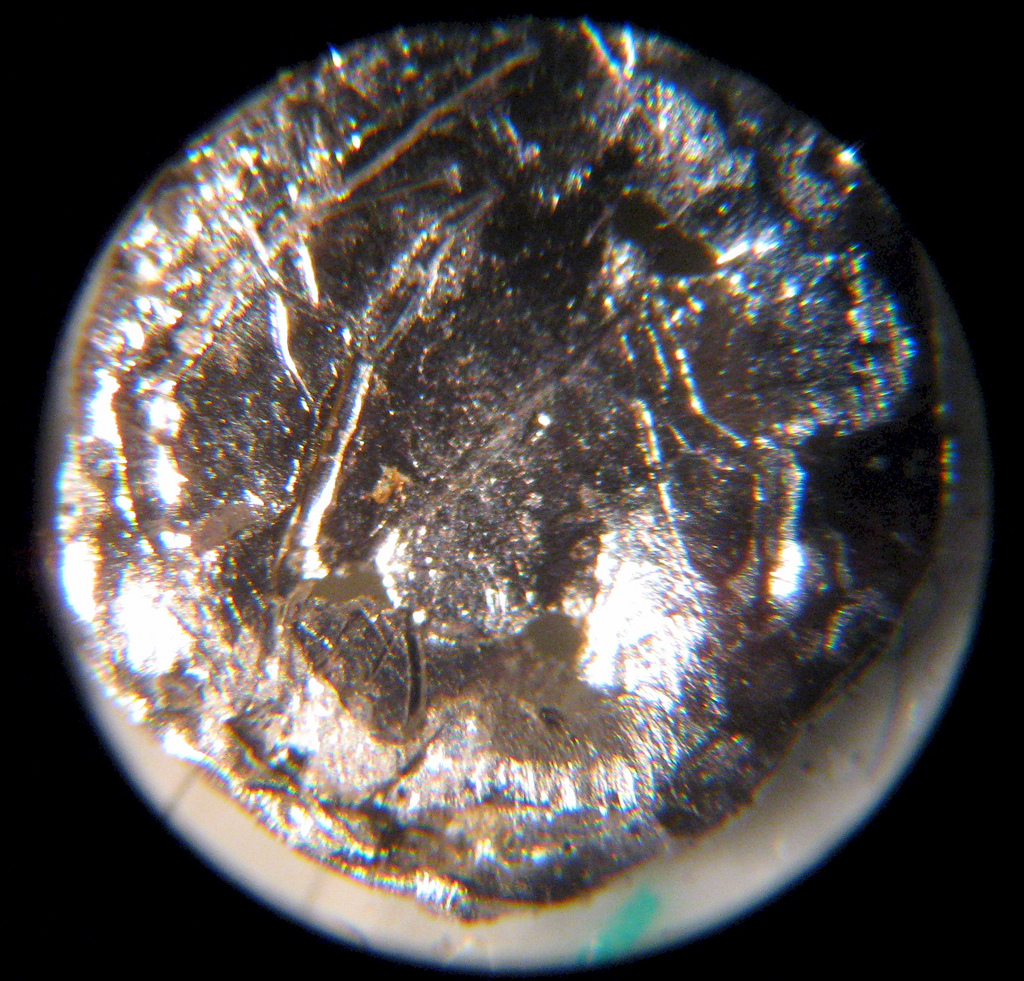
Look up at the smoke alarm in a hallway and there is a fair chance it contains americium. Around a third of a microgram of americium-241 sits inside a small ionisation chamber, quietly making the air conduct electricity. When smoke drifts in, the current drops and the alarm sounds. It is the one element beyond uranium that has become a genuinely everyday object.
Americium was made in 1944 as part of the Manhattan Project, and its existence was announced on a children's radio quiz show before it appeared in a scientific journal. It is a soft, silvery metal, the fourth transuranium element to be found and the first to be sold commercially.
Where it is found
Americium does not occur naturally in any meaningful amount. It is made inside nuclear reactors, where plutonium-239 captures two neutrons to become plutonium-241, which then decays with a half-life of about 14 years into americium-241. This means that any stored plutonium slowly grows a coating of americium, and old plutonium gives off more gamma radiation than fresh plutonium because of it.
Spent nuclear fuel is the main source. When fuel is reprocessed, americium can be separated from the other actinides by chemistry. The United States, Russia and the United Kingdom have all extracted americium-241 from aged plutonium stocks. Small amounts of americium from weapons tests and nuclear accidents are present in soils worldwide.
How it was discovered
Glenn Seaborg, Ralph James, Leon Morgan and Albert Ghiorso identified americium in late 1944 at the Metallurgical Laboratory in Chicago. They irradiated plutonium-239 with neutrons in a reactor, then used painstaking chemistry to separate the tiny amount of new element from the plutonium and from curium, which they had found shortly before. The two elements were so difficult to separate that the team privately nicknamed them pandemonium and delirium.
Seaborg named it americium after the Americas, mirroring europium, the element directly above it in the table. He first mentioned the discovery publicly in November 1945 when a young listener on the Quiz Kids radio programme asked whether any new elements had been found. The formal announcement followed a few days later.
What we use it for
The smoke detector is the classic application. Americium-241 emits alpha particles that ionise the air in a tiny chamber, allowing a small current to flow. Smoke particles absorb the alpha particles and reduce the current, which triggers the alarm. Millions of these detectors are made every year, each using less than a microgram.
Americium-241 also emits low-energy gamma rays at a fixed energy, which makes it useful in gauges that measure the thickness of glass or paper, and in portable instruments that check for lead in paint. Mixed with beryllium it produces neutrons and is used in well logging to probe rock around oil and gas boreholes. Americium-241 has been studied as a power source for future European space missions because it is more readily available in Europe than plutonium-238.
Reading the numbers
Americium melts at about 1,180 °C, much higher than its neighbours neptunium and plutonium, and boils near 2,610 °C. Its density of about 12 grams per cubic centimetre is a little more than lead and roughly one and a half times iron, notably lighter than plutonium. The reason lies in the electron configuration [Rn] 5f7 7s2. A half-filled 5f shell is especially stable, so the f electrons withdraw from bonding and the metal behaves more like a lanthanide, with the +3 oxidation state dominating in solution. This is the point in the actinide series where the elements start to resemble their lanthanide cousins closely. Its Pauling electronegativity of 1.13 is low, marking it as a reactive metal that tarnishes in air.
Safety and the environment
Americium-241 is an alpha emitter with a half-life of about 432 years, and it also gives off gamma rays that need shielding. Taken into the body it lodges in bone and liver. A smoke detector is safe because the americium is sealed in a metal foil and the amount is tiny; the risk arises only if someone dismantles many detectors and concentrates the material. Used detectors should be returned to the manufacturer or disposed of through proper channels rather than in household waste. In soil, americium binds to particles and moves slowly, and it will persist for centuries.
Did you know?
- A typical household smoke detector contains about 0.3 micrograms of americium-241, with an activity of roughly 37 kilobecquerels.
- Americium went on sale to industry from the US Atomic Energy Commission in 1962, at 1,500 dollars per gram.
- The discovery team nicknamed americium pandemonium because it was so hard to separate from curium, which they called delirium.
- Aged plutonium becomes more radioactive at its surface as americium-241 builds up from the decay of plutonium-241.
- Americium-243, the longest-lived isotope, has a half-life of about 7,370 years, while the americium-241 in smoke detectors lasts about 432 years.
More in the actinides
The nearest neighbours of americium in the family, by atomic number.
See all 15 actinides on one page, or browse all 118 elements.
Frequently asked questions
Why is there americium in smoke detectors?
Its alpha particles ionise the air inside a chamber so a small current flows. Smoke interrupts that current and sets off the alarm. The amount used is tiny and sealed in foil.
Is americium in a smoke detector dangerous?
No, not in normal use. The alpha particles cannot escape the plastic casing, and the quantity is minute. Do not take the source out or break it open, and dispose of old detectors properly.
How is americium made?
In nuclear reactors, where plutonium-239 absorbs neutrons and becomes plutonium-241, which decays into americium-241. It is separated during fuel reprocessing or from aged plutonium stocks.
Was americium named after America?
Yes, after the Americas as a whole. Its position directly below europium, named for Europe, suggested the parallel.
Read next
Guess the mystery element in six tries. A new one every day, free, no sign-up.
Written by Anthony. Updated September 2026. Numerical data from Periodic-Table-JSON (CC BY-SA), cross-checked against the Americium reference article. Spotted an error? Tell us.