Plutonium · element 94
Made by the tonne in reactors, feared for its weapons, and quietly powering probes at the edge of the solar system
Key facts
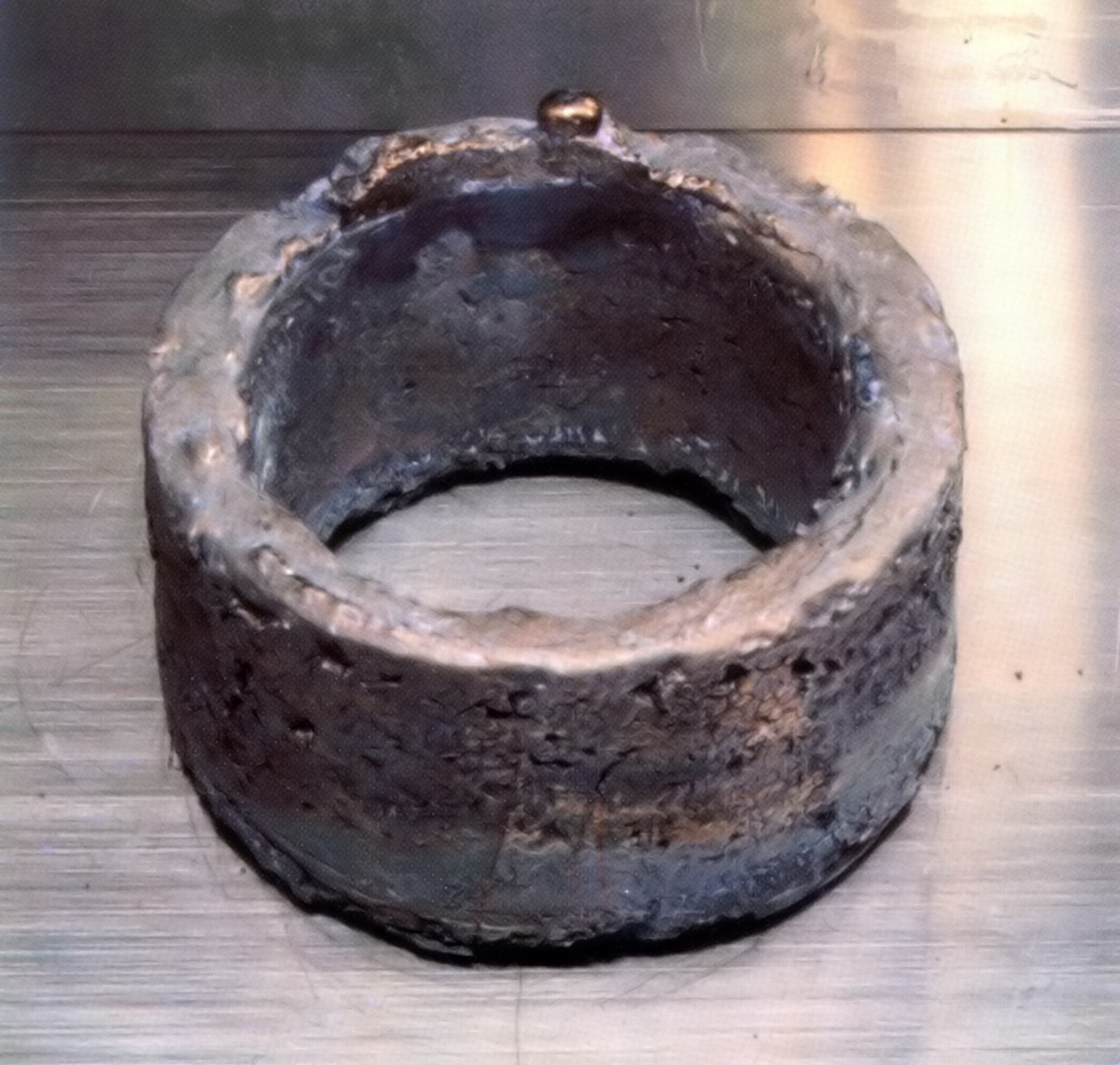
Few elements carry as much weight in the public imagination as plutonium. It was created in a Berkeley laboratory in early 1941, kept secret for years, and within four years had fuelled the Trinity test and the bomb dropped on Nagasaki. Yet the same element, in a different isotope, has kept the Voyager spacecraft alive for more than four decades and warms the electronics of rovers on Mars.
Chemically, plutonium is a metallurgist's nightmare and a physicist's fascination. It has six different crystal structures at ordinary pressure, one of them shrinks when heated, and a lump of it is warm to the touch because of its own radioactive decay.
Where it is found
Plutonium is absent from nature. Minute traces of plutonium-239 form in uranium ore when neutrons are captured by uranium-238, and a few atoms of the very long-lived plutonium-244 may survive from before the solar system formed, but neither could ever be mined. All usable plutonium is made in reactors.
When uranium-238 in fuel captures a neutron it becomes uranium-239, which decays within days via neptunium-239 to plutonium-239. Every uranium-fuelled reactor does this, so spent fuel is typically around one per cent plutonium. Worldwide there are several hundred tonnes of plutonium in spent fuel and separated stockpiles. Plutonium-238, the isotope used for spacecraft, is made separately by irradiating neptunium-237.
How it was discovered
Glenn Seaborg, Edwin McMillan, Joseph Kennedy and Arthur Wahl produced plutonium at Berkeley in December 1940 and confirmed it in February 1941. They fired deuterons from the 60-inch cyclotron at uranium-238, making neptunium-238, which decayed into plutonium-238. In March 1941 they showed that plutonium-239 splits when struck by slow neutrons, which made it a candidate for a weapon. The discovery paper was withheld until 1946.
The name followed the planetary pattern of uranium and neptunium, honouring Pluto. Seaborg chose the symbol Pu rather than Pl partly as a joke, expecting objections that never came. The first weighable amount, about a millionth of a gram, was made in 1942, and the wartime reactors at Hanford in Washington State later produced it by the kilogram.
What we use it for
Plutonium-239 is a nuclear explosive and a reactor fuel. A bare sphere of about ten kilograms can sustain a chain reaction, and less is needed inside a neutron reflector. In civil nuclear power, plutonium recovered from spent fuel is blended with uranium into mixed oxide fuel, known as MOX, which is burned in some reactors in France, Japan and elsewhere.
Plutonium-238 has a very different role. It emits alpha particles and almost no penetrating radiation, and its 88-year half-life means a lump stays hot for decades. Radioisotope thermoelectric generators turn that heat into electricity for missions where sunlight is too weak, including Voyager, Cassini, New Horizons and the Curiosity and Perseverance rovers. In the 1970s a few hundred heart pacemakers were powered by tiny plutonium-238 batteries.
Reading the numbers
Plutonium melts at only 639 °C, about the same as neptunium and lower than aluminium, but boils at around 3,230 °C. Its density of 19.8 grams per cubic centimetre puts it among the densest metals, above gold and two and a half times iron, though the figure changes noticeably between its crystal forms. The configuration [Rn] 5f6 7s2 is the first in the actinides with no 6d electron, meaning the 5f electrons are becoming more tightly bound and more like the lanthanides. That balance sits on a knife edge in plutonium, which is why it has so many crystal phases and such odd properties. It is a poor conductor of heat and electricity for a metal. Its electron affinity is negative, so a free plutonium atom does not want an extra electron.
Safety and the environment
Plutonium is an alpha emitter. Outside the body it is nearly harmless, because alpha particles cannot penetrate skin, but inhaled particles lodge in the lungs and migrate to bone and liver, where they raise cancer risk over many years. The common claim that it is the most toxic substance known is an exaggeration, but it is certainly hazardous. Plutonium metal powder can ignite spontaneously in air. Atmospheric weapons tests in the 1950s and 1960s spread a thin layer of plutonium over the whole planet, and sites such as Hanford and Sellafield carry legacy contamination that will take decades and vast sums to clean up.
Did you know?
- Plutonium's delta phase contracts as it is heated, one of very few metals with negative thermal expansion.
- Plutonium is warm to the touch, and a sizeable piece of plutonium-238 can glow red from its own decay heat.
- The Voyager probes, launched in 1977, still send data from interstellar space using electricity from plutonium-238 decay.
- The Trinity test in July 1945 used a plutonium core about the size of a grapefruit.
- Plutonium-244 has a half-life of about 80 million years, and tiny amounts appear to have survived from the formation of the solar system.
- In solution plutonium changes colour with oxidation state, from violet through brown to orange, and a beaker can hold several states at once.
More in the actinides
The nearest neighbours of plutonium in the family, by atomic number.
See all 15 actinides on one page, or browse all 118 elements.
Compare Plutonium with another element
Each comparison has a side-by-side data table and a plain-English summary of the differences.
Frequently asked questions
Is plutonium used in bombs?
Yes. Plutonium-239 was the core of the Trinity test device and the Nagasaki bomb, and most modern nuclear weapons use it. Separated plutonium of any grade is controlled under international safeguards.
Is plutonium found in nature?
Only in vanishing traces. Effectively all plutonium is manufactured in nuclear reactors from uranium-238, and the world holds several hundred tonnes of it.
Why is plutonium so toxic?
It emits alpha radiation, which is harmless outside the body but very damaging to cells when the element is inhaled and lodges in the lungs or bone. Its chemical toxicity is comparable to other heavy metals; the radiation is the main issue.
Why do spacecraft use plutonium?
Plutonium-238 gives out steady heat for decades and needs no sunlight. Beyond Jupiter, solar panels cannot gather enough energy, so probes like Voyager and New Horizons rely on plutonium generators.
Read next
Guess the mystery element in six tries. A new one every day, free, no sign-up.
Written by Anthony. Updated September 2026. Numerical data from Periodic-Table-JSON (CC BY-SA), cross-checked against the Plutonium reference article. Spotted an error? Tell us.