Cesium · element 55
The softest, most reactive metal, melting in a warm room, and the tick behind every second on Earth
Key facts
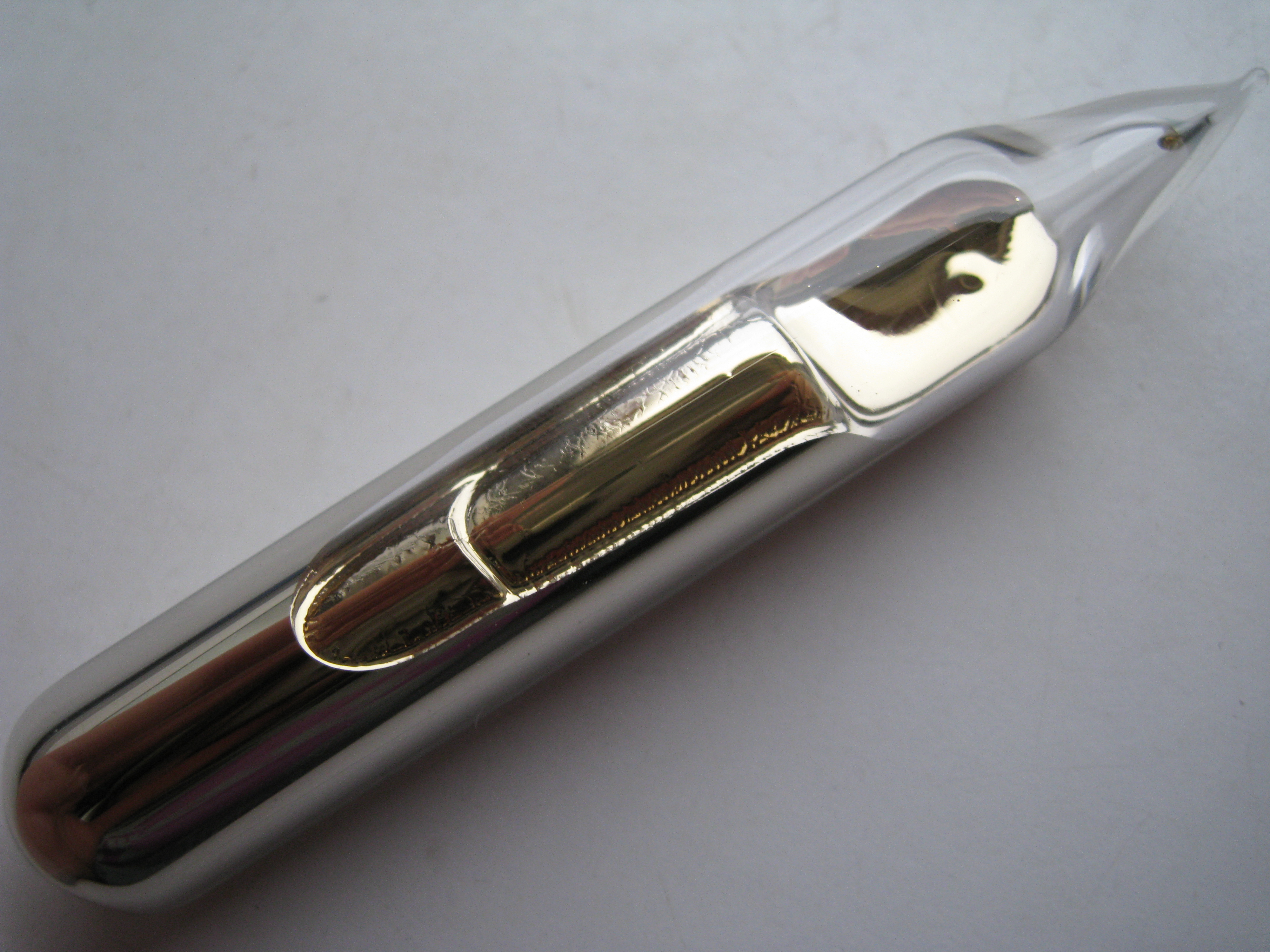
Caesium, spelt cesium in American English and in the data behind this site, is the most reactive of all the stable metals. Drop it into water and it explodes. It melts at 28.5 °C, so on a hot summer day a sealed ampoule of it turns to a pale golden liquid in your hand. Yet this alarming element has one of the most orderly jobs imaginable: it defines the second.
Since 1967 the international unit of time has been fixed by counting vibrations of caesium atoms. Every clock in the world, from a phone to a navigation satellite, is ultimately kept honest by this soft, gold-tinged metal.
Where it is found
Caesium is not particularly rare, at a few parts per million of the crust, but it is widely scattered. The only ore rich enough to mine is pollucite, a caesium aluminium silicate found in certain granite pegmatites.
For decades almost all the world's caesium came from a single deposit at Bernic Lake in Manitoba, Canada, which also yields tantalum and lithium. Smaller occurrences exist in Zimbabwe, Namibia and Australia. Because demand is measured in tonnes rather than thousands of tonnes, the supply chain is tiny and the price is high.
How it was discovered
Caesium was the first element found by looking at light rather than at a substance. In 1860 Robert Bunsen and Gustav Kirchhoff in Heidelberg were using their new spectroscope, which spread the light of a flame into a pattern of lines unique to each element. They evaporated tens of thousands of litres of mineral water from Dürkheim and, in the concentrated residue, saw two bright blue lines that matched no known element.
They named it from the Latin caesius, meaning sky blue, after those lines. The following year the same technique revealed rubidium. Bunsen was unable to isolate caesium as a metal, and that was finally achieved by Carl Setterberg in 1882 by electrolysing molten caesium cyanide.
What we use it for
The defining use is the atomic clock. Caesium-133 atoms can be nudged between two very slightly different energy states by microwaves of an exact frequency, 9,192,631,770 cycles per second. That number is now the definition of the second. Caesium clocks in national laboratories, and simpler versions aboard navigation satellites, keep global time and make GPS positioning possible.
The largest use by weight is less glamorous. Caesium formate is a dense, non-toxic liquid used as a drilling fluid in deep oil and gas wells, where its weight helps control pressure. Caesium compounds are used in some specialist glasses and optics and in photoelectric cells that respond to light. Caesium-137, a radioactive isotope produced in nuclear reactors, is used in medical radiotherapy sources, industrial thickness gauges and sterilisation equipment.
Reading the numbers
Caesium melts at 28.5 °C, only a little above a comfortable room, and boils at about 671 °C. Among the stable metals only mercury melts at a lower temperature. Its density of 1.93 grams per cubic centimetre is roughly twice that of water and a quarter that of iron, so this is a very light metal, in keeping with its large, loosely packed atoms.
The configuration [Xe] 6s1 is the key to everything. A single electron sits alone in the sixth shell, far from the nucleus and shielded by 54 inner electrons. It takes just 376 kilojoules per mole to remove it, the lowest first ionisation energy of any stable element, and caesium's electronegativity of 0.79 is likewise the lowest in the table. That is why caesium sits at the bottom of group 1 with the alkali metals and reacts even more fiercely than sodium or potassium. Its position at the start of period 6 marks the point where the table begins the long stretch through barium and the lanthanides.
Safety and the environment
Caesium metal must be kept under argon or sealed in glass. It ignites spontaneously in air and reacts explosively with water, including ice and moist skin. Caesium compounds are only mildly toxic, since caesium ions behave a little like potassium in the body, and they are not a dietary hazard.
The serious concern is caesium-137. It is a major product of nuclear fission with a half-life of about thirty years, and it spread widely after the Chernobyl and Fukushima accidents, settling into soils and entering food chains. Because it dissolves easily and mimics potassium, it moves through plants and animals. In 1987 an abandoned radiotherapy source containing caesium-137 was broken open by scrap collectors in Goiânia, Brazil, killing four people and contaminating parts of the city.
Did you know?
- The second is defined as exactly 9,192,631,770 oscillations of the microwave radiation that flips caesium-133 atoms between two energy states.
- Caesium was the first element discovered using a spectroscope, and it was named after the sky-blue lines it produces.
- Bunsen and Kirchhoff boiled down tens of thousands of litres of mineral water to obtain just a few grams of caesium salts.
- Caesium has the lowest first ionisation energy and the lowest electronegativity of any stable element.
- Pure caesium has a faint golden colour, one of only a handful of metals that are not silver-grey.
More in the alkali metals
These share a column with cesium, so their outer electrons are arranged in a similar way and they tend to behave alike.
See all 6 alkali metals on one page, or browse all 118 elements.
Compare Cesium with another element
Each comparison has a side-by-side data table and a plain-English summary of the differences.
Frequently asked questions
Is caesium dangerous?
The metal is extremely reactive and must never touch air or water, where it ignites or explodes. Its ordinary compounds are only mildly toxic. The real danger is the radioactive isotope caesium-137, released by nuclear accidents, which lingers in soil for decades and is taken up by plants and animals.
Why is caesium used in atomic clocks?
Caesium-133 atoms absorb microwaves at one extremely precise frequency when they flip between two energy states, and every caesium atom does this identically. Counting those oscillations gives a tick that does not drift, which is why the second has been defined by caesium since 1967.
Is it cesium or caesium?
Both are correct. Caesium is the spelling recommended by IUPAC and used in British English, while cesium is standard in American English. The name comes from the Latin caesius, meaning sky blue, after the colour of its spectral lines.
What happens when caesium is dropped in water?
It reacts instantly and violently, releasing hydrogen gas and enough heat to ignite it, so the result is an explosion that can shatter the container. Caesium reacts even with ice at well below freezing. It is the most vigorous reaction of any stable alkali metal with water.
Read next
Guess the mystery element in six tries. A new one every day, free, no sign-up.
Written by Anthony. Updated September 2026. Numerical data from Periodic-Table-JSON (CC BY-SA), cross-checked against the Cesium reference article. Spotted an error? Tell us.