Xenon · element 54
A stranger in the air at under one part in ten million, yet it lights headlights and pushes spacecraft between worlds
Key facts
Xenon is the rarest of the stable noble gases in the atmosphere. Every breath you take contains an enormous number of its atoms, yet it still makes up less than one part in ten million of the air. It is colourless, odourless and almost completely unreactive, which for a long time made it seem like little more than a curiosity.
That changed in the twentieth century. Xenon's heavy atoms and easily excited electrons turned out to be perfect for bright lamps, for gently anaesthetising patients, and for propelling spacecraft over enormous distances using almost no fuel. It was also the element that broke a rule: in 1962 it became the first noble gas ever to be made into a compound.
Where it is found
Xenon exists in the atmosphere at about 87 parts per billion by volume. It is separated from air at the same industrial plants that produce liquid oxygen and nitrogen. Because it boils at a higher temperature than the other gases in air, it collects with krypton in the liquid oxygen fraction and is then distilled out in tiny quantities.
Xenon is far more abundant in the Sun and in the giant planets than on Earth, and the puzzling shortage of xenon in our atmosphere compared with what meteorites predict is an unsolved question in planetary science, sometimes called the missing xenon problem.
How it was discovered
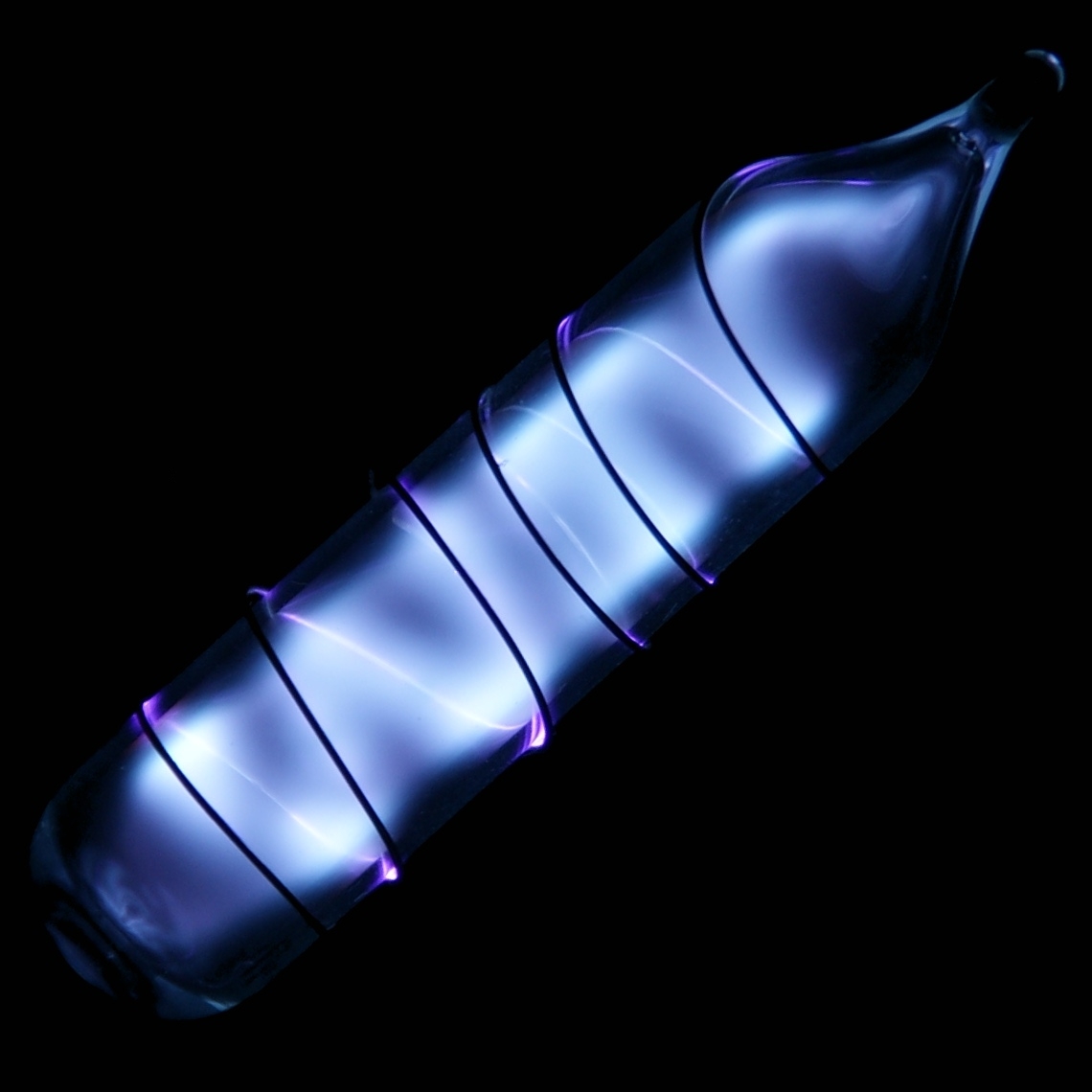
In 1898 William Ramsay and Morris Travers in London were systematically examining the leftovers from liquefied air. They built a better refrigeration apparatus and evaporated a large volume of liquid air until only a tiny bubble remained. In a discharge tube it glowed blue and showed spectral lines nobody had seen.
They named it xenon from the Greek word for stranger or foreigner. Ramsay had by then found or co-discovered argon, terrestrial helium, neon, krypton and xenon, and he received the Nobel Prize in Chemistry in 1904 for completing this whole new column of the periodic table. Xenon was the last stable noble gas to be identified.
What we use it for
Xenon lamps are the best-known application. A high-voltage discharge through xenon produces an intense white light close to daylight, used in cinema projectors, camera flashes, lighthouse beams, and the high-intensity headlights fitted to many cars.
In space, xenon is the standard propellant for ion thrusters. Electric fields accelerate xenon ions to very high speeds, producing a tiny but steady push that can run for years. NASA's Dawn probe used xenon thrusters to visit both the asteroid Vesta and the dwarf planet Ceres. In medicine, xenon is an effective anaesthetic with few side effects, though its cost limits its use, and the radioactive isotope xenon-133 is inhaled for lung imaging. Physicists use tanks of ultra-pure liquid xenon as detectors in the search for dark matter.
Reading the numbers
Xenon condenses to a liquid at about minus 108 °C and freezes at about minus 112 °C, a gap of only a few degrees. Those are far higher than for helium and neon because xenon's large atoms attract each other more strongly. As a gas its density is 5.89 grams per litre, more than four times that of air, so it sinks and pools in an open container.
The configuration [Kr] 4d10 5s2 5p6 is a completely filled outer shell of eight electrons, the classic reason noble gases refuse to react. Yet xenon's first ionisation energy of 1170 kilojoules per mole is noticeably lower than for the noble gases above it, because the outer electrons are far from the nucleus. That is just low enough for very aggressive elements like fluorine to pull electrons away, which is why xenon fluorides exist while neon and argon form virtually no stable compounds. Its position at the far right of period 5 completes the row that begins with rubidium.
Safety and the environment
Xenon is not toxic, and it is not flammable. Its main hazard is that it displaces oxygen: because it is so dense it can accumulate at floor level in poorly ventilated spaces. Breathing pure xenon also has an anaesthetic effect, which is why the party trick of inhaling it to lower your voice is far riskier than the same trick with helium.
Xenon has no known environmental harm and simply returns to the atmosphere when released. Radioactive xenon isotopes are produced in nuclear reactors and in nuclear explosions, and detecting traces of them in air is one of the main ways international monitoring stations verify that a nuclear test has taken place.
Did you know?
- Xenon was the first noble gas to form a chemical compound, when Neil Bartlett made xenon hexafluoroplatinate in 1962.
- Xenon is so dense that a person who inhales it briefly speaks with a much deeper voice, the opposite of the helium effect.
- NASA's Dawn spacecraft used xenon ion thrusters to orbit two different bodies in the asteroid belt, the first mission ever to do so.
- Xenon-135, produced in nuclear reactors, absorbs neutrons so strongly that its build-up can stall a reactor, an effect operators must plan around.
- The World Anti-Doping Agency banned inhaled xenon in 2014 because it can boost the body's production of red blood cells.
More in the noble gases
These share a column with xenon, so their outer electrons are arranged in a similar way and they tend to behave alike.
See all 7 noble gases on one page, or browse all 118 elements.
Compare Xenon with another element
Each comparison has a side-by-side data table and a plain-English summary of the differences.
Frequently asked questions
Is xenon flammable?
No. Xenon is a noble gas and does not burn or support combustion. The only real hazards are that it can displace oxygen in an enclosed space and that breathing it has an anaesthetic effect.
What is xenon used for in cars?
Xenon headlights, also called HID lamps, pass a high-voltage arc through xenon gas to produce a bright, bluish-white light that is closer to daylight than a halogen bulb. They were popular in the 2000s and 2010s but are now being replaced by LEDs, which are cheaper and last longer.
Can xenon form compounds?
Yes, unlike the lighter noble gases. Xenon reacts with fluorine to form xenon difluoride, tetrafluoride and hexafluoride, and from these chemists have made oxides, oxyfluorides and other compounds. The first, xenon hexafluoroplatinate, was made by Neil Bartlett in 1962 and overturned the belief that noble gases were completely inert.
Why is xenon so expensive?
Because there is so little of it. Air contains under one part in ten million of xenon, so producing it means liquefying and distilling enormous volumes of air as a side line to oxygen and nitrogen production. World output is only a few tens of tonnes a year and demand from lighting, space and medicine keeps prices high.
Read next
Guess the mystery element in six tries. A new one every day, free, no sign-up.
Written by Anthony. Updated September 2026. Numerical data from Periodic-Table-JSON (CC BY-SA), cross-checked against the Xenon reference article. Spotted an error? Tell us.