Einsteinium · element 99
Found in the fallout of the first hydrogen bomb, and so rare that its chemistry was still being measured in 2021
Key facts
Einsteinium was not made on purpose. It appeared in the debris of Ivy Mike, the first full-scale hydrogen bomb, detonated at Enewetak Atoll in November 1952. Scientists collecting fallout on filter papers flown through the mushroom cloud found atoms of elements 99 and 100 that nobody had planned to make. The discovery was classified, and the world learned of it only in 1955.
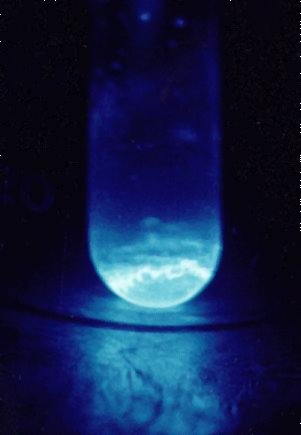
Since then einsteinium has been produced deliberately in reactors, but only in micrograms. It is so radioactive that samples visibly glow and its own decay wrecks the crystals it forms. Measuring its basic chemistry has taken decades.
Where it is found
Einsteinium has no natural source. Its longest-lived isotope, einsteinium-252, has a half-life of about 472 days, so any that existed when the Earth formed vanished billions of years ago. Nothing about it can be mined.
It is produced in high-flux reactors, chiefly the High Flux Isotope Reactor at Oak Ridge, as a by-product of making californium. Curium and californium targets absorb neutrons for months, and a small fraction of the atoms climb to einsteinium-253, which has a half-life of about 20 days. A production run yields only micrograms, and the amount available worldwide at any time is a few micrograms at most. Because einsteinium-253 decays quickly, samples must be used within weeks.
How it was discovered
Albert Ghiorso led a team from Berkeley, Argonne and Los Alamos who analysed the Ivy Mike debris in December 1952. The bomb's intense neutron burst had caused uranium-238 atoms to capture fifteen or more neutrons in an instant, and the resulting heavy nuclei then decayed step by step into new elements. Filter papers from aircraft gave the first hint, and tonnes of coral from the atoll were processed to gather more atoms. Einsteinium-253 was identified by its alpha decay after careful chemical separation.
The findings were kept secret because they revealed how the weapon worked. In the meantime, the Berkeley group produced einsteinium in the laboratory by neutron irradiation so that they could publish without referring to the test. The element was named after Albert Einstein, who died in April 1955, a few months before the discovery was declassified. The neighbouring element was named after Enrico Fermi at the same time.
What we use it for
Einsteinium has no applications outside research. Its most historically important use was as a target: in 1955, about a billion atoms of einsteinium-253 were bombarded with alpha particles to make seventeen atoms of mendelevium, the first element to be discovered one atom at a time.
Modern experiments use einsteinium to test how the heaviest atoms bond. In 2021 a team led by Lawrence Berkeley National Laboratory used about 200 nanograms of einsteinium-254 to measure the length of an einsteinium chemical bond for the first time. Such measurements help theorists understand how relativistic effects on fast-moving inner electrons change the chemistry of very heavy elements, which in turn informs how actinides in nuclear waste might be separated.
Reading the numbers
Einsteinium melts at about 860 °C and is estimated to boil near 1,000 °C, giving it a remarkably narrow liquid range, though the boiling point is a prediction rather than a measurement. Its density of 8.84 grams per cubic centimetre is the lowest of any actinide metal for which a value exists, close to copper and only a little above iron. This surprisingly low density hints that einsteinium metal is starting to behave differently from the earlier actinides. Its configuration [Rn] 5f11 7s2 mirrors holmium in the lanthanides, and it forms +3 ions in solution just as holmium does. The first ionisation energy of about 619 kilojoules per mole is in line with its neighbours.
Safety and the environment
Einsteinium is an alpha emitter and, at the concentrations produced, it heats itself strongly and damages any material it touches. Samples are handled in hot cells with remote tools. Inside the body it would concentrate in bone, but the total amount in existence is so small that no member of the public will ever encounter it. It contributes nothing to long-term nuclear waste because its isotopes decay within a few years.
Did you know?
- Einsteinium was first detected in fallout collected on filter papers by aircraft flying through the cloud of the Ivy Mike test.
- Uranium atoms in the bomb absorbed at least fifteen neutrons each in a fraction of a second to produce einsteinium.
- The 2021 bond-length experiment used about 200 nanograms of einsteinium-254, a tiny fraction of the mass of a grain of salt.
- Einsteinium-253 targets provided the raw material for discovering mendelevium in 1955.
- Its discovery was kept secret for more than two years because it exposed details of the hydrogen bomb.
More in the actinides
The nearest neighbours of einsteinium in the family, by atomic number.
See all 15 actinides on one page, or browse all 118 elements.
Frequently asked questions
How was einsteinium discovered?
In the fallout of the first hydrogen bomb test in 1952. Uranium in the device captured many neutrons and decayed into new elements, which were found by scientists from Berkeley, Argonne and Los Alamos.
What is einsteinium used for?
Nothing practical. It is used in research to make heavier elements and to study the chemistry of very heavy atoms, such as the 2021 measurement of its bond length.
Why is einsteinium so rare?
It can only be made by long neutron irradiation in a couple of specialised reactors, the yield is micrograms, and its isotopes decay within weeks to a year or so.
Did Einstein know an element was named after him?
No. The discovery was secret until 1955, and Einstein died in April of that year, before the name was made public.
Read next
Guess the mystery element in six tries. A new one every day, free, no sign-up.
Written by Anthony. Updated September 2026. Numerical data from Periodic-Table-JSON (CC BY-SA), cross-checked against the Einsteinium reference article. Spotted an error? Tell us.