Fermium · element 100
The last element a reactor can build by adding neutrons, and the wall beyond which accelerators take over
Key facts
Fermium marks a boundary. It is the heaviest element that can be produced in a nuclear reactor by repeatedly bombarding atoms with neutrons. Try to go further and you hit the so-called fermium gap: fermium-258 splits apart by spontaneous fission in a fraction of a millisecond, so the chain of neutron captures cannot climb past it. Every element beyond fermium has to be built in a particle accelerator, atom by atom.
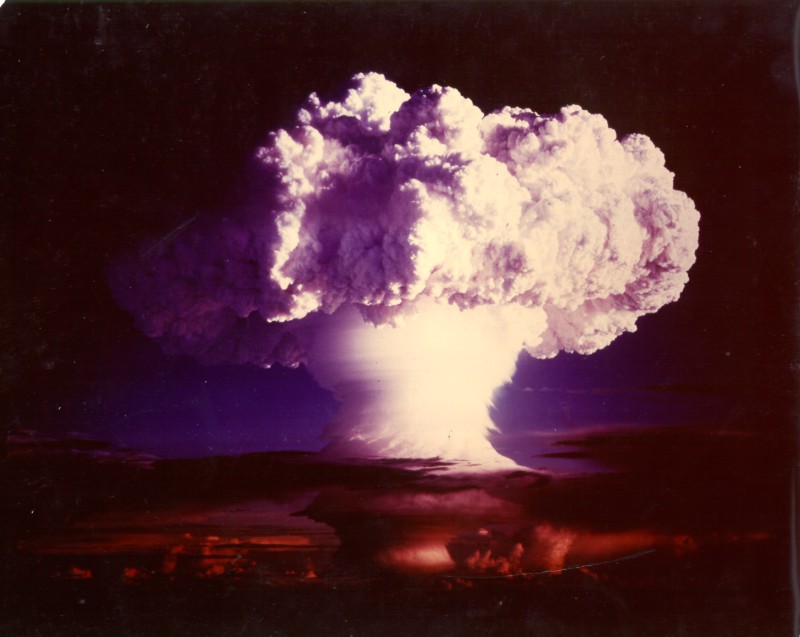
It shares its origin with einsteinium, appearing in the debris of the 1952 Ivy Mike hydrogen bomb test. It is named after Enrico Fermi, who built the first nuclear reactor and died shortly before the element was announced.
Where it is found
Fermium does not occur in nature. Its longest-lived isotope, fermium-257, has a half-life of about 100 days, so none can survive from the Earth's formation. No natural process on the planet makes it.
It is produced in the High Flux Isotope Reactor at Oak Ridge as a by-product of californium and einsteinium manufacture, in picogram quantities, roughly a trillionth of a gram at a time. In the past, larger amounts of fermium-257 were recovered from rock around underground nuclear tests, where the fierce neutron burst drove uranium through many captures at once. Fermium has never been isolated as a solid piece of metal; all its chemistry has been done with atoms dissolved in solution.
How it was discovered
The same team of Berkeley, Argonne and Los Alamos scientists led by Albert Ghiorso that found einsteinium in the Ivy Mike fallout identified fermium a few weeks later, in January 1953. Working through coral collected from the atoll, they found about 200 atoms of fermium-255, which decays with a half-life of around 20 hours. The atoms were recognised by their alpha decay energy and by where they emerged during ion-exchange separation, one position beyond einsteinium.
Like einsteinium, the find was classified. A group in Stockholm bombarding uranium with oxygen ions independently reported an isotope of fermium in 1954, before the American work was made public. When the secrecy lifted in 1955 the discovery was credited to the American team, and the name fermium was chosen in honour of Enrico Fermi, who had died in November 1954.
What we use it for
Fermium has no uses beyond fundamental science. Even its research value is constrained by the tiny amounts available and by the fact that fermium-257 samples decay away over months. What can be done is chemistry in solution: chemists have shown that fermium forms +3 ions like the other late actinides, and that it can be reduced to a +2 state more easily than its lighter neighbours.
The other key area is nuclear physics. Fermium isotopes sit at the point where spontaneous fission overtakes alpha decay as the dominant way for heavy nuclei to die. Studying how fermium-256, 257 and 258 fission has helped physicists refine models of nuclear shape and stability, which matter for predicting whether superheavy elements might exist in an island of stability.
Reading the numbers
Most of fermium's bulk properties have never been measured, because a solid sample large enough to weigh has never existed. The melting point of about 1,530 °C in our data is an estimate based on trends among the heavier actinides, and the boiling point and density are blank for the same reason. Its atomic mass, 257, is the mass of its longest-lived isotope, since a synthetic element has no natural mix of isotopes to average. The electron configuration [Rn] 5f12 7s2 places it under erbium, and its solution chemistry as a +3 ion matches that expectation. Its first ionisation energy, about 627 kilojoules per mole, is a calculated value that follows the steady rise across the actinide series as the nucleus gains charge while the outer 7s electrons stay in the same shell.
Safety and the environment
Fermium is dangerously radioactive per atom but exists in such small amounts that it poses no threat to anyone outside a handful of laboratories. Its isotopes decay into californium and lighter actinides within weeks or months, so it plays no part in long-term nuclear waste. Handling is carried out in shielded facilities, with the main hazard being the intense radiation of the californium and einsteinium it is made alongside.
Did you know?
- Fermium-258 undergoes spontaneous fission with a half-life of less than a thousandth of a second, which blocks reactors from making anything heavier than fermium.
- About 200 atoms of fermium were enough to establish its discovery in 1953.
- Fermium has never been seen as a solid; everything known about it comes from atoms in solution.
- Enrico Fermi, its namesake, led the team that built the first artificial nuclear reactor beneath the stands of a Chicago sports field in 1942.
- Fermium is produced at about a picogram per reactor run, a trillionth of a gram.
More in the actinides
The nearest neighbours of fermium in the family, by atomic number.
See all 15 actinides on one page, or browse all 118 elements.
Frequently asked questions
What is fermium used for?
Nothing practical. It is studied in tiny amounts to understand the chemistry and nuclear physics of very heavy elements, especially how they fission.
Why can't reactors make elements heavier than fermium?
Fermium-258 fissions spontaneously almost instantly, so a neutron-capture chain cannot pass through it. Heavier elements require accelerators that fuse two nuclei together.
How was fermium discovered?
In fallout from the Ivy Mike hydrogen bomb test in 1952, alongside einsteinium. The discovery was kept secret until 1955.
Is fermium radioactive?
Yes, intensely. Its most stable isotope has a half-life of about 100 days, and some isotopes last only milliseconds.
Read next
Guess the mystery element in six tries. A new one every day, free, no sign-up.
Written by Anthony. Updated September 2026. Numerical data from Periodic-Table-JSON (CC BY-SA), cross-checked against the Fermium reference article. Spotted an error? Tell us.