Lanthanides and Actinides: The Two Rows at the Bottom of the Table
Lanthanides and actinides are the two f-block rows below the main table. See why they sit apart, what they are used for and why group 3 is disputed.
Almost every periodic table has two extra rows floating underneath the main body, looking as if they have been cut out and stuck back on. These are the lanthanides and the actinides, fifteen elements each, and between them they contain the ingredients of wind turbine magnets, phone screens, nuclear reactors and smoke alarms. This article explains why they are drawn that way, what they are, and why chemists still argue about where they begin and end.
Why the two rows are drawn separately
The periodic table is arranged by the way electrons fill up shells and sub-shells. The first two columns are the s-block, the six right-hand columns are the p-block, and the ten columns of transition metals in the middle are the d-block, named for the type of orbital being filled. Starting at element 57, a fourth type of orbital, the f-orbital, begins to fill. There are seven f-orbitals, each holding two electrons, so filling them takes fourteen elements. That happens twice: once in period 6 and once in period 7.
If those elements were slotted into their true positions, between groups 2 and 3, the table would be 32 columns wide instead of 18. Such "long form" tables exist and are perfectly correct, but they are awkwardly shaped for a page or a screen, so by convention the two f-block rows are lifted out and placed below, with a marker showing where they belong. It is a layout decision, not a chemical one; the elements are just as much part of periods 6 and 7 as caesium or lead.
The first row takes its name from lanthanum, element 57, and the second from actinium, element 89.
The lanthanides: rare earths that are not rare
The lanthanides run from lanthanum to lutetium. Together with scandium and yttrium, which behave very similarly, they are often called the rare earth elements. The name is misleading on both counts. They are metals, not "earths" (an old word for oxides), and most of them are not rare. Cerium is about as abundant in the Earth's crust as copper. Even the scarcest stable lanthanides are considerably more common than gold or platinum.
They earned the "rare" label for two historical reasons. First, they were discovered in unusual minerals, many from a single quarry at Ytterby in Sweden, which gave its name to yttrium, ytterbium, terbium and erbium. Second, and more importantly, they are extremely hard to separate from each other. All fifteen lanthanides form ions with a charge of +3 and almost identical size, because the electrons being added go into inner f-orbitals that barely affect chemical behaviour. Nineteenth-century chemists spent decades teasing them apart, and several "new elements" turned out to be mixtures. Promethium, the one lanthanide with no stable isotope, was not confirmed until the 1940s.
Physically, the lanthanides are soft, silvery metals that tarnish in air. Their chemistry is fairly uniform, but their physics is not. Because the f-electrons are partly filled and partly shielded, many lanthanides have strong magnetic properties and absorb and emit light at very sharp, specific wavelengths. Those two features are what make them valuable.
Where lanthanides come from and why they matter
Rare earths are mined mainly from two minerals, bastnäsite and monazite, with large deposits in China, Australia, the United States and a few other countries. Mining is only part of the challenge. Separating the ore into pure elements takes many stages of solvent extraction, produces acidic and mildly radioactive waste (monazite contains thorium), and has for years been concentrated in China, which is why rare earths keep appearing in news stories about supply chains.
Here is what they are used for:
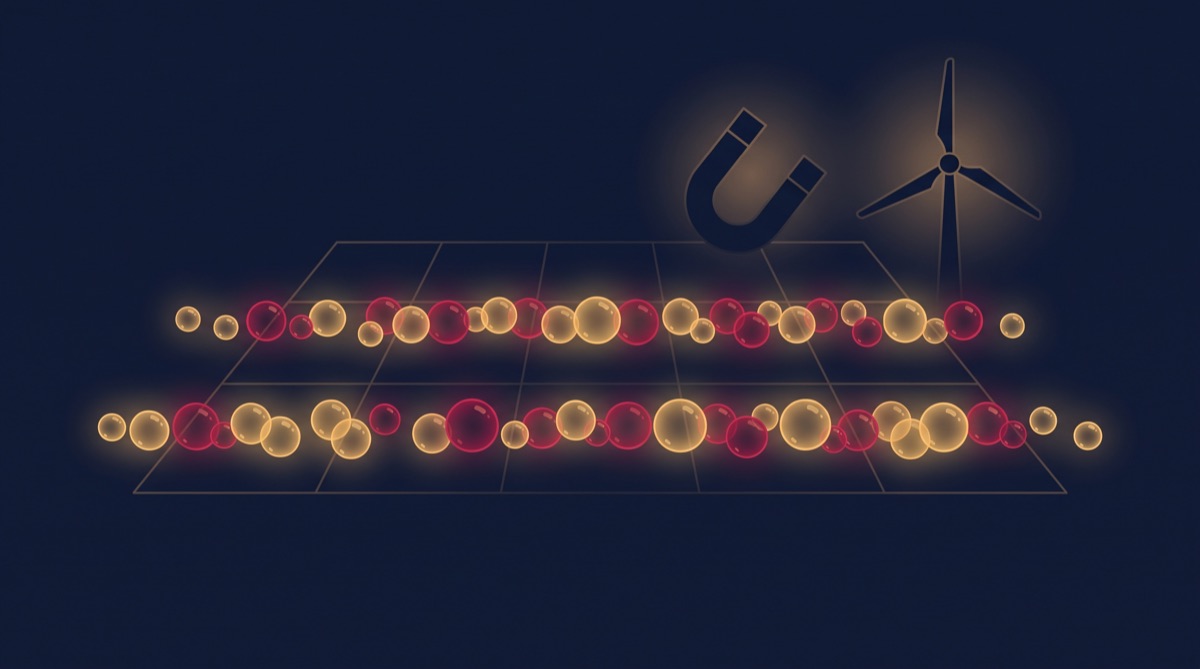
- Magnets. The strongest permanent magnets available are made from neodymium, iron and boron, often with some dysprosium added so they keep working at high temperatures. They are in the motors of electric cars, the generators of direct-drive wind turbines, hard disk drives, headphones and the vibration motor in your phone.
- Screens and lighting. Europium glows red and terbium glows green when excited, which made colour television possible and still provides the phosphors in many LEDs and fluorescent lamps. Cerium and yttrium compounds convert the blue light of an LED chip into the warm white light of a household bulb.
- Batteries. Lanthanum is a major component of the nickel-metal hydride batteries used in many hybrid cars and rechargeable AA cells.
- Glass and optics. Cerium oxide polishes glass, lanthanum improves camera lenses, and erbium amplifies signals in long-distance fibre-optic cables.
- Medicine and catalysis. Gadolinium compounds are MRI contrast agents, and cerium is used in catalytic converters.
Try it on Periodic Bubbles. Pop neodymium and its neighbours on the bubbles and notice how similar their melting points and densities are; the near-identical chemistry that frustrated Victorian chemists is visible in the numbers.
The actinides and radioactivity
The second row, from actinium to lawrencium, is different in one crucial way: every actinide is radioactive. Their nuclei are too large to hold together indefinitely, and they break apart, releasing energy and turning into lighter elements. How quickly varies from billions of years to fractions of a second, and that half-life decides whether an actinide can be found in nature or has to be made.
Chemically the actinides are less uniform than the lanthanides. The early members, thorium to plutonium, can show several oxidation states, with uranium commonly appearing as +4 or +6. From americium onwards they settle into lanthanide-like +3 behaviour. This resemblance is what led Glenn Seaborg in the 1940s to propose that these elements formed a second f-block row beneath the lanthanides, rather than continuing the transition metals. Rearranging the table this way correctly predicted the chemistry of the elements made afterwards.
Uranium and thorium: the natural actinides
Only two actinides exist on Earth in useful quantities. Thorium-232 and uranium-238 have half-lives of the order of the age of the Earth or longer, so a good fraction of the atoms present when the planet formed are still here. Both are found in granite and in minerals such as monazite and uraninite.
Uranium's importance comes from its rarer isotope, uranium-235, which makes up less than one per cent of natural uranium and can sustain a nuclear chain reaction. Enriching the fraction of uranium-235 a little gives reactor fuel; enriching it a lot gives weapons material. Thorium cannot sustain a chain reaction on its own but can be converted in a reactor into a uranium isotope that does, which is why thorium reactors are periodically proposed.
Tiny traces of actinium, protactinium, neptunium and plutonium also occur naturally inside uranium ores, but in amounts far too small to extract.
Plutonium and the synthetic actinides
Everything beyond uranium in significant quantity is made by people. Neptunium and plutonium were first produced in 1940 and 1941 at Berkeley by bombarding uranium with neutrons and deuterium nuclei. Plutonium-239 became the material of the first nuclear weapons and remains a product of every uranium-fuelled reactor. A different isotope, plutonium-238, produces steady heat as it decays and has powered spacecraft from the Voyager probes to the Curiosity and Perseverance Mars rovers.
The rest of the row was filled in over the following two decades: americium, curium, berkelium, californium, einsteinium, fermium, mendelevium, nobelium and lawrencium. Most are made only in tiny quantities for research. The exception in daily life is americium, a speck of which sits inside most ionisation smoke alarms; its alpha particles ionise the air in a small chamber, and smoke interrupting that current triggers the alarm.
The disputed corners: lanthanum, actinium, lutetium, lawrencium
Look at different periodic tables and you will find the f-block rows starting in different places. Some show all fifteen elements in each row and put a blank or a range marker under scandium and yttrium in group 3. Others place lanthanum and actinium in group 3 and start the rows with cerium and thorium. A third design puts lutetium and lawrencium in group 3 instead, and starts the rows with lanthanum and actinium.
The argument exists because the f-block row is fifteen elements long but there are only fourteen f-electrons to add. One element at each end has to be squeezed into group 3, and the electron configurations do not settle the matter cleanly: lanthanum has no f-electrons at all, while lutetium has a full set of fourteen plus one d-electron, so each can be argued to be "really" a d-block element. Chemical properties, atomic sizes and trends down the group have all been cited as evidence for one side or the other.
The International Union of Pure and Applied Chemistry, which governs such matters, set up a project to make a recommendation. Its work has leaned towards placing lutetium and lawrencium in group 3, which gives a tidier 14-element f-block, but no binding decision has been imposed, and textbooks and wall charts continue to differ. For students, the practical message is simple: check which convention the table in front of you uses.
Key takeaways
- The lanthanides and actinides are the f-block, drawn below the main table only to keep it 18 columns wide instead of 32.
- Lanthanides are not rare; they are called rare earths because they were hard to separate, and they are essential to magnets, screens, batteries and fibre optics.
- Every actinide is radioactive; only uranium and thorium survive in quantity from the Earth's formation.
- Plutonium and the heavier actinides are man-made, with americium in smoke alarms and plutonium-238 powering space probes.
- Whether lanthanum and actinium or lutetium and lawrencium belong in group 3 remains unsettled, so tables differ.