The Elements in Your Kitchen: Everyday Chemistry You Can Touch
Tour a home room by room and meet the elements behind salt, foil, wiring, stainless steel, toothpaste, phone batteries, light bulbs, glass, balloons and bones.
The periodic table can feel like something that lives in a classroom, a grid of symbols with no connection to daily life. In fact you handle dozens of elements before breakfast. Some are hiding in plain sight as pure metals. Others are locked up in compounds that behave nothing like the elements they contain.
This article takes a walk through an ordinary home and points out the chemistry as we go. Along the way you will meet a good fraction of the first thirty elements and a few surprising heavier ones.
The kitchen
Salt. Table salt is sodium chloride, a compound of two elements that are individually dangerous. Sodium is a soft metal that fizzes violently in water, and chlorine is a poisonous green gas. When sodium hands its single outer electron to chlorine, the two form ions that lock together in a rigid crystal lattice. The result is stable, edible and essential for life. This is the clearest everyday example of how a compound can have completely different properties from its ingredients.
Aluminium foil. Foil is almost pure aluminium, rolled thin. Aluminium is a reactive metal, yet it does not corrode in the kitchen because its surface instantly forms a thin, tough layer of aluminium oxide that seals the metal beneath. The same protective oxide is why aluminium drinks cans and window frames last for years outdoors. Aluminium is the most abundant metal in the Earth's crust, but it was rare and expensive until an electrical extraction method was developed in the late nineteenth century.
Stainless steel. Your cutlery, sink and probably your saucepans are stainless steel. Steel is mainly iron with a little carbon, but ordinary steel rusts. Adding a good proportion of chromium changes everything. Chromium forms its own invisible oxide skin, just as aluminium does, and that skin repairs itself if scratched. Many stainless steels also contain nickel for extra toughness and corrosion resistance. Hold a fork and you are holding three or four elements working as a team.
Non-stick pans. The slippery coating on a non-stick pan is a polymer of carbon and fluorine. Fluorine is the most reactive element there is, but once it has bonded to carbon it holds on so tightly that almost nothing else can get a grip on it, including fried eggs. That extreme stability is exactly what makes the coating useful.
Matches. The striking surface on a box of safety matches contains red phosphorus mixed with an abrasive. Friction converts a tiny amount into the far more reactive white form, which ignites and sets off the oxidising compounds in the match head. Phosphorus takes its name from a Greek word meaning light-bearer, a nod to the faint glow white phosphorus gives off in air.
Glass. Every jar, tumbler and oven door is mostly silicon dioxide, the same compound that makes up sand and quartz. Silicon and oxygen bond into a rigid, disordered network that lets light through. Sodium and calcium compounds are added to lower the melting point and make the glass practical to shape.
Behind the walls
Copper wiring. Pull back a socket cover and you will find copper. Copper conducts electricity better than any common metal except silver, is easy to draw into wire, and bends without cracking. Its reddish colour is unusual among metals; most are silvery grey. Copper pipes carry water in many older homes too, though plastic has taken over in newer builds.
Argon in double glazing. The gap between the two panes of a modern window is often filled with argon rather than air. Argon is a noble gas, with a full outer electron shell, so it reacts with nothing and never degrades. It is also denser than air and a poorer conductor of heat, so it cuts heat loss. Argon is the third most common gas in the atmosphere, making up nearly one per cent of the air you breathe, and it is collected as a by-product of separating air into oxygen and nitrogen.
Lighting
Tungsten in old bulbs. The traditional incandescent bulb works by passing current through a thin coil of tungsten until it glows white hot. Tungsten has the highest melting point of any metal, above 3400 degrees Celsius, which is why it could survive that treatment when almost anything else would melt or evaporate. The glass envelope is filled with argon, or a mixture of argon and nitrogen, to stop the hot filament reacting with oxygen and burning away.
Modern bulbs. LED bulbs replace the filament with a semiconductor chip, usually based on gallium and nitrogen compounds, that emits light directly when electricity flows through it. Because far less energy is wasted as heat, an LED uses a small fraction of the power of the tungsten bulb it replaces. The white LEDs in most homes are actually blue LEDs coated with a yellow-emitting phosphor material, and the two colours combine to look white to the eye.
Gadgets and phones
Lithium and cobalt in batteries. The rechargeable battery in a phone or laptop is a lithium-ion cell. Lithium is the lightest metal, and its ions shuttle back and forth between the two electrodes as the battery charges and discharges. One of the electrodes in many phone batteries is a compound of lithium, cobalt and oxygen. Cobalt helps the electrode hold together through thousands of cycles, but it is expensive and its mining raises ethical concerns, so manufacturers are working hard to reduce or replace it.
Silicon in chips. The processor at the heart of every device is carved from a single crystal of ultra-pure silicon. Silicon is a metalloid, sitting between metals and non-metals on the table, and it conducts electricity only under the right conditions. Adding minute traces of other elements, such as phosphorus or boron, tunes exactly how it conducts, and that control is what makes transistors possible. The word "silicon" is now shorthand for the entire electronics industry.
Gold on the contacts. Look closely at a charging connector and you may see a yellow tint. Gold is used on electrical contacts because it never tarnishes, so the connection stays clean for the life of the device. Only a thin plating is needed, but with billions of devices in the world it adds up.
The bathroom
Fluorine in toothpaste. Most toothpastes contain a fluoride compound, typically sodium fluoride or a related salt. Fluoride ions replace some of the hydroxide in tooth enamel, forming a harder mineral that resists acid attack from bacteria. It is the same element that makes non-stick pans work, in a completely different chemical setting.
Calcium in bones. You are carrying about a kilogram of calcium, almost all of it in your bones and teeth as a calcium phosphate mineral. The same element, as calcium carbonate, forms chalk, limestone, marble, eggshells and seashells. Blackboard chalk, antacid tablets and the white deposits inside a kettle in a hard-water area are all calcium carbonate.
Titanium in sunscreen and paint. Titanium dioxide is a brilliant white pigment used in paint, toothpaste and mineral sunscreens. It scatters light so effectively that a thin coat of white paint can hide the colour beneath, and it reflects ultraviolet light away from skin.
Party time
Helium balloons. Helium is the second lightest element, after hydrogen, and a helium balloon floats because it displaces a heavier volume of air. Unlike hydrogen it cannot burn, which is why it is the safe choice. Helium is a finite resource on Earth; it is extracted from natural gas and, once released, escapes to space. Scientists who need it to cool MRI scanners and research magnets are keen that we do not waste too much of it on balloons.
Carbon everywhere. Carbon has appeared several times already, in steel, non-stick coatings and calcium carbonate, and it deserves a section of its own. The pencil in the kitchen drawer is graphite, pure carbon in flat sheets that slide off onto paper. A diamond in a ring is also pure carbon, arranged in a rigid three-dimensional lattice. Sugar, flour, cooking oil, wood, plastic, cotton, and every cell of every living thing are built on chains and rings of carbon atoms. Carbon can form four strong bonds and link to itself endlessly, and that single property underlies all of biology.
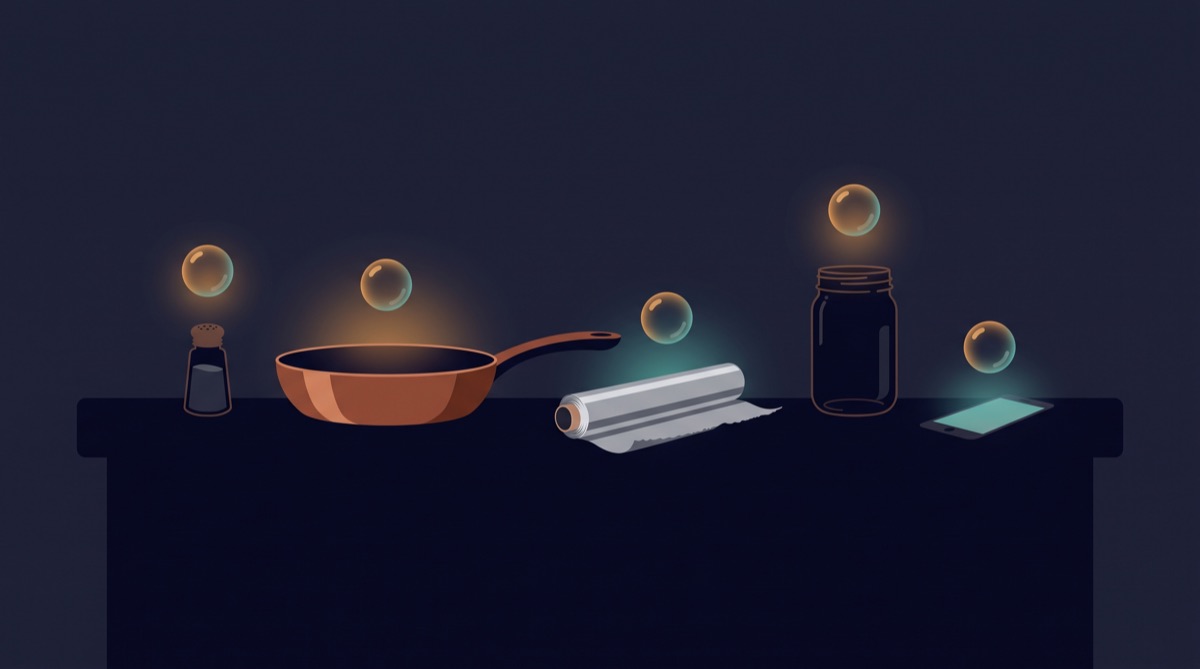
Once you start noticing elements, it is hard to stop. Cast iron pans, brass door handles made of copper and zinc, the zinc coating that stops steel fences rusting, the neon that glows red in a shop sign, the iodine in table salt fortified for health. Each one is a bubble on the interactive periodic table, and each element's details page lists where it turns up in real life.
Key takeaways
- Compounds can behave completely differently from the elements inside them; salt is made of a violently reactive metal and a poisonous gas.
- Aluminium and stainless steel resist corrosion because a thin oxide layer forms on the surface and protects the metal beneath.
- Copper conducts electricity well and is the standard choice for wiring; silicon's controllable conductivity makes it the basis of every chip.
- Argon, a noble gas, appears in double glazing and inside bulbs because it reacts with nothing; tungsten's very high melting point made filaments possible.
- Lithium-ion batteries, fluoride toothpaste, helium balloons and calcium in bones show how a few elements shape daily life.
- Carbon is in almost everything, from pencil leads and diamonds to food, plastics and living cells.