Flame Test Colours and Firework Colours: Which Element Makes Which Colour?
Which element makes which flame and firework colour? A seven-metal table, the plain-English science, how a lab flame test works and a five-question quiz.
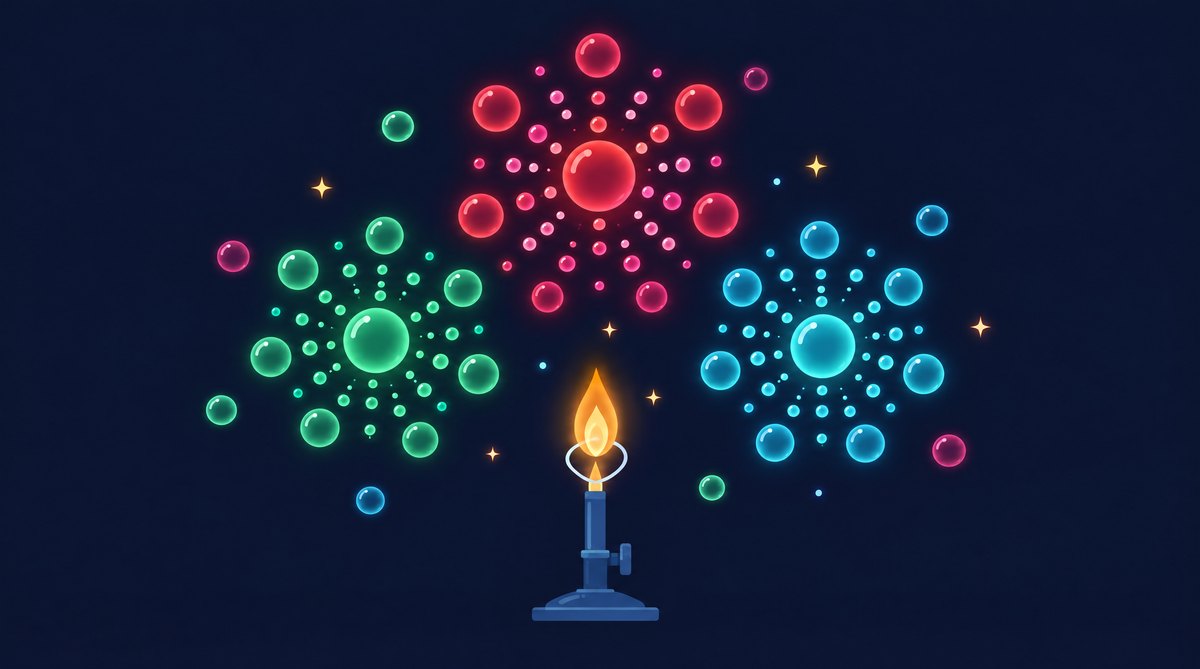
Many metals give a flame a colour of their own. Lithium and strontium burn crimson, sodium golden yellow, potassium lilac, calcium brick red, barium apple green and copper blue-green. Fireworks use the same trick, which is why strontium makes the reds, barium the greens and copper the blues. A flame test is the school experiment where a pinch of a substance is held in a hot flame to see which colour appears.
Flame test colours at a glance
| Element | Flame test colour | Firework colour | Family |
|---|---|---|---|
| Lithium | Crimson (or red) | Red | Alkali metals |
| Sodium | Golden yellow (or yellow) | Yellow | Alkali metals |
| Potassium | Lilac | Rarely used for colour (faint), but potassium compounds supply oxygen to help the mix burn | Alkali metals |
| Calcium | Brick red (or orange-red) | Orange | Alkaline earth metals |
| Strontium | Crimson (or red) | Red | Alkaline earth metals |
| Barium | Apple green (or pale green) | Green | Alkaline earth metals |
| Copper | Blue-green (or green) | Blue | Transition metals |
The Family column names the part of the table each element sits in. Colour is not a tidy family pattern, though: beryllium and magnesium sit in the same family as calcium, strontium and barium, directly above them, yet their compounds give no flame test colour. Magnesium metal burns a brilliant white, but that is the metal itself burning, not a flame test.
A fair warning about the words. Exam boards and textbooks do not word these colours alike. One says red where another says crimson, one says brick red where another says orange-red, barium's green can be "apple" or "pale", and copper is plain green in some resources. Nobody is wrong, because flame colour is judged by eye, in a particular flame, with a particular compound. For an exam, use the colours in your own exam board's course list (its specification). Many GCSE courses (the main school exams taken at 16 in England, Wales and Northern Ireland) want only lithium, sodium, potassium, calcium and copper, so strontium and barium are not on every list.
The three reds, lithium, strontium and calcium, are the classic muddle, and lithium and strontium look so alike that a flame test alone cannot reliably separate them. See calcium and strontium side by side.
Why does each element have its own colour?
Electrons, the tiny charged particles in every atom, can only have certain amounts of energy. These allowed amounts are called energy levels. Think of a staircase: you can stand on step three or step four, but not on step three and a half. Electrons are not tiny planets on tracks. The rings in school diagrams simply draw the steps, as our guide to atoms explains.
A flame supplies energy. An electron picks up a small packet of energy from the hot gas and jumps up a step, which scientists call being excited. It cannot stay there. Almost at once it drops back, and the energy it gives up leaves as a tiny packet of light.
The size of the drop sets the colour. Light travels as a wave, and its colour is its wavelength, the distance from one crest to the next: longest for red, shorter for blue. A big drop gives bluer light and a small drop redder light. Every element has a staircase with steps of its own heights, so it can make only its own set of colours. That set is a fingerprint. Even relatives differ: lithium and sodium share a column, yet one burns crimson and the other golden yellow. An element usually gives out several colours at once, and your eye blends them into one. Two practical points are worth knowing about flame tests.
- A flame test identifies the metal ion in a compound. A compound is a substance whose atoms of different elements are joined together, such as salt, which is sodium and chlorine joined together as sodium chloride. In salt the metal is a positive ion, an atom that has lost electrons and so carries an electric charge, and the test finds that ion, not the negative one it is paired with. In an exam, write sodium ions or lithium ions, not just sodium. School tests use compounds, as several of these metals are too reactive to handle.
- Sodium shouts. Its yellow is so intense, and sodium so common in salt, dust and sweat, that a trace can drown out gentler colours. Potassium's lilac is the usual victim (see sodium versus potassium), so some labs watch it through cobalt blue glass, which absorbs the yellow. Cooks see the effect by accident when salty water boils over onto a gas hob.
One refinement to the staircase picture: the flame frees some of the metal from the compound, but not always as lone atoms. For lithium, sodium and potassium the glowing particles are mostly free atoms. For calcium, strontium, barium and copper, much of the colour comes from small molecules, tiny groups of atoms joined together, that form briefly in the flame. Their electrons jump between energy levels too, but their colour is a broader smear than the narrow, sharp colours that single atoms give out. Copper joined to chlorine glows blue and survives best in a cooler flame, while other copper molecules glow green, so a school flame looks blue-green.
What makes fireworks red, green and blue?
Fireworks burn compounds of the same elements in much bigger, brighter bursts than a school flame test. Here is which element gives which colour:
- Red: strontium, with lithium as a second source.
- Green: barium.
- Yellow: sodium.
- Orange: calcium.
- Blue: copper.
- White and silver sparks: magnesium and aluminium.
- Gold sparks: iron or charcoal (carbon). Iron also gives the sparks from a grinding wheel.
The sparks are a different kind of light: specks of burning metal or charcoal so hot that they glow, like a poker left in a fire, rather than the light of single atoms or small molecules dropping between energy levels.
Copper needs a footnote. In a classroom flame test it is blue-green, but in a firework it is blue, because the burning mix suits the blue-glowing copper molecule better than a Bunsen flame does. Pyrotechnicians, the people who design fireworks, often call a clean, deep blue the hardest colour to get right.
Safety. Fireworks are explosives. This article names elements only and gives no recipes, amounts or methods, on purpose. Making fireworks is dangerous and is a job for trained professionals, so enjoy them at an organised display, whether it is Bonfire Night, Diwali or New Year, and follow the safety advice there.
Try it on Periodic Bubbles. Pop strontium and barium to see two neighbours in one family end up with different colours, then check lithium, potassium and calcium against the table, since each of those pages gives its flame colour. Then try today's Daily Bubble for a different kind of element puzzle.
How a flame test is really done in a lab
This is an overview of what happens in a school lab, not instructions. Pupils usually do flame tests themselves, with a teacher present, eye protection and school safety guidance. They belong in a school lab, never at home.
A thin wire with a small loop on the end carries the sample. It is cleaned first, by whatever method the school uses, until it adds no colour of its own. A tiny amount of the compound goes on the loop, and the loop goes into the edge of a Bunsen burner flame set to its hot blue setting. (A Bunsen burner is a gas burner used in school labs. Its soft yellow "safety" flame glows by itself and would hide every colour.) The class notes the colour and compares it with the chart.
The classic mistakes are:
- Sodium contamination (see "Sodium shouts" above). Salty fingers or a dirty loop turn every sample yellow.
- Not cleaning the wire between samples. Leftovers from the first sample colour the flame for the second, so a single compound can look like a mixture.
A flame test has limits: only a handful of metals give a clear colour (magnesium compounds, for example, give none), so labs use it alongside other tests and instruments that measure light precisely.
Safety. Wear eye protection (safety goggles) and follow your teacher, your school's rules and the guidance from CLEAPSS, the organisation that advises UK school science departments on safe practice. Some of the compounds are harmful: soluble barium compounds, for instance, are poisonous.
Same idea, different gas
A flame is only one way to hand atoms energy. In a sodium street lamp, electricity does the job, and the sodium atoms give out their strong yellow, which looks yellow-orange to us. Neon signs do the same with neon gas, which glows red-orange.
Memory hooks for each colour
- Lithium, crimson: a deep red velvet theatre curtain.
- Sodium, golden yellow: salt on golden chips.
- Potassium, lilac: lilac pyjamas, and potassium and pyjamas both start with P.
- Calcium, brick red: calcium compounds go into cement and plaster, and walls need bricks.
- Strontium, crimson or red: the stop sign.
- Barium, apple green: a Bramley cooking apple.
- Copper, blue-green: an old copper roof gone green, with the sea behind it.
The velvet curtain and the stop sign are both red, so for the shade, trust your notes.
How light fingerprints found caesium, rubidium and helium
Reading flame colours also found new elements. In 1859 Robert Bunsen and Gustav Kirchhoff in Heidelberg, Germany, built a spectroscope for chemical analysis, which spreads a flame's light into thin bright lines, one for each colour an element can make. Those lines revealed caesium, named from the Latin caesius for its sky-blue ones, and then rubidium, from rubidus for its deep red ones.
The Sun came next. In 1868 a bright yellow line close to sodium's, but not the same, showed up in light from the edge of the Sun during a total solar eclipse. Pierre Janssen saw it first, but Norman Lockyer and the chemist Edward Frankland argued that it came from a new element, which they named helium after Helios, the Greek word for the Sun. It was not found on Earth until 1895, as the noble gases article tells. The history article tells how the noble gas column was added to the table.
Quick self-test
Cover the answers underneath and have a go.
- Which metal gives a lilac flame, and which gives an apple green one?
- A flame test flashes yellow whatever the sample. What is the likely culprit, and how might it have got in?
- In one sentence, why does each element give its own colours?
- What colour is copper in a classroom flame test, and in a firework?
- Which element was named after sky-blue lines of light, and which was first detected in the Sun's light before it was found on Earth?
Answers. 1. Potassium, then barium. 2. Sodium, from fingers or an unclean loop. 3. Heat lifts electrons in the metal ions or atoms to higher energy levels, and when they drop back they give out light, but each element's levels allow only its own colours. 4. Blue-green (some courses say green), then blue. 5. Caesium, then helium.
Key takeaways
- Lithium is crimson, sodium golden yellow, potassium lilac, calcium brick red, strontium crimson, barium apple green and copper blue-green, though books and boards vary.
- In the heat, electrons jump up energy levels and drop back, giving out light that only their own element can make.
- A flame test shows which metal ion a compound contains. Not every metal works, and sodium contamination is the classic way to spoil it.
- Fireworks borrow the same colours and are for professionals only.
- The same light fingerprints revealed caesium, rubidium and helium.