What Is an Atom? Protons, Neutrons, Electrons and Shells for Beginners
A plain-English guide to atoms: protons, neutrons and electrons, the nucleus, electron shells, isotopes, ions and why the Bohr model is still worth learning.
Everything you can touch is made of atoms. The chair you are sitting on, the air in the room, the water in your glass and the cells in your own body are all built from a surprisingly small kit of parts. There are only 118 known kinds of atom, one for each element on the periodic table, and every one of them is assembled from the same three particles.
This article explains those three particles, how they are arranged, and why that arrangement decides how an element behaves. It is written for anyone meeting the topic for the first time or refreshing it before an exam.
The three particles
An atom is made of protons, neutrons and electrons. Each has a charge and a mass, and it helps to learn both together.
| Particle | Relative charge | Relative mass | Where it lives |
|---|---|---|---|
| Proton | +1 | 1 | Nucleus |
| Neutron | 0 | 1 | Nucleus |
| Electron | -1 | About 1/2000 (often treated as zero) | Shells around the nucleus |
The masses in the table are relative, meaning we compare each particle to a proton rather than quoting a value in grams. A proton and a neutron weigh almost exactly the same. An electron is far lighter, so light that when you add up the mass of an atom you can ignore the electrons and be very close to the right answer.
The charges are what hold the whole thing together. Protons are positive, electrons are negative, and opposite charges attract. The negative electrons are pulled towards the positive nucleus, which is what keeps them from drifting off. Neutrons have no charge, but they still matter, as we will see when we get to isotopes.
The nucleus and the electron cloud
Protons and neutrons are packed together in the centre of the atom in a dense lump called the nucleus. The electrons move around the nucleus in a region often called the electron cloud. Almost all of the atom's mass is in the nucleus, but almost all of its size comes from the cloud.
The difference in scale is hard to picture, so try this. Imagine the nucleus is a single pea placed on the centre spot of a large football stadium. The electrons would be moving somewhere out around the top rows of the stands. Everything in between is empty. An atom is mostly nothing at all.
If atoms are mostly empty space, why can't you push your hand through a table? Because the electron clouds in your hand and in the table both carry negative charge, and like charges repel. What you feel as a solid surface is electrical repulsion, not particles bumping into each other.
Atomic number and mass number
Every element is defined by one number: how many protons its atoms have. This is the atomic number. Hydrogen has 1 proton, helium has 2, carbon has 6, and so on up to oganesson with 118. If you change the number of protons, you change the element. There are no exceptions to this rule, which is why the periodic table is arranged in order of atomic number.
In a neutral atom the number of electrons equals the number of protons, so the charges cancel out. That means the atomic number also tells you how many electrons a neutral atom has.
The mass number is the total count of protons plus neutrons. Since electrons weigh almost nothing, this is a good measure of how heavy the atom is. To find the number of neutrons, subtract the atomic number from the mass number. A sodium atom with mass number 23 and atomic number 11 has 23 minus 11, which is 12 neutrons.
On the periodic table you will usually see a decimal number rather than a whole mass number. That is the relative atomic mass, an average across all the naturally occurring versions of the element, which brings us to isotopes.
Isotopes: same element, different mass
Atoms of the same element always have the same number of protons, but they do not have to have the same number of neutrons. Versions of an element with different neutron counts are called isotopes.
Carbon is the classic example. Every carbon atom has 6 protons. Most carbon atoms also have 6 neutrons, giving a mass number of 12, so we call this isotope carbon-12. A much rarer form has 8 neutrons and a mass number of 14, which is carbon-14. Both are carbon. Both form the same compounds and take part in the same reactions, because chemistry depends on electrons rather than neutrons.
Where they differ is stability. Carbon-12 lasts forever. Carbon-14 is radioactive and slowly decays over thousands of years. Living things constantly take in fresh carbon-14 from the atmosphere, but once they die the intake stops and the carbon-14 begins to disappear at a known rate. Measuring how much is left lets scientists estimate the age of wood, bone and cloth. That technique, radiocarbon dating, is a direct application of the isotope idea.
Electron shells: 2, 8, 8
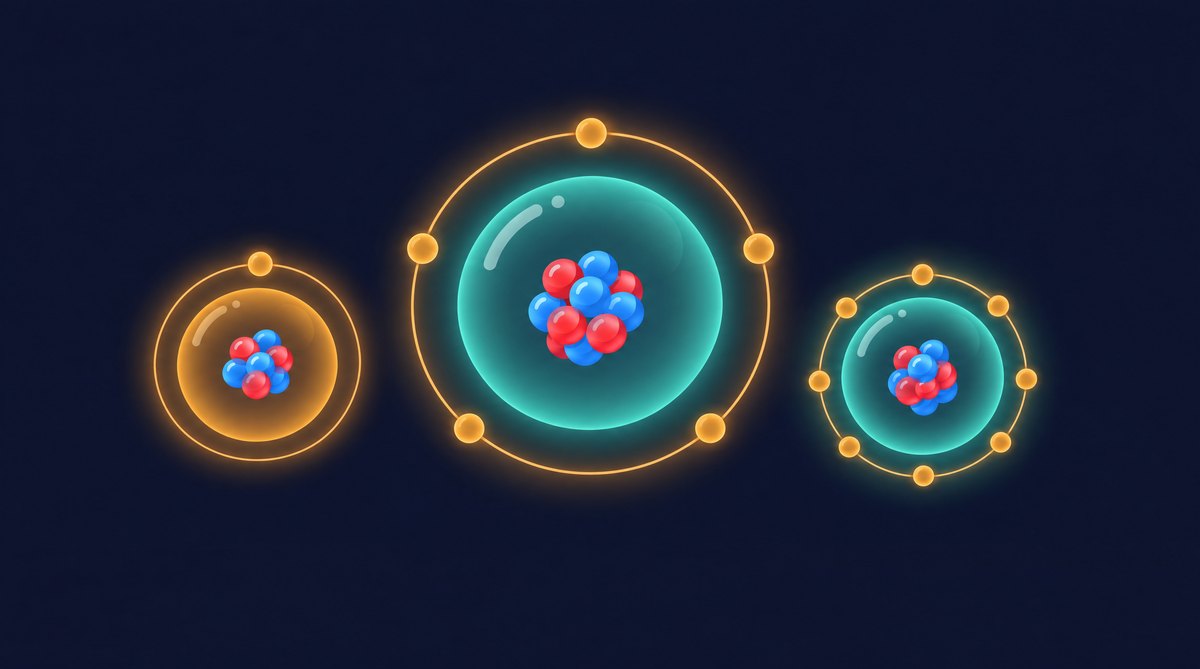
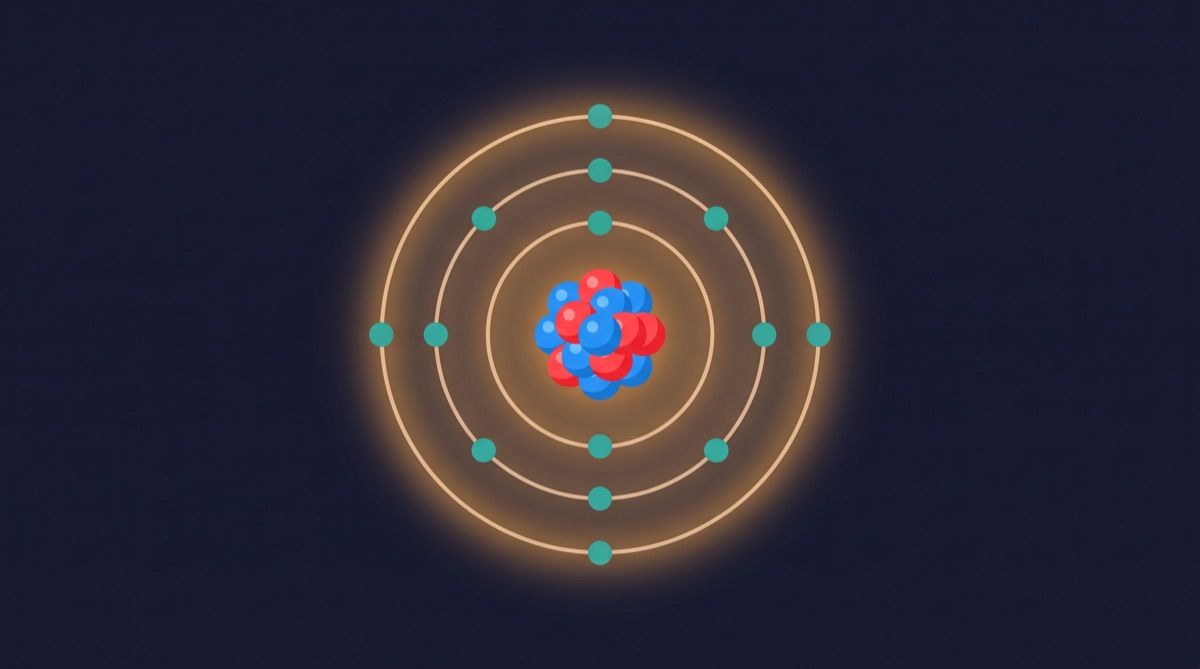
Electrons do not simply swarm around the nucleus at random. They occupy energy levels, usually drawn as rings and called shells. The shell closest to the nucleus has the lowest energy and fills first.
For the first twenty elements a simple rule works well. The first shell holds up to 2 electrons, the second holds up to 8, and the third holds up to 8. Electrons fill the inner shell before starting on the next one out.
A few examples show the pattern:
- Helium has 2 electrons: 2. The first shell is full.
- Carbon has 6 electrons: 2, 4. The second shell is half full.
- Sodium has 11 electrons: 2, 8, 1. One electron sits alone in the third shell.
- Chlorine has 17 electrons: 2, 8, 7. The third shell is one short of full.
- Argon has 18 electrons: 2, 8, 8. Every shell is full.
The outermost shell is the one that matters for chemistry. Its electrons are furthest from the nucleus, least tightly held, and the first to meet other atoms. Elements with a full outer shell, like helium and argon, are stable and barely react with anything, which is why they are called noble gases. Elements with nearly empty or nearly full outer shells are far more eager to react, because losing or gaining a few electrons gets them to a full shell.
This explains the shape of the periodic table. Elements in the same column have the same number of outer electrons, so they behave in similar ways. Sodium, with its single outer electron, sits above potassium, which also has a single outer electron, and both react vigorously with water.
Ions: when atoms gain or lose electrons
An atom that has lost or gained electrons is no longer neutral. It is called an ion. Because electrons are negative, losing one leaves the atom with more protons than electrons and an overall positive charge. Gaining one gives it a negative charge.
Sodium readily gives up its lone outer electron to become a sodium ion with a charge of +1. Chlorine readily accepts an extra electron to fill its outer shell, becoming a chloride ion with a charge of -1. Put the two together and the opposite charges attract strongly, forming sodium chloride, better known as table salt. Metals tend to form positive ions and non-metals tend to form negative ions, and a great deal of GCSE chemistry follows from that single sentence.
Why the Bohr model is a useful simplification
The picture described above, with a small nucleus and electrons travelling in neat rings, is called the Bohr model, after the Danish physicist Niels Bohr who proposed it in the early twentieth century. It is the model you will see when you open any element's details on this site, where a 3D version of the shells spins around the nucleus.
It is worth knowing that the Bohr model is not the whole story. Electrons do not travel along fixed tracks like planets. Modern physics describes them as spread-out regions of probability, called orbitals, with shapes that are sometimes spherical and sometimes more like dumbbells. Beyond the first twenty elements the simple 2, 8, 8 counting also breaks down and the third shell can eventually hold 18.
None of that makes the Bohr model wrong to learn. It gets the essentials right: electrons are arranged in energy levels, inner levels fill first, and the outer level controls reactivity. Those three ideas carry you through almost all school chemistry. A good model is as simple as it can be while still being useful, and the Bohr model passes that test.
If you would like to see the shells for yourself, pop any bubble on the periodic table, open the element's details and watch how the pattern changes as you move along a row or down a column.
Key takeaways
- Atoms are made of protons (+1, mass 1), neutrons (0, mass 1) and electrons (-1, almost no mass).
- Protons and neutrons form the tiny, dense nucleus; electrons occupy a much larger cloud around it, so atoms are mostly empty space.
- The atomic number is the number of protons and defines the element. The mass number is protons plus neutrons.
- Isotopes are atoms of the same element with different numbers of neutrons, such as carbon-12 and carbon-14.
- Electrons fill shells in the order 2, 8, 8 for the first twenty elements, and the outer shell decides how an element reacts.
- Ions form when atoms lose or gain electrons; the Bohr model is a simplification, but a very useful one.