Periodic Trends: Atomic Radius, Ionisation Energy and Electronegativity Made Simple
How atomic radius, ionisation energy and electronegativity change across a period and down a group, the reasons, the exceptions and a table of real values.
The periodic table is not just a filing system. Because the elements are arranged by the structure of their atoms, a handful of properties change in smooth, predictable ways as you move across a row or down a column. These are the periodic trends. Learn three of them, atomic radius, ionisation energy and electronegativity, and you can explain most of what happens in GCSE and A-level chemistry: which elements form ions, which form covalent bonds, why some reactions are violent and others barely happen.
The good news is that all three trends come from the same two ideas, so once you understand the first, the others follow.
Two ideas that explain everything
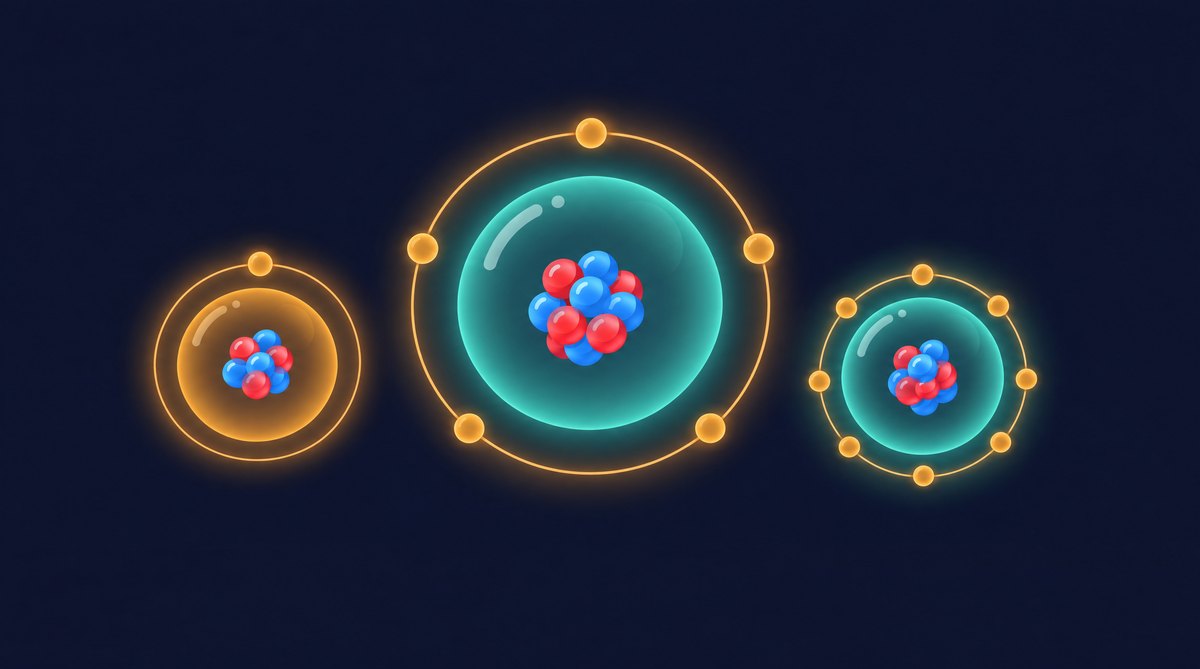
Nuclear charge. The nucleus is positively charged, and the more protons it has, the harder it pulls on the electrons around it. Moving one square to the right adds one proton.
Shielding and shells. Electrons live in shells at increasing distances from the nucleus. The inner shells sit between the nucleus and the outer electrons and cancel out part of the nuclear pull. Chemists call this shielding. Moving one row down adds a whole new shell, which both pushes the outer electrons further out and adds a full layer of shielding.
The balance between these two is often called the effective nuclear charge: the pull an outer electron actually feels after shielding is subtracted. Across a period, effective nuclear charge rises because protons are added but shielding barely changes (the new electrons join the same outer shell and do not shield each other well). Down a group, the extra protons are almost entirely cancelled by the extra inner shell, so effective nuclear charge stays roughly constant while distance increases.
Hold those two sentences in mind. Each trend below is just a consequence.
Atomic radius
What it means. The size of an atom, measured from the nucleus to the outer edge of the electron cloud. Since electron clouds have no hard edge, it is usually defined as half the distance between two neighbouring nuclei in a solid or molecule, and different methods give slightly different numbers. The trends, however, are the same whichever method you use.
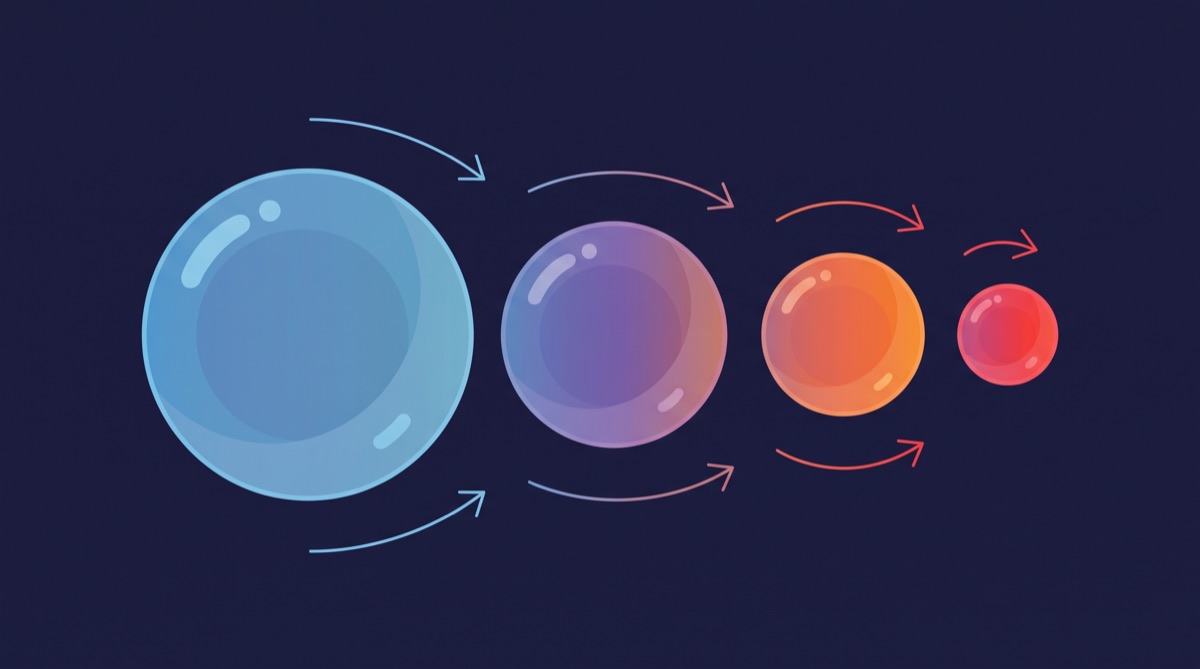
Down a group: radius increases. Each step down adds a shell. Lithium's outer electron is in the second shell, sodium's in the third, potassium's in the fourth. More shells means a bigger atom. Caesium atoms are among the largest of all.
Across a period: radius decreases. This surprises people, because each element to the right has more electrons. But those electrons are going into the same shell, while the nucleus gains a proton each time. The stronger pull draws the whole shell inward. Sodium is the largest atom in period 3 and chlorine one of the smallest, even though chlorine has six more electrons.
Worth knowing. Positive ions are smaller than their parent atoms, because they have lost an entire outer shell or at least reduced repulsion between electrons. Negative ions are larger, because the extra electron increases repulsion in the outer shell. A sodium ion is much smaller than a sodium atom; a chloride ion is larger than a chlorine atom. Across the transition metals the radius changes very little, because the electrons being added go into an inner d sub-shell that shields the outer electrons fairly well.
Ionisation energy
What it means. The energy needed to remove one electron from an atom in the gas phase, making a positive ion. The first ionisation energy removes the most loosely held electron. It is a direct measure of how tightly an atom grips its outer electrons, and it is measured in kilojoules per mole.
Down a group: ionisation energy decreases. The outer electron is further from the nucleus and shielded by more inner shells, so it is easier to pull away. Lithium needs about 520 kJ/mol, sodium about 496, potassium about 419. This is exactly why the alkali metals get more reactive down the group: their defining reaction is losing that electron, and it gets cheaper each step down.
Across a period: ionisation energy increases. Higher effective nuclear charge and a smaller radius mean the outer electron is held more firmly. Sodium's first ionisation energy is about 496 kJ/mol, while argon's at the far end of the same period is about 1521. Helium, with two electrons held very close to a doubly charged nucleus and no shielding at all, has the highest first ionisation energy of any element.
Exceptions worth knowing. The increase across a period is not perfectly smooth, and the dips are favourite exam questions. Between group 2 and group 13 (beryllium to boron, magnesium to aluminium) the ionisation energy drops slightly, because the new electron starts a p sub-shell, which is a little higher in energy and easier to remove than the s sub-shell before it. Between group 15 and group 16 (nitrogen to oxygen, phosphorus to sulfur) there is another dip, because the electron being removed from oxygen is the first one that has to share an orbital with another electron, and the repulsion between the pair makes it easier to lose.
Electronegativity
What it means. How strongly an atom attracts the shared electrons in a covalent bond towards itself. It is a relative scale rather than a measured energy. The most common version, the Pauling scale, runs from about 0.7 for caesium to 4.0 for fluorine. There is no unit.
Across a period: electronegativity increases. Same reason as before: more protons pulling on a shell that is getting smaller. Sodium is about 0.9, aluminium 1.6, chlorine 3.2.
Down a group: electronegativity decreases. Shared electrons are further from the nucleus and more shielded, so the pull on them is weaker. Fluorine at 4.0 is the most electronegative element; iodine below it is about 2.7.
Put the two together and electronegativity increases towards the top right of the table. Fluorine, oxygen, nitrogen and chlorine are the champions.
Exceptions worth knowing. The noble gases are usually left off the scale entirely because they rarely form bonds, which is why heatmaps of electronegativity show them as blanks. Among the halogens, chlorine actually releases slightly more energy than fluorine when it gains an electron (a related but different property called electron affinity). Fluorine is so small that the incoming electron is repelled by the ones already crowded there. This does not change the electronegativity order, but it is a reminder that "smaller is always stronger" has limits.
Why the trends matter
Type of bond. When two atoms with very different electronegativities meet, the more electronegative one takes the electron almost completely and an ionic bond forms. Sodium (0.9) and chlorine (3.2) are a textbook case. When electronegativities are similar, the electrons are shared and a covalent bond results, as in two chlorine atoms or in carbon and hydrogen. In between, the bond is polar covalent, with one end slightly negative. Water is polar because oxygen (3.4) pulls harder than hydrogen (2.2), and almost everything unusual about water follows from that.
Reactivity of metals. Low ionisation energy means easy electron loss, which is what metals do when they react. The bottom left of the table, with the lowest ionisation energies, holds the most reactive metals.
Reactivity of non-metals. High electronegativity means a strong appetite for electrons. Fluorine reacts with almost every other element, including some noble gases, because nothing else pulls electrons as hard.
Size and structure. Atomic and ionic radii decide how ions pack together in crystals, how many neighbours a central atom can fit around itself, and how strongly oppositely charged ions attract. Smaller ions with higher charge give stronger ionic bonds and higher melting points.
A few elements compared
The table below reads down group 1 (lithium to potassium) and then across period 3 (sodium to chlorine). Radii are approximate and given to the nearest ten picometres; different reference sources will vary a little.
| Element | Group | Period | Approx. atomic radius (pm) | First ionisation energy (kJ/mol) | Electronegativity (Pauling) |
|---|---|---|---|---|---|
| Lithium | 1 | 2 | 150 | 520 | 0.98 |
| Sodium | 1 | 3 | 190 | 496 | 0.93 |
| Potassium | 1 | 4 | 230 | 419 | 0.82 |
| Aluminium | 13 | 3 | 140 | 578 | 1.61 |
| Silicon | 14 | 3 | 120 | 787 | 1.90 |
| Chlorine | 17 | 3 | 100 | 1251 | 3.16 |
| Argon | 18 | 3 | (not bonded) | 1521 | none assigned |
Read down the first three rows and watch the radius grow while the other two numbers fall. Read across the last four and watch the opposite happen. The silicon to aluminium step is also a useful check: the radius shrinks and both energies rise, exactly as the theory predicts.
Try it on Periodic Bubbles: open the bubbles and choose Colour: ionisation energy from the colour menu. The gradient runs from cool at the bottom left to hot at the top right, with helium the brightest of all. Switch to Colour: electronegativity and the same diagonal appears, but the last column goes blank because the noble gases have no value. Then pop fluorine and caesium to see the two extremes side by side.
Key takeaways
- All three trends come from effective nuclear charge (rises across a period) and shells plus shielding (increase down a group).
- Atomic radius grows down a group and shrinks across a period, despite the extra electrons.
- Ionisation energy and electronegativity both increase across a period and decrease down a group, peaking at the top right.
- Small dips in ionisation energy at groups 13 and 16 come from sub-shell structure and electron pairing, and are worth memorising.
- Electronegativity differences decide whether a bond is ionic, polar or covalent; ionisation energy explains why the most reactive metals sit at the bottom left.