How to Read the Periodic Table (A Plain-English Guide)
How to read the periodic table in minutes: what each number and symbol means, what the rows and columns tell you, and how to spot patterns.

The periodic table looks intimidating the first time you meet it. A wall of boxes, a jumble of letters, numbers in the corners, and a shape that seems to have been cut out badly. Yet once you know what you are looking at, it becomes one of the most useful single pages in all of science. It tells you, at a glance, how an element is built, what it is likely to do, and which other elements it resembles.
This guide walks through the table piece by piece, starting with a single square and ending with the whole thing. No prior chemistry is assumed beyond knowing that everything is made of atoms.
What one square tells you
Every element gets one square. Layouts vary a little between textbooks, but almost all of them show four things.
- The symbol. One or two letters, the first always a capital. Na is sodium, Cl is chlorine, O is oxygen. Some symbols come from Latin or German names rather than English, which is why sodium is Na (natrium), potassium is K (kalium), iron is Fe (ferrum) and tungsten is W (wolfram).
- The name. Written in full, usually beneath the symbol.
- The atomic number. A whole number, usually in the top corner. This is the number of protons in the nucleus of one atom of that element, and it is the single most important number on the square. It is also equal to the number of electrons in a neutral atom. Change the proton count and you have a different element, full stop.
- The atomic mass. A number with decimal places, usually at the bottom. Sodium's is close to 23, chlorine's is about 35.5. It is an average mass of the atoms of that element as found in nature, measured in atomic mass units, and it has decimals because most elements exist as a mixture of isotopes, atoms with the same number of protons but different numbers of neutrons.
A quick trick for GCSE work: round the atomic mass to the nearest whole number and subtract the atomic number. The answer is the number of neutrons in the most typical atom. For sodium that is 23 minus 11, so 12 neutrons.
Rows are periods, columns are groups
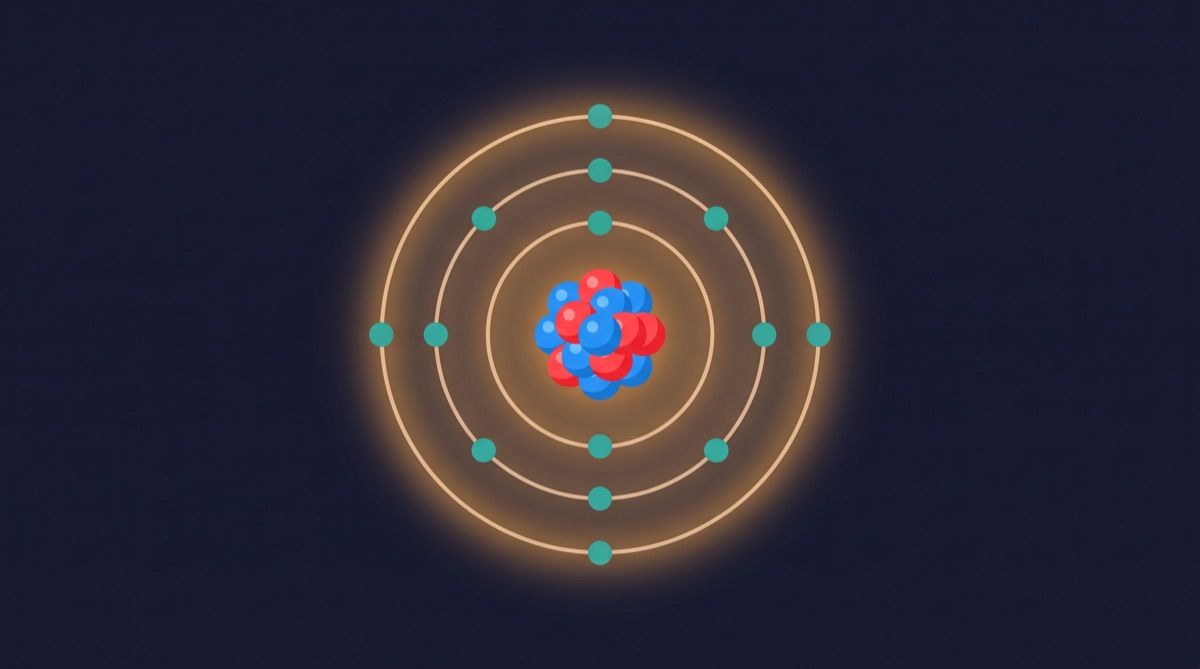
The table has seven horizontal rows, called periods. Reading left to right along a period, the atomic number increases by one each square. Each new period begins when the atoms start filling a new outer shell of electrons. Period 1 contains only hydrogen and helium because the first shell holds just two electrons. Period 2 has eight elements because the second shell holds eight.
The vertical columns are called groups, numbered 1 to 18 from left to right. Elements in the same group have the same number of electrons in their outer shell, and because chemical reactions are mostly about outer electrons, elements in a group behave in similar ways. This is the reason the table is arranged as it is. Mendeleev did not know about electrons when he drew his first version in 1869, but he noticed that properties repeated at regular intervals, and he arranged the elements so that the look-alikes lined up vertically.
For a neutral atom of any element in the first twenty, you can read the electron arrangement straight off the table. The period number tells you how many shells are occupied, and for groups 1 and 2 the group number tells you how many electrons are in the outer shell. For groups 13 to 18, subtract ten from the group number to get the outer electron count. Sodium, in period 3 and group 1, is 2,8,1. Chlorine, in period 3 and group 17, is 2,8,7.
Why the table has that odd shape
Three features puzzle newcomers: the big gap at the top, the wide block in the middle, and the two rows floating underneath.
The gap at the top. Periods 1, 2 and 3 are short because the early electron shells are small. Hydrogen and helium sit alone in period 1, one on each side, and periods 2 and 3 skip straight from group 2 to group 13. Nothing is missing. There are simply no elements that belong in those positions.
The wide middle. From period 4 onwards, an extra set of orbitals called the d sub-shell becomes available. Filling it takes ten electrons, which adds ten columns. These are the transition metals, groups 3 to 12, and they include most of the metals you meet every day: iron, copper, zinc, silver, gold.
The two detached rows. Periods 6 and 7 gain yet another sub-shell, the f sub-shell, which holds fourteen electrons. Fitting those fourteen elements into the main grid would make the table about 32 squares wide, too long to print sensibly. So the lanthanides (starting after lanthanum) and actinides (starting after actinium) are cut out and parked below. They belong in the small notch between groups 2 and 3 in periods 6 and 7.
Reading behaviour from position
Once you know where an element sits, you can make confident predictions about it.
Metals and non-metals. A stair-step line runs diagonally from boron down to astatine. Elements to the left and below it are metals: shiny, conductive, mostly solid, and they tend to lose electrons in reactions. Elements to the right and above are non-metals, which tend to gain or share electrons. The handful of elements hugging the line, such as silicon and germanium, are metalloids with a mixture of properties. Roughly three quarters of the table is metallic.
Reactivity. The most reactive metals are in the bottom left corner (caesium, rubidium, potassium). The most reactive non-metals are in the top right, just short of the last column (fluorine, chlorine). The last column itself, group 18, contains the noble gases, which barely react at all because their outer shells are already full.
Charge of ions. Group 1 elements form 1+ ions, group 2 form 2+, group 17 form 1- and group 16 form 2-. This follows directly from how many electrons an atom must lose or gain to reach a full outer shell.
State at room temperature. Only two elements are liquid at ordinary room temperature, bromine and mercury. Eleven are gases, all in the top right region plus hydrogen. Everything else is solid.
Worked example: three squares in period 3
Let us read three neighbours from the same row and see how much they differ.
Sodium (Na, atomic number 11). Period 3, group 1. Electron arrangement 2,8,1. That single outer electron is loosely held, so sodium gives it away easily, forming Na+ ions. It is a soft metal that reacts vigorously with water and has to be stored under oil. Its atomic mass of about 23 tells us a typical atom has 12 neutrons.
Chlorine (Cl, atomic number 17). Same period, group 17. Electron arrangement 2,8,7. One electron short of a full shell, so it grabs electrons from other atoms, forming Cl- ions. It is a pale green gas, poisonous, and highly reactive. Its atomic mass of 35.5 is not close to a whole number because natural chlorine is roughly three parts chlorine-35 to one part chlorine-37.
Argon (Ar, atomic number 18). Same period, group 18. Electron arrangement 2,8,8. Full outer shell, so it has no reason to gain, lose or share electrons. It is a colourless gas that makes up almost one per cent of the air you breathe and is used to fill light bulbs precisely because it will not react with the hot filament.
Three elements, next to each other, with one, seven and eight outer electrons respectively. That difference alone explains why sodium and chlorine combine so eagerly to make table salt, while argon sits out the whole affair. Put sodium's spare electron into chlorine's gap and both end up with the same arrangement as argon.
Try it on Periodic Bubbles: open the bubbles, switch the colour mode to category, and watch how the metals and non-metals separate. Then pop sodium and chlorine to compare their electron shells side by side.
Common misconceptions
"The atomic mass is the number of neutrons." It is not. It is the average mass of the whole atom, protons plus neutrons, weighted across isotopes. Subtract the atomic number to estimate neutrons.
"Elements in the same row are similar." Generally the opposite. Neighbours in a period can be wildly different, as sodium, chlorine and argon show. It is the column that groups look-alikes together.
"Hydrogen is an alkali metal because it is in group 1." Hydrogen has one outer electron like the alkali metals, but it is a non-metal gas and behaves quite differently. Many tables set it slightly apart for this reason.
"The table is finished." Period 7 was completed in 2016 with the naming of elements 113, 115, 117 and 118, but researchers are still attempting to make elements 119 and 120, which would start an eighth period.
Key takeaways
- Each square shows a symbol, name, atomic number (protons) and atomic mass (average mass across isotopes).
- Rows are periods and mark a new electron shell; columns are groups and share outer electron counts.
- Elements in the same group behave alike; elements in the same row usually do not.
- The gaps and detached rows come from the sizes of the electron sub-shells, not from missing elements.
- Position predicts behaviour: metals left, non-metals right, most reactive at bottom left and top right, noble gases inert in the last column.