Groups and Periods Explained: Why Columns Matter More Than Rows
Periods are the rows and groups are the columns. See what each tells you about electrons and reactivity, with all 18 groups in one table.
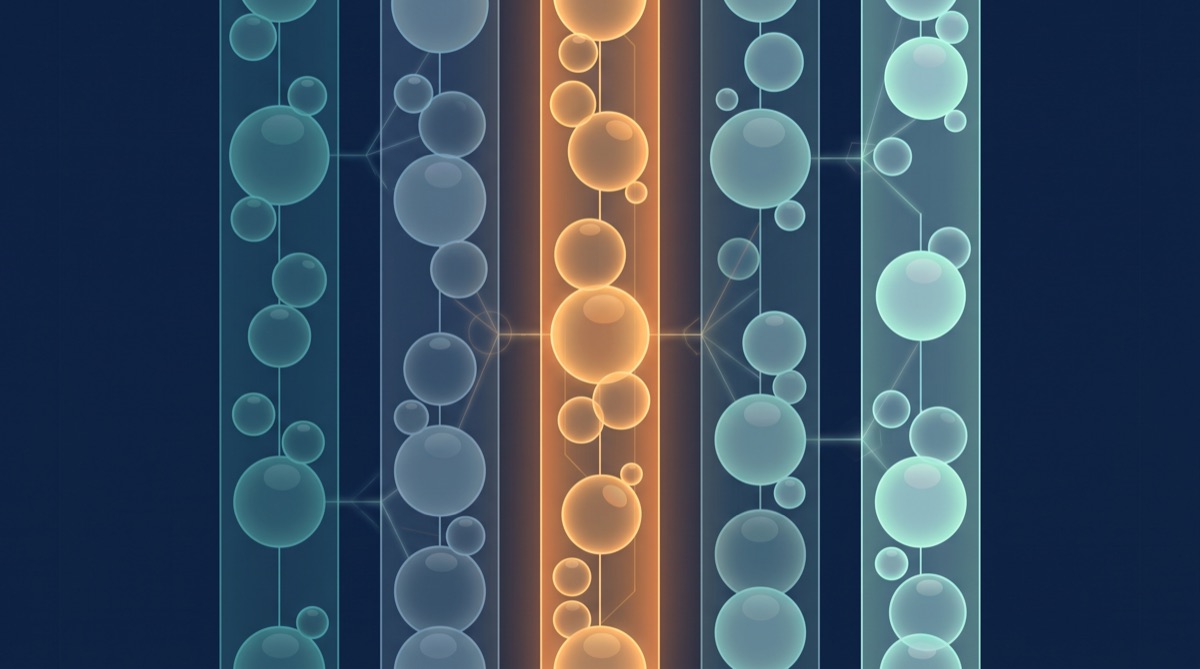
If you remember one idea from the periodic table, make it this: read it in columns. A row tells you how many electron shells an atom has, which is useful. A column tells you how an element behaves, which is what chemistry is actually about. This article explains what the groups and periods are, why the columns carry so much information, and how to use them to predict what an element will do before you have ever seen it.
Periods: the rows
The table has seven horizontal rows, called periods. Moving along a period from left to right, each element has one more proton and one more electron than the last. The extra electrons go into the same outer shell until it is full, at which point the next element starts a new shell and a new period begins.
That is why the period number equals the number of occupied shells. Lithium, in period 2, has two shells. Potassium, in period 4, has four. It is also why periods get longer further down the table: later shells have more room, so more elements fit before the shell is complete.
Elements in the same period do not have much in common chemically. Period 3 runs from sodium, a soft reactive metal, through aluminium, silicon and sulfur, to chlorine, a poisonous gas, and finishes with argon, which reacts with almost nothing. Reading a row is like reading a street of very different houses that happen to share a postcode.
Groups: the columns
The eighteen vertical columns are the groups, numbered 1 to 18 from left to right. Older British textbooks number only the eight tall columns, calling the transition metals a block in the middle, so you may see group 17 referred to as group 7. Both systems describe the same column.
Elements in a group share the same number of electrons in their outer shell. That is the single fact that makes groups so powerful. When atoms react, they gain, lose or share their outer electrons in order to reach a stable full shell. Two elements with the same outer arrangement will want to do the same thing, so they form the same kinds of compounds, make ions with the same charge and follow the same patterns of reactivity.
Several groups have family names that you will meet constantly.
- Group 1, the alkali metals: lithium, sodium, potassium, rubidium, caesium, francium. Soft, low-density metals with one outer electron. They react with water to make an alkaline solution and hydrogen gas, hence the name.
- Group 2, the alkaline earth metals: beryllium, magnesium, calcium, strontium, barium, radium. Harder and less reactive than group 1, with two outer electrons. "Earth" is an old chemists' word for oxides that would not melt or dissolve.
- Groups 3 to 12, the transition metals: the wide central block, including iron, copper, zinc, silver, gold and platinum. Typically hard, dense, high-melting, good conductors, and able to form coloured compounds and ions with more than one charge.
- Group 15, the pnictogens: nitrogen, phosphorus and their heavier relatives. The name is rarely used at school but you will see it in university texts.
- Group 16, the chalcogens: oxygen, sulfur, selenium and below. Usually form 2- ions.
- Group 17, the halogens: fluorine, chlorine, bromine, iodine, astatine. Reactive non-metals with seven outer electrons. The name means "salt-formers" because they combine with metals to make salts.
- Group 18, the noble gases: helium, neon, argon, krypton, xenon, radon. Full outer shells, so they are almost completely unreactive. "Noble" in the sense of aloof, keeping themselves apart.
Hydrogen sits at the top of group 1 because it has one outer electron, but it is a non-metal gas and is best treated as a group of its own.
What changes as you go down a group
Going down a column, each element has one more shell of electrons than the one above. Two consequences follow.
First, atoms get bigger. More shells means a larger radius. Caesium atoms are several times wider than lithium atoms.
Second, the outer electrons are further from the nucleus and are screened from its pull by all the inner shells. They are held less tightly. This has opposite effects for metals and non-metals.
For metals, which react by losing electrons, a loosely held outer electron means more reactivity further down. Lithium fizzes gently in water, sodium fizzes vigorously, potassium bursts into a lilac flame, and caesium explodes.
For non-metals, which react by gaining electrons, a large atom with lots of shielding is less good at pulling in an extra electron, so reactivity decreases down the group. Fluorine is the most reactive halogen; iodine is the least.
Melting and boiling points also shift down a group, but again in different directions. The alkali metals melt at lower temperatures as you descend, since larger atoms form weaker metallic bonds. The halogens go the other way: fluorine and chlorine are gases at room temperature, bromine is a liquid and iodine is a solid, because larger molecules attract each other more strongly.
What changes as you go across a period
Across a period, the number of shells stays the same but the number of protons in the nucleus rises. The outer electrons are pulled in more tightly, so atoms actually get smaller from left to right, even though they contain more particles. The energy needed to remove an electron rises, and the tendency to attract electrons in a bond (electronegativity) rises too.
Chemically, the shift is from metal to non-metal. On the left, elements have one or two outer electrons and lose them readily to form positive ions. On the right, they have six or seven and gain electrons to form negative ions. In the middle, elements like carbon and silicon prefer to share electrons in covalent bonds. At the far right, the noble gases have complete shells and do neither.
The oxides tell the same story. Sodium oxide and magnesium oxide dissolve to give alkaline solutions. Sulfur dioxide and the oxides of chlorine give acidic solutions. Aluminium oxide, in between, can act as either.
Group 1 versus group 17: a study in opposites
The alkali metals and the halogens sit near opposite ends of the table and make a good pair for seeing how group position drives behaviour.
An alkali metal atom has one electron more than a full shell. The cheapest route to stability is to lose it, forming a 1+ ion. A halogen atom has one electron fewer than a full shell, and the cheapest route is to gain one, forming a 1- ion. Put them together and the transfer is almost inevitable. Sodium and chlorine make sodium chloride, potassium and bromine make potassium bromide, and so on down both columns. Every alkali metal reacts with every halogen in a one-to-one ratio.
The reactivity trends run in opposite directions. The most reactive alkali metal is at the bottom (francium, though it is too rare to test properly, so caesium in practice). The most reactive halogen is at the top (fluorine). The most violent combination is therefore caesium with fluorine, and the tamest is lithium with iodine.
You can watch the halogen trend in a test tube. Add chlorine water to a solution of potassium bromide and the solution turns orange as bromine is displaced. Add it to potassium iodide and it turns brown as iodine appears. Bromine will displace iodine, but nothing lower in the group will displace chlorine. A more reactive halogen always pushes out a less reactive one.
Try it on Periodic Bubbles: open the bubbles and use the group filter to show only group 1, then only group 17. Compare the electron shells on the potassium and bromine pages and you will see the "one too many" and "one too few" pattern directly.
The main groups at a glance
| Group | Family name | Outer electrons | Typical ion | Typical properties |
|---|---|---|---|---|
| 1 | Alkali metals | 1 | 1+ | Soft, low density, react with water, more reactive down the group |
| 2 | Alkaline earth metals | 2 | 2+ | Harder, react with water more slowly, form basic oxides |
| 3 to 12 | Transition metals | Varies | Often more than one | Dense, high melting points, coloured compounds, useful catalysts |
| 13 | Boron group | 3 | 3+ | Boron is a metalloid, the rest are metals, aluminium most familiar |
| 14 | Carbon group | 4 | Usually covalent | Carbon and silicon form giant covalent structures, tin and lead are metals |
| 15 | Pnictogens | 5 | 3- | Nitrogen is a stable gas, phosphorus is reactive, metallic character increases down |
| 16 | Chalcogens | 6 | 2- | Oxygen and sulfur are reactive non-metals, form acidic oxides |
| 17 | Halogens | 7 | 1- | Reactive, coloured, form salts with metals, less reactive down the group |
| 18 | Noble gases | 8 (2 for helium) | None | Colourless gases, almost completely unreactive |
Key takeaways
- Periods are rows and show how many electron shells an atom has; groups are columns and show how many outer electrons it has.
- Elements in the same group react alike because chemistry is driven by outer electrons.
- Down a group, atoms get bigger and outer electrons are held less tightly: metals become more reactive, non-metals less.
- Across a period, atoms get smaller and character shifts from metallic to non-metallic to inert.
- Group 1 and group 17 are mirror images: one electron too many meets one electron too few, and a salt is the result.