Periodic Table Lesson Plans for Ages 11 to 16 (KS3, GCSE, Middle and High School)
Three complete 60-minute periodic table lessons for ages 11 to 16 with objectives, starters, activities, plenaries, differentiation, misconceptions and homework.
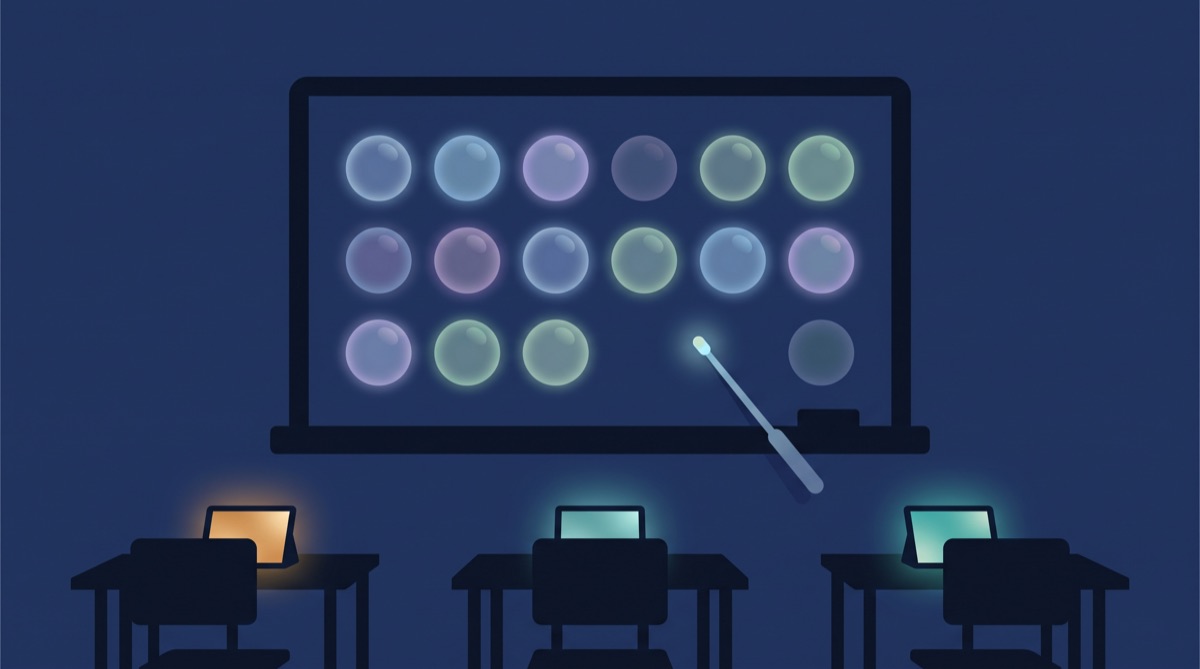
The periodic table appears in every year of secondary science, from a first encounter in Key Stage 3 (ages 11 to 14, roughly grades 6 to 8 in the United States) to trends and reactivity at GCSE (ages 14 to 16, grades 9 and 10), and it rewards teaching that lets students explore the table rather than memorise it. The three plans below use the free interactive tools on this site alongside printable resources, each fitting a 60-minute lesson.
Each plan has learning objectives, a starter, a main activity, a plenary and differentiation notes, with assessment ideas, misconceptions and homework at the end. You will need a projector for the starter and plenary and ideally tablets, laptops or a computer room for the main activities. Where devices are not available, the printable resources allow the lessons to run offline.
Lesson 1: Introducing the periodic table (KS3)
The Key Stage 3 programme of study asks students to understand the principles behind the periodic table and the properties of metals and non-metals. This lesson gives them a first look at the whole table and the idea that its layout carries meaning.
Learning objectives
- State that an element is a substance made of one type of atom and that there are 118 known elements.
- Describe how the periodic table is arranged in rows (periods) and columns (groups).
- Sort elements into metals, non-metals and noble gases and describe typical properties of each.
Starter (10 minutes)
Project the bubble periodic table with all 118 elements floating. Ask students to shout out any elements they recognise and pop them as they are named. Most classes know gold, oxygen, iron, helium and carbon. Ask what these have in common, and establish that each is an element, a single type of atom.
Main activity (35 minutes)
Switch the display to colour-by-category so that metals, non-metals, metalloids and noble gases are each shaded differently. Give pairs five minutes to describe the pattern: metals dominate the left and centre, non-metals cluster in the top right, and a staircase separates them.
Students then sort ten familiar elements (sodium, iron, copper, carbon, oxygen, sulfur, silicon, helium, argon and gold) into metal, non-metal or noble gas, predict two properties for each, and check by opening the element's details on their device. Each element page shows appearance, state at room temperature and a summary, so students can check independently. Finish by asking each pair to find one element they have never heard of and write down its name, symbol and one fact about it.
Plenary (10 minutes)
Return to the projected table. Pop three bubbles at random and ask the class to classify each with a show of hands, giving a reason. Close with the question the next lesson will answer: why are the columns grouped the way they are?
Differentiation
For students who need support, provide a partially labelled table and reduce the sort to six elements. Early finishers can hunt for boundary cases, such as silicon, which does not fit neatly, and mercury, a liquid metal, and explain why a classification struggles with them.
Lesson 2: Groups, electrons and reactivity (GCSE)
GCSE specifications expect students to link an element's position to its electron configuration, explain the reactivity trends down groups 1 and 7, and describe why the noble gases are unreactive. This lesson uses the Daily Bubble puzzle as a starter and then hands over to independent research on element pages.
Learning objectives
- Explain that elements in the same group have the same number of electrons in their outer shell.
- Describe and explain the trend in reactivity down group 1 and down group 7.
- Explain why group 0 elements are unreactive in terms of full outer shells.
Starter (10 minutes)
Open the Daily Bubble on the board. It works like a word puzzle: the class has a limited number of guesses to identify the day's mystery element from clues about its position and properties. Ask each student to justify their guess with a property. This gets vocabulary such as period, group and reactive into the air within minutes.
Main activity (35 minutes)
Divide the class into threes and assign each team either group 1 (lithium, sodium, potassium) or group 7 (fluorine, chlorine, bromine, iodine). Each team researches its elements on the element pages, recording atomic number, electron configuration by shell, melting point and one observation about reactivity. The 3D Bohr model on each page makes the shared outer-shell count visible immediately, and the melting points reveal opposite trends in the two groups.
After twenty minutes, pair a group 1 team with a group 7 team to explain their trends to each other and answer the central question: why does reactivity increase down group 1 but decrease down group 7? Guide them towards the idea that the outer electron in a large atom is further from the nucleus and more easily lost, whereas a large halogen atom finds it harder to attract an extra electron.
Plenary (10 minutes)
Ask students to write an exam-style explanation in three sentences: state the trend, describe the change in atomic structure, and link the two. Improve two examples live on the board. Finish by opening the argon page, showing the full 2, 8, 8 shell diagram and asking why argon is used in light bulbs.
Differentiation
Provide a scaffolded recording sheet for students who need it. Extension students can research group 2 and predict, then check, whether it follows the group 1 pattern.
Lesson 3: Revision using quiz levels and printables (GCSE)
This lesson suits the run-up to mocks or the end of the topic, combining quick-fire recall, a paper assessment and targeted follow-up.
Learning objectives
- Recall the symbols, atomic numbers and groups of the first twenty elements plus common transition metals.
- Apply understanding of atomic structure and periodic trends to unfamiliar questions.
- Identify personal gaps and plan revision to address them.
Starter (10 minutes)
Run the Pop Quiz at its easiest level on the board, with students answering on mini whiteboards before the answer is revealed. Level one focuses on names and symbols, so every student can participate. Keep a tally of the class score to compare with the end of the lesson.
Main activity (35 minutes)
Hand out the printable 20-question worksheets for students to complete individually in fifteen minutes under exam conditions. Then display the answer key and have students mark their own work, colour-coding each question green, amber or red according to confidence.
For the remaining twenty minutes students choose their own route. Those with mostly green move to the second and third Pop Quiz levels on devices, which introduce properties, groups and trends and are considerably harder. Those with several reds pair up and use the 118 printable flashcards to drill the elements they missed. Circulate and spend time with the students who marked the most reds.
Plenary (10 minutes)
Repeat a short round of the quiz and compare the score with the starter. Then ask each student to complete the sentence "The thing I most need to revise is..." on an exit ticket. These give you a precise picture of the class's remaining gaps.
Differentiation
The traffic light approach differentiates automatically, but be ready to redirect students who over- or under-estimate their confidence. Students who complete the hardest quiz level can write two exam questions of their own with a mark scheme.
Assessment ideas
- Use the worksheet as a pre-test at the start of the topic and again at the end to measure progress.
- Set a Pop Quiz level as a homework challenge and ask students to record their best score.
- Ask students to draw the shell diagram for an element you name, then justify its group and period from the diagram alone.
- Give students an unfamiliar element and its position and ask them to predict its properties, marking the reasoning rather than the answer.
Common misconceptions to address
- Atomic number and mass number are the same thing. Students frequently confuse the two. Insist on the vocabulary: atomic number counts protons; mass number counts protons plus neutrons.
- Electrons orbit like planets. The Bohr model is useful, but students should hear that it is a simplification.
- All metals are hard, shiny and solid. Sodium can be cut with a knife and mercury is a liquid.
- Elements in the same period are similar. Contrast sodium and chlorine, which share a period but could hardly be more different.
- The noble gases have no electrons in their outer shell. The correct idea is a full outer shell, not an empty one. The shell diagrams make this concrete.
- Reactivity means "dangerous". Reactivity describes how readily an element forms compounds; sodium and chlorine are both highly reactive yet form harmless salt.
Homework suggestions
- After lesson 1: find five elements in objects at home, name the object and the element, and note whether the element is a metal or non-metal.
- After lesson 2: write a paragraph explaining to a younger student why potassium is more reactive than lithium, using a labelled shell diagram.
- After lesson 3: play the Daily Bubble each day for a week and log the mystery element, the guesses taken and one fact learned.
Key takeaways
- Three 60-minute lessons cover a KS3 introduction, GCSE group trends and a GCSE revision session, each with objectives, starter, main, plenary and differentiation.
- Interactive tools such as colour-by-category, the Daily Bubble and the Pop Quiz work as starters and self-paced activities; printables allow the lessons to run without devices.
- Element pages with 3D shell diagrams make the link between electron configuration and group behaviour visible.
- Self-marked worksheets and traffic-light confidence ratings let students direct their own revision and give you precise feedback.
- Tackle misconceptions about atomic number, the Bohr model, metal properties and the meaning of reactivity explicitly rather than hoping they resolve themselves.