Elements Named After Places, People and Myths
Which elements are named after countries, places and people? From germanium and francium to Curie and Seaborg, plus one Swedish village behind four.
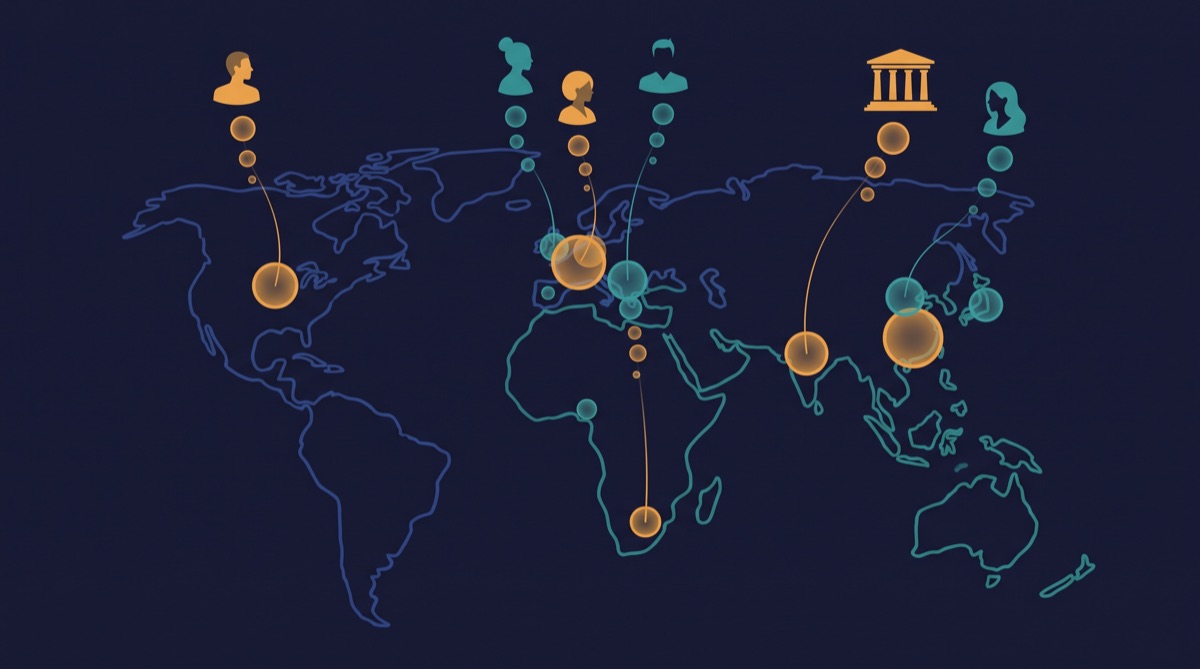
Every element has a story hidden in its name. Some names are thousands of years old and describe a colour or a smell. Others were chosen at a committee meeting within living memory. Between them they record a village quarry in Sweden, a laboratory in Japan, the gods of Greece and Scandinavia, and a roll call of the scientists who worked out what matter is made of.
This article sorts the names into three groups: places, people, and myths. It finishes with the official rules that govern how a new element gets its name today, and why the most recent four names took so long to settle.
One village, four elements
The champion of place names is Ytterby, a village on an island near Stockholm. A feldspar quarry there produced an unusual black mineral in the 1780s, and chemists spent the next century teasing it apart. It turned out to contain a whole cluster of rare earth elements that are very hard to separate from one another. Four of them are named directly after the village: yttrium, terbium, erbium and ytterbium, each using a different slice of the name.
The same mineral led to several more. Holmium is named after Holmia, the Latin name for Stockholm. Thulium takes its name from Thule, an ancient name for the far north. Scandium honours Scandinavia as a whole. Gadolinium is named after the mineral gadolinite, which was itself named after the Finnish chemist Johan Gadolin, who first analysed the Ytterby rock.
Countries, cities and regions
Many elements simply carry the name of where they were discovered or where the discoverer came from. Francium was identified in France in 1939 by Marguerite Perey. Germanium was isolated in Germany in 1886. Polonium was named by Marie Curie in 1898 after Poland, her homeland, which at the time was divided between neighbouring empires and did not exist as an independent state.
The heavy artificial elements are a map of the laboratories that made them. Americium is named for the Americas, deliberately echoing europium, which sits directly above it in the table. Berkelium and californium honour the city of Berkeley and the state of California, home of the laboratory where they were first produced. Dubnium is named after Dubna, the Russian town whose institute has made many superheavy elements, and moscovium after the surrounding Moscow region. Darmstadtium takes its name from Darmstadt in Germany, and hassium from Hesse, the German state in which Darmstadt sits, via its Latin name Hassia. Nihonium comes from Nihon, one of the Japanese words for Japan, and was the first element discovered in Asia. Tennessine recognises the state of Tennessee, where several of the institutions involved in its discovery are based.
Older names use Latin versions of place names, which can disguise them. Lutetium is from Lutetia, the Roman name for Paris. Hafnium is from Hafnia, the Latin name for Copenhagen. Rhenium is named after the Rhine, and ruthenium after Ruthenia, a Latin name for the lands of the Rus, roughly modern Russia and its neighbours. Strontium was named after Strontian, a small village in the Scottish Highlands where the mineral was first found.
Two of the very oldest place names belong to familiar metals. The Latin word for copper, cuprum, comes from a phrase meaning "metal from Cyprus", the island that supplied the Roman world. Magnesium and manganese both trace back to Magnesia, a region of Greece, where two different dark minerals were confused with each other for centuries. The mix-up survives in the near identical names.
Then there is gallium. Its discoverer, Paul-Émile Lecoq de Boisbaudran, said he named it after Gallia, the Latin name for France. Critics pointed out that gallus is Latin for a cockerel, which in French is le coq, and accused him of quietly naming the element after himself. He denied it, and the truth is impossible to know. Treat the story as a disputed anecdote rather than fact.
Elements named after people
For most of chemistry's history, naming an element after a person was considered bad taste. The first to slip through did so by accident: samarium, discovered in 1879, is named after the mineral samarskite, which had been named after a Russian mining official called Vasili Samarsky-Bykhovets. Gadolinium, mentioned above, followed the same path through a mineral.
Direct honours began with the artificial elements of the atomic age. Curium, made in 1944, commemorates Marie and Pierre Curie. Einsteinium and fermium honour Albert Einstein and Enrico Fermi, though both men had died by the time the names were made public. Mendelevium celebrates Dmitri Mendeleev, the creator of the periodic table itself. Nobelium recognises Alfred Nobel, and lawrencium recognises Ernest Lawrence, inventor of the cyclotron, the machine that made many of these elements possible.
The superheavy elements continued the tradition. Rutherfordium honours Ernest Rutherford, who discovered the atomic nucleus. Bohrium is for Niels Bohr and his model of the atom. Meitnerium honours Lise Meitner, who explained nuclear fission, making it one of only two elements named after a woman, the other being curium, which she shares with Marie Curie. Roentgenium is for Wilhelm Röntgen, discoverer of X-rays. Copernicium remembers the astronomer Nicolaus Copernicus. Flerovium is officially named after the Flerov Laboratory in Dubna, which in turn honours the physicist Georgy Flyorov.
Seaborgium broke a long-standing rule. When it was named in 1997, Glenn Seaborg was still alive, the first time an element had honoured a living person. Oganesson, named in 2016 after Yuri Oganessian, a leading figure in superheavy element research, was the second.
Gods, heroes and planets
Mythology supplied names long before modern chemistry. Mercury shares its name with the swift Roman messenger god and the fast-moving planet, fitting for a metal that runs like liquid. Titanium was named after the Titans of Greek myth, and vanadium after Vanadis, another name for the Norse goddess Freyja, chosen because of its beautifully coloured compounds. Thorium is named after Thor, the Norse god of thunder.
Some mythological names tell a story about chemistry. Tantalum was named after Tantalus, who in Greek myth stood in water he could never drink. The chemist who discovered it found that its oxide would not dissolve even when surrounded by acid. Niobium, which is almost always found alongside tantalum and is chemically very similar, was named after Niobe, the daughter of Tantalus. Promethium recalls Prometheus, who stole fire from the gods.
Astronomy provides a related set. Helium was named after Helios, the Greek sun god, because it was first detected in light from the Sun in 1868, decades before it was found on Earth. Selenium, from Selene, the Moon, was named to pair it with tellurium, from tellus, the Latin word for Earth, because the two elements are so alike. Cerium and palladium celebrate the dwarf planet Ceres and the asteroid Pallas, both discovered just before the elements were. And three elements march outwards through the solar system: uranium after Uranus, discovered in 1781, followed in the 1940s by neptunium and plutonium, named after the next two bodies out.
The official naming rules
Today no one can simply pick a name. When a new element is claimed, a joint working group of the International Union of Pure and Applied Chemistry, known as IUPAC, and its physics counterpart examines the evidence. Only once a discovery is confirmed are the discoverers invited to propose a name, and it must fall into one of five categories: a mythological concept or character, including astronomical objects; a mineral or similar substance; a place or geographical region; a property of the element; or a scientist.
The ending is fixed too. Most new elements end in "-ium". Elements in group 17, the halogens, end in "-ine", and elements in group 18, the noble gases, end in "-on". That is why element 117 became tennessine rather than tennessium, and why element 118 is oganesson.
The four newest elements, numbers 113, 115, 117 and 118, illustrate how slow the process can be. Claims for them were made between 2003 and 2010, but each element was produced only a few atoms at a time and vanished within fractions of a second. Independent laboratories had to repeat and confirm the results before the working group accepted the discoveries in December 2015. The proposed names were then published for a five-month public review, and nihonium, moscovium, tennessine and oganesson were finally approved in November 2016. Until then, the elements had been known by placeholder names built from their atomic numbers, such as ununseptium for element 117.
Reading the table as a map
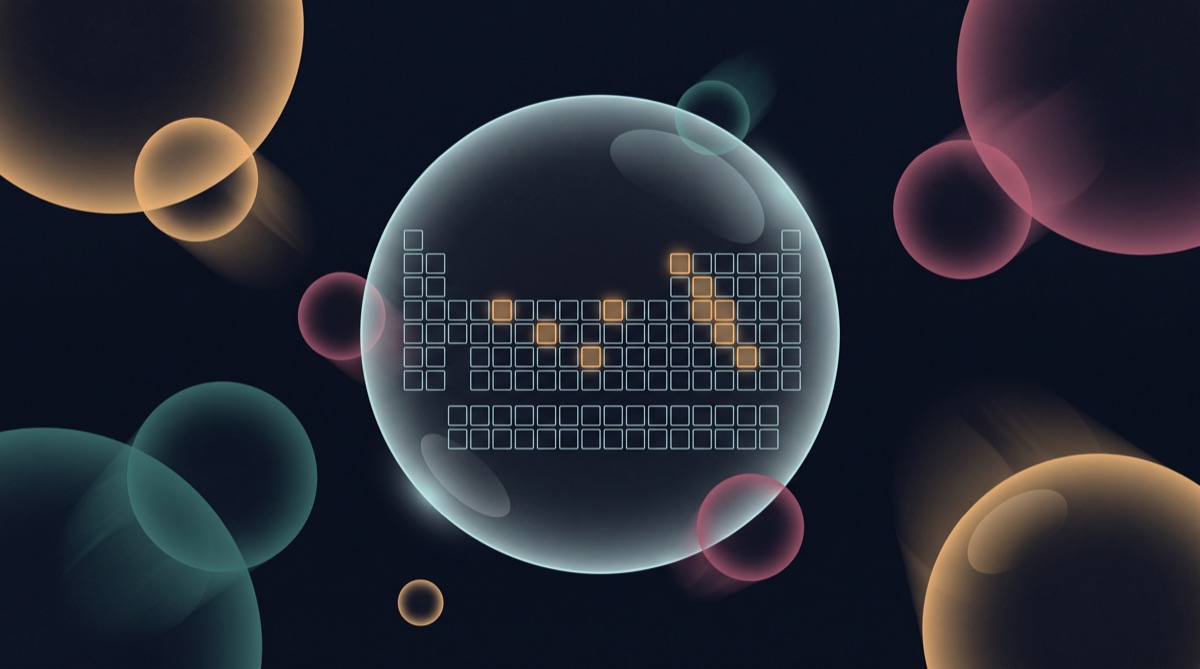
Once you know where the names come from, the periodic table turns into an atlas and a history book at once. Pop a bubble on the interactive table and check the origin of the name for any element you are curious about.
Key takeaways
- A single quarry in Ytterby, Sweden, gave its name to yttrium, terbium, erbium and ytterbium, and led to the discovery of several more elements.
- Place names range from countries such as France, Germany and Poland to cities such as Berkeley, Dubna and Darmstadt, often disguised in Latin.
- Elements named after people are mostly artificial and modern; seaborgium and oganesson are the only two named while the person was alive.
- Mythological and planetary names include helium, mercury, titanium, thorium, tantalum, uranium, neptunium and plutonium.
- IUPAC allows names based on a myth, a mineral, a place, a property or a scientist, with endings fixed by the element's group.
- The names of elements 113 to 118 were settled only in 2016 because discoveries of a few short-lived atoms had to be independently confirmed first.