Iron · element 26
The most used metal on Earth, the reason your blood is red, and the ash of dying stars
Key facts
Iron makes up most of the Earth's core, gives the planet its magnetic field, colours the surface of Mars and carries oxygen around your body. It is the metal humans have used most for three thousand years, and each year well over a billion tonnes of steel are made, almost all of it iron. It is cheap, strong, magnetic, and it rusts.
Iron is also where the story of a star ends. Fusion in a star's core releases energy only as far as iron; making anything heavier costs energy instead. When a massive star has built an iron core it collapses, and the supernova that follows scatters iron across space.
Where it is found
Iron is the fourth most abundant element in the crust and, counting the core, the most abundant element in the whole Earth by mass. The main ores are the oxides haematite and magnetite, mined on a huge scale in Australia, Brazil, China, India and Russia. Many deposits are banded iron formations, laid down more than two billion years ago when oxygen released by early photosynthesis reacted with iron dissolved in the oceans and rained it down as rust.
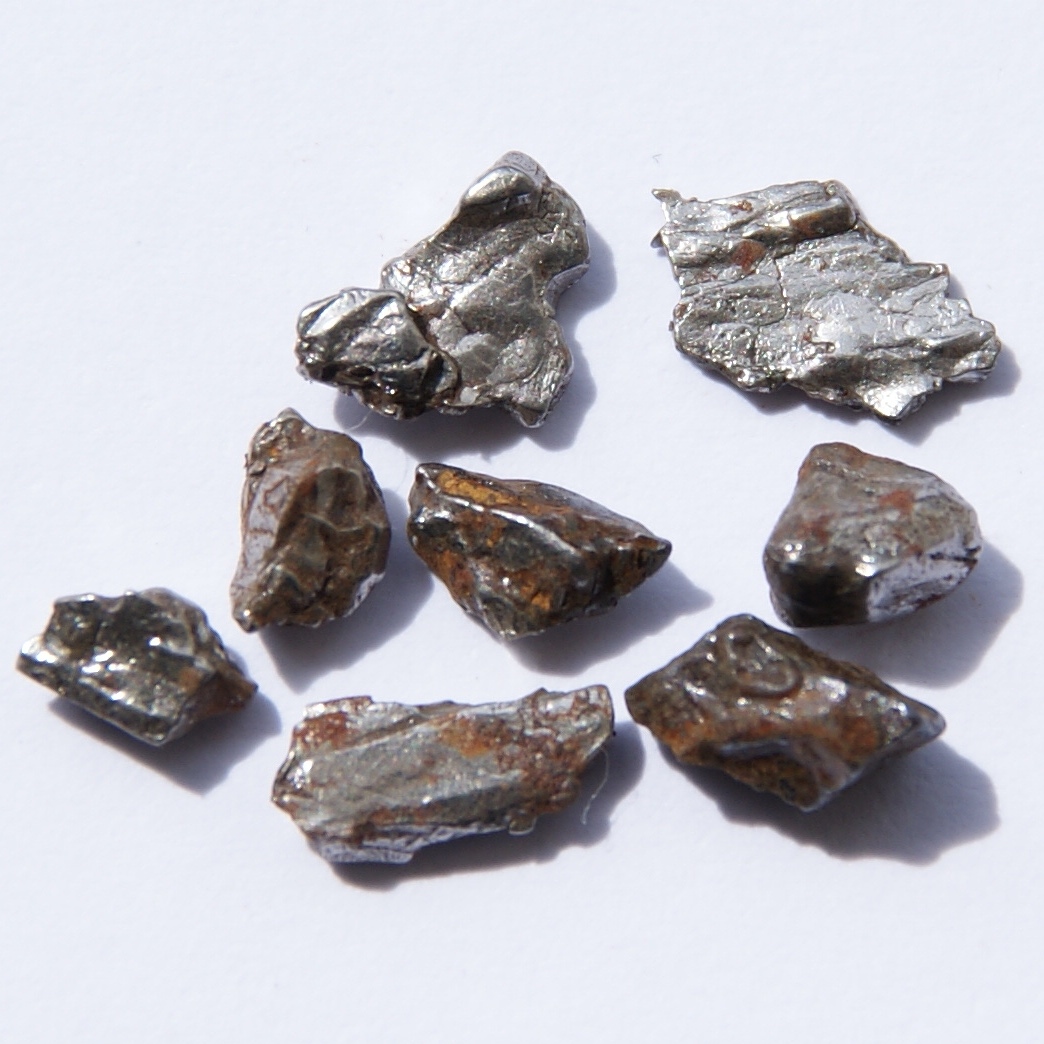
Native iron is rare and comes mostly from meteorites, which is how some ancient cultures first met it. Iron colours soils red and brown and is present in clays, garnet and olivine. In living things it sits at the centre of haemoglobin, myoglobin and many enzymes, and iron deficiency is the most common nutritional shortfall in the world.
How it was discovered
There is no discoverer. Beads of meteoritic iron were made in Egypt more than five thousand years ago, and iron smelted from ore appears in Anatolia and the Near East by around 1200 BC, the start of what archaeologists call the Iron Age. The key skill was running charcoal furnaces hot enough to reduce the ore and then hammering the spongy bloom into wrought iron. Blast furnaces producing molten cast iron were developed in China and reached Europe in the Middle Ages. Abraham Darby's use of coke in 1709 and Henry Bessemer's converter of 1856 turned iron and steel into the basis of the industrial world.
What we use it for
Steel, which is iron with a small amount of carbon and often other elements, is by far the biggest use. It frames buildings and bridges, forms car bodies and ship hulls, and becomes rails, pipes, cans, tools and the reinforcing bars inside concrete. Cast iron, with more carbon, makes engine blocks, manhole covers and frying pans. Stainless steels add chromium and nickel.
Iron is also the core of electromagnets, transformers and electric motors because it channels magnetic fields so efficiently. Iron oxide pigments colour paint, concrete and cosmetics, iron catalysts make the ammonia for fertiliser in the Haber process, and iron tablets treat anaemia. Tiny magnetic iron oxide particles are used to improve medical scans.
Reading the numbers
Iron melts at about 1538 °C and boils at about 2861 °C. The melting point is high enough that early smiths could never melt it, only soften it, which is why wrought iron was hammered rather than cast. Its density of 7.874 g/cm³ makes it the everyday reference point for a heavy metal: nearly eight times denser than water, though lighter than copper or lead. The configuration [Ar] 3d6 4s2 gives eight outer electrons, and iron commonly loses two or three to form Fe2+ (pale green ferrous compounds) and Fe3+ (yellow-brown ferric compounds). Unpaired d electrons on neighbouring atoms line up in the same direction, making iron ferromagnetic, one of only three elements that are magnetic at room temperature, along with cobalt and nickel. Its first ionisation energy of 762 kJ per mole is ordinary for a transition metal. Iron sits in group 8 in the middle of the first transition series, and its nucleus, iron-56, is among the most tightly bound of all, which is why stellar fusion stops here.
Safety and the environment
Iron metal is safe to handle, and cooking in iron pans adds a little useful iron to food. The dangers are indirect. Iron supplements are a leading cause of accidental poisoning in young children, because a handful of adult tablets can overwhelm a small body. Rust is harmless but costs enormous sums every year in repairs and replacements. Environmentally, iron and steel production is one of the largest industrial sources of carbon dioxide, because coke is burned to strip oxygen from the ore. Steelmaking using hydrogen instead of coke is being developed to cut those emissions.
Did you know?
- The Earth's magnetic field is generated by liquid iron churning in the outer core, some 3000 kilometres beneath your feet.
- Tutankhamun's dagger, found in his tomb, was made from meteoritic iron centuries before the Iron Age began in Egypt.
- Mars is red because its dusty surface is rich in iron oxide, the same compound as rust.
- The Iron Pillar of Delhi has stood outdoors for around 1600 years with remarkably little rust, thanks to a protective layer that formed from phosphorus in the metal.
- An adult body contains about four grams of iron, most of it in haemoglobin, which is roughly enough to make a small nail.
- Iron-56 is one of the most stable nuclei in existence, so stars cannot release energy by fusing it, and a massive star with an iron core is about to explode.
More in the transition metals
Column-mates come first, since elements in one column have outer electrons arranged in a similar way and tend to behave alike; the rest are the nearest neighbours in the family.
See all 38 transition metals on one page, or browse all 118 elements.
Compare Iron with another element
Each comparison has a side-by-side data table and a plain-English summary of the differences.
Frequently asked questions
Why does iron rust?
Iron reacts with oxygen and water to form hydrated iron oxide, which is rust. Unlike the oxide layer on aluminium or chromium, rust is flaky and porous, so it does not protect the metal beneath and the reaction keeps going.
Is iron magnetic?
Yes, iron is one of only three elements that are ferromagnetic at room temperature, along with cobalt and nickel. Its unpaired electrons align across large regions of the metal, and it loses this property if heated above about 770 °C.
Why is there iron in blood?
Each haemoglobin molecule in a red blood cell contains four iron atoms, and each one can grip an oxygen molecule in the lungs and release it in the tissues. The iron is also what makes oxygenated blood bright red.
What is the difference between iron and steel?
Steel is iron with a small, controlled amount of carbon, usually under two per cent, and often other metals. The carbon makes the metal much harder and stronger than pure iron, while too much carbon makes brittle cast iron.
Read next
Guess the mystery element in six tries. A new one every day, free, no sign-up.
Written by Anthony. Updated September 2026. Numerical data from Periodic-Table-JSON (CC BY-SA), cross-checked against the Iron reference article. Spotted an error? Tell us.