Which Elements Are Gases, Liquids or Solids at Room Temperature?
Which elements are liquid, gas or solid at room temperature? The full list, the near misses such as gallium, and a simple test for most elements.
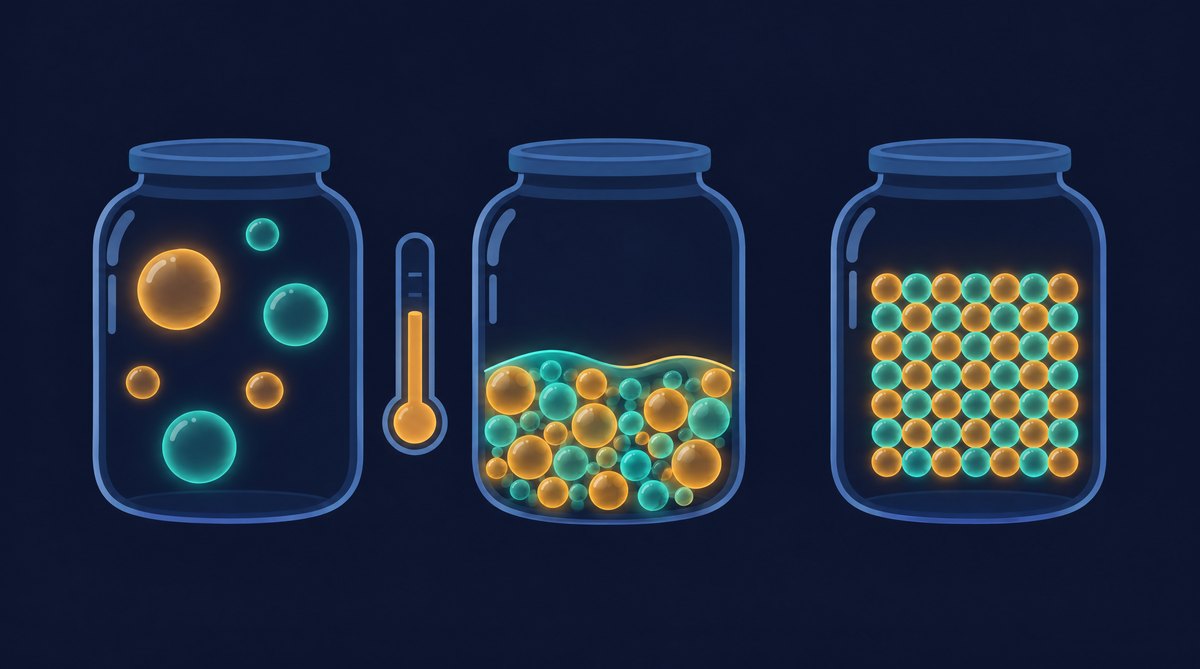
At normal room temperature and air pressure, only two elements are liquids, mercury and bromine, and eleven are gases. The other 105 are counted as solids, although for francium, astatine and the heaviest twenty or so elements that is a prediction, because nobody has held a visible lump of them. For copernicium nobody knows, so it is counted with the solids only to make the total reach 118.
That adds up: 11 + 2 + 105 = 118. "Room temperature" is not one exact number, so chemists settle on about 20 to 25 degrees Celsius with ordinary air pressure. The count holds anywhere in that range, and even at 0 degrees. The Colour: phase mode on this site (phase is another word for state) sorts the bubbles almost the same way, with one catch explained below.
The short answer
- Gases (11): hydrogen, helium, nitrogen, oxygen, fluorine, neon, chlorine, argon, krypton, xenon and radon.
- Liquids (2): mercury and bromine.
- Solids (105): everything else. Copernicium is counted here only so the total reaches 118. Its real state is unknown, so strictly it is 104 solids plus one unknown (more on that below).
Ten of the eleven gases live on the right-hand side of the table. Hydrogen is the stray from the top left. The noble gases, a family of very unreactive gases, are the six long-known elements in the last column (helium to radon; oganesson, element 118, completes it). The halogens, a family of very reactive elements, sit next to them, and the first four are fluorine, chlorine, bromine and iodine. Mercury is the only metal we can be sure is liquid at room temperature, and bromine is the only liquid non-metal (an element without the shine and electrical conduction typical of metals).
The 13 elements that are not solid
At ordinary air pressure, two numbers decide an element's state. The melting point is where a solid turns into a liquid (ice, at 0 degrees Celsius). The boiling point is where a liquid turns into a gas (a kettle, at about 100). The figures below come from the kelvin values in the site's data, converted as explained shortly and rounded to the nearest degree.
| Element | Family | State | Melts at (°C) | Boils at (°C) |
|---|---|---|---|---|
| Helium | Noble gas | Gas | minus 272, under pressure only | minus 269 |
| Neon | Noble gas | Gas | minus 249 | minus 246 |
| Argon | Noble gas | Gas | minus 189 | minus 186 |
| Krypton | Noble gas | Gas | minus 157 | minus 153 |
| Xenon | Noble gas | Gas | minus 112 | minus 108 |
| Radon | Noble gas | Gas | minus 71 | minus 62 |
| Fluorine | Halogen | Gas | minus 220 | minus 188 |
| Chlorine | Halogen | Gas | minus 102 | minus 34 |
| Hydrogen | Non-metal | Gas | minus 259 | minus 253 |
| Nitrogen | Non-metal | Gas | minus 210 | minus 196 |
| Oxygen | Non-metal | Gas | minus 219 | minus 183 |
| Bromine | Halogen | Liquid | minus 7 | 59 |
| Mercury | Metal | Liquid | minus 39 | 357 |
Why the bubbles show three liquids, and why the careful answer is two
Pick Colour: phase from the menu on the bubbles page. Gases turn purple, solids blue and liquids green. Count the green bubbles and you will find three: mercury, bromine and copernicium. The third is a catch.
Copernicium, element 112, does not exist in nature. Only a small number of atoms have ever been made, and the longest-lived kind loses half of any batch in about thirty seconds. The data holds a predicted boiling point of about 84 degrees Celsius (357 kelvin), with a wide margin of error, and no melting point at all. If that prediction is right, copernicium is not a gas at room temperature, but it is a calculation, not a measurement, and other calculations allow a gas or a very volatile liquid. With no melting point, it cannot say liquid or solid anyway. The green label is a forecast.
The site's copernicium write-up describes 2007 experiments in which a few atoms drifted along a gold-lined channel and clung to the gold less firmly than mercury does, which suggests an unusually volatile metal (one that turns to vapour easily). Single atoms cannot show whether a lump would be solid, liquid or gas. Flerovium, oganesson and their very heavy neighbours are in the same boat, made a few atoms at a time and lasting from under a millisecond to about half a minute. The data labels them all solid anyway.
So the careful answer is two liquids and eleven gases. The other 105 are counted as solids as a bookkeeping choice. Only 104 of the 118 are labelled solid in the data, and the 105th is copernicium, which the data labels liquid even though its state is unknown. Strictly, that is 104 solids plus one unknown.
How to tell the state of an element
This test works for any element that has both a melting point and a boiling point on record. Compare room temperature with the two numbers.
- Room temperature below the melting point: solid.
- Room temperature between the melting point and the boiling point: liquid.
- Room temperature above the boiling point: gas.
The site stores temperatures in kelvin, the scale scientists prefer because zero kelvin is absolute zero, the coldest anything can possibly be. One kelvin is the same size as one degree Celsius, so converting is a subtraction: Celsius equals kelvin minus 273.15. Room temperature is about 293 to 298 kelvin.
- Chlorine. The data gives 171.6 K and 239.11 K, which is about minus 102 and minus 34 degrees Celsius. Room temperature is above the boiling point, so chlorine is a gas.
- Bromine. 265.8 K and 332 K become about minus 7 and 59 degrees Celsius. Room temperature falls between them, so bromine is a liquid. It gives off reddish-brown vapour well below its boiling point, the way a puddle dries without boiling.
- Iodine. 386.85 K and 457.4 K become about 114 and 184 degrees Celsius. Room temperature is far below the melting point, so iodine is a solid. Warm it gently and some of it turns straight to violet vapour without melting, which is called sublimation. Heat it harder and it does melt. In school this is done in a fume cupboard (a ventilated cabinet that sweeps fumes away),.
We ran the same test on all 102 elements whose data holds both numbers. It matched the label in the data every time: 11 gases, 2 liquids, 89 solids. The other 16 lack a full pair. Carbon and arsenic turn straight to vapour at normal pressure and phosphorus has several forms, so the data gives them no single pair. Fermium, mendelevium, nobelium and lawrencium lack a boiling point, elements 105 to 111 lack both numbers, and copernicium and oganesson lack a melting point.
The Daily Bubble asks this question every day in its State clue. A cross beside a solid guess rules out every solid at once.
Why are some elements gases and others solids?
It is tempting to say metals are solid and non-metals are gases. That is wrong both ways: mercury is a liquid metal, and carbon, sulfur and iodine are solid non-metals. What decides the state is how firmly the particles of an element hold on to each other.
Picture the particles (single atoms, or small groups of atoms joined together, called molecules) as a crowd. Heat makes them jostle. In a solid they shuffle on the spot, in a liquid they slide past one another, and in a gas they fly about alone. Melting and boiling points measure how hard you must shake the crowd to loosen it.
Oxygen, nitrogen, hydrogen, fluorine and chlorine are small molecules of two atoms. Inside a molecule the grip is strong, but it hardly matters when the substance boils, because the molecules stay whole. What changes is the pull between neighbouring molecules, and it is feeble: chlorine boils at minus 34 degrees Celsius and hydrogen at minus 253.
Carbon and silicon are solids for a different reason. Their atoms are locked together by strong bonds (the links between atoms) in one giant network, so melting means breaking the bonds themselves. Sulfur and phosphorus form bigger molecules than oxygen and nitrogen do (rings of eight atoms for sulfur, groups of four for white phosphorus), so the pull between them is stronger.
The noble gases are single atoms that barely cling to each other (the noble gases article explains why). Bigger atoms carry more electrons (tiny charged particles around the atom's centre), which makes the weak pull, called a London force, stronger. Boiling points rise as you go down the column, from minus 269 for helium to minus 62 for radon. The halogens show it best: fluorine and chlorine are gases, bromine (melts at minus 7, boils at 59 degrees Celsius) is a liquid, and iodine (melts at 114) is a solid. One family, three states.
In a simple picture of a metal, the outer electrons come loose and wander through the whole piece. Having lost them, the atoms become positive ions (charged atoms), held in a regular pattern by their attraction to this sea of electrons. Many metals therefore need serious heat to melt: tungsten melts at about 3,422 degrees Celsius, although tin and lead melt below 330. Caesium and rubidium melt easily because each atom adds only one electron to the sea and the atoms are big.
Mercury is the odd one out, and the leading explanation is relativity, Einstein's theory of how very fast things behave. Its nucleus (the dense centre of the atom) is so strongly charged that its inner electrons move at a large fraction of the speed of light, which pulls its outer pair in tightly. Those two join the sea very little, so mercury atoms attract each other only weakly. The metals, non-metals and metalloids article compares the families.
The near misses
- Gallium melts at about 29.8 degrees Celsius (302.9 K in the data), cooler than a hand, so a lump of it runs in a warm palm.
- Caesium melts at about 28.5 degrees Celsius, so a sealed sample could turn runny on a hot day.
- Rubidium melts at about 39 degrees Celsius, so it takes a fierce heatwave to soften it.
- Francium is estimated to melt near 27 degrees Celsius (300 K), but that is an extrapolation, a trend carried on from the elements above it. It has never been collected in a visible amount.
Raise the thermostat to 30 degrees and gallium and caesium would both be liquid. Francium sits just below caesium in the same column, and the caesium and francium comparison puts the two side by side. Keep the alkali metals (soft, very reactive metals such as caesium, rubidium and francium) on the page and out of the home: caesium and rubidium react violently with water, and francium is radioactive (its atoms break up and give off energy).
Two loose ends: helium and safety
The data lists a melting point of 0.95 K for helium, about minus 272 degrees Celsius. At normal air pressure helium never freezes, however close to absolute zero you get. It becomes a solid only if you also squeeze it to at least about 25 times normal air pressure. Its boiling point, 4.222 K or minus 269 degrees Celsius, is what matters on an ordinary bench.
Mercury and bromine are both toxic. Mercury evaporates slowly even at room temperature and its vapour harms the nervous system, and bromine's brown vapour burns the eyes and lungs. Never touch a spill, such as one from an old thermometer, and never vacuum it up, because that spreads the vapour. Keep clear and tell a teacher or another adult.
Try it on Periodic Bubbles. On the bubbles, choose Colour: phase and find the green ones. Pop mercury and bromine, read their melting and boiling points (shown in kelvin) and do the subtraction yourself. Then switch to Colour: melting point, where blue means easy to melt. Helium, gallium and caesium all land in the blue end, while tungsten glows red at the other.
Key takeaways
- At about 20 to 25 degrees Celsius there are 11 gases, 2 liquids (mercury and bromine) and 105 elements counted as solids, including copernicium, whose state nobody knows.
- The bubbles show copernicium as a third liquid, but that is only a forecast, so the careful answer is two.
- Compare room temperature with the melting and boiling points: below melting is solid, between is liquid, above boiling is gas. Subtract 273.15 from kelvin to get degrees Celsius.
- State depends on how firmly particles hold each other, not on metal versus non-metal. Even near absolute zero, helium freezes only if it is also squeezed to about 25 times normal air pressure.