Lutetium · element 71
The last, hardest and priciest lanthanide, now carrying radiation straight to cancer cells
Key facts
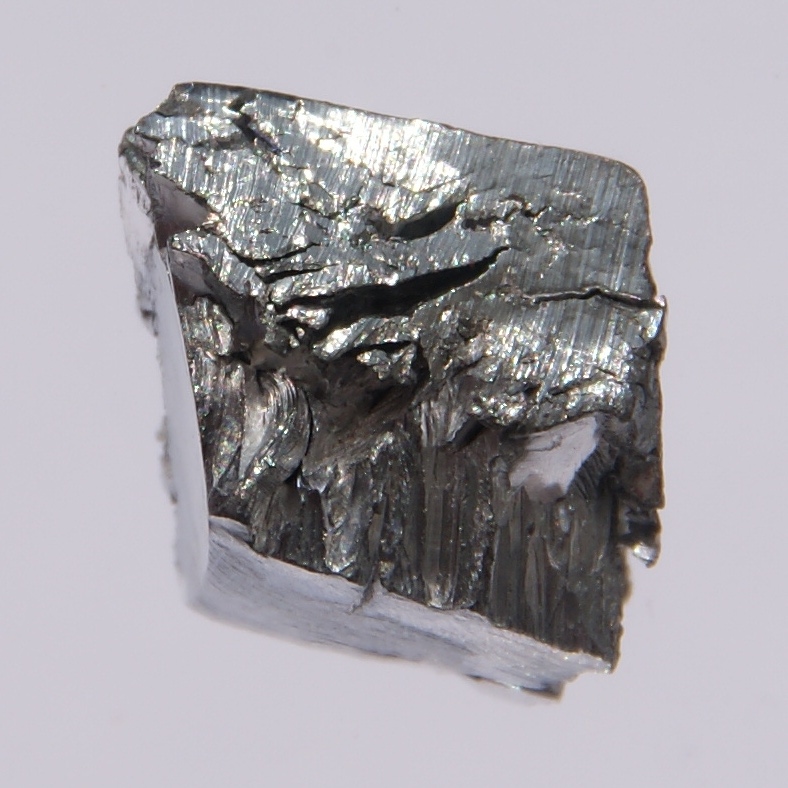
Lutetium closes the lanthanide series. It is the heaviest, densest and hardest of the rare earth metals, with the highest melting point of the group, and for a long time it was also the least useful. That has changed dramatically. A radioactive form, lutetium-177, is now attached to molecules that seek out cancer cells and deliver a dose of radiation to them from inside the body, a treatment that has transformed the outlook for some patients with prostate and neuroendocrine tumours.
The element is named after Lutetia, the Roman name for Paris, where Georges Urbain identified it in 1907. It was one of the last naturally occurring stable elements to be recognised, hidden for decades inside what chemists had taken to be pure ytterbium.
Where it is found
Lutetium is among the least abundant lanthanides, though still more common in the crust than silver. It never occurs as a free metal and forms no mineral of its own. Small amounts are present in monazite and xenotime, and the heavy rare earth clays of southern China supply most of the world's output. Because it is the final fraction in the separation sequence, only a handful of tonnes are produced each year.
The scarcity, the many purification steps and the small market together make lutetium one of the most expensive rare earths per gram.
How it was discovered
In 1907 three chemists working independently found that ytterbium, as isolated by Marignac thirty years earlier, was two elements. Georges Urbain in Paris named the new one lutecium, later spelt lutetium. Carl Auer von Welsbach in Vienna called it cassiopeium, a name that persisted in German literature into the 1950s. Charles James in New Hampshire had also separated it but had not yet published. The naming committee sided with Urbain.
The metal itself was not produced in pure form until 1953.
What we use it for
Targeted radionuclide therapy is the breakthrough use. Lutetium-177 has a half-life of about six and a half days and emits beta particles that travel only a couple of millimetres in tissue. Chemists attach it to a molecule that binds to a marker on cancer cells, such as PSMA on prostate cancer or somatostatin receptors on neuroendocrine tumours. The drug circulates, locks on to the tumour and irradiates it from within while sparing most healthy tissue. Two such treatments have been approved for routine use in recent years.
Lutetium also helps find cancer before it is treated. Lutetium oxyorthosilicate crystals are the scintillator of choice in many PET scanners, converting gamma rays from the patient into flashes of light with high efficiency and fast timing.
In geology the slow decay of lutetium-176 to hafnium-176, with a half-life around 37 billion years, provides a dating method for ancient rocks and meteorites. Lutetium compounds are also used as catalysts in petroleum refining and in some phosphors and lasers.
Reading the numbers
Lutetium melts at about 1652 °C and boils near 3402 °C, the highest melting point of any lanthanide and higher than titanium. Its density of 9.84 grams per cubic centimetre is the greatest in the series, nearly ten times that of water and well above iron. These records are consequences of the lanthanide contraction: as the 4f shell fills from lanthanum to lutetium, the atoms shrink steadily, and lutetium has the smallest atoms and the tightest packing of them all.
Its configuration is [Xe] 4f14 5d1 6s2. The 4f shell is full, so the chemistry is carried by the three outer electrons, giving a +3 ion and nothing else. That single 5d electron is why the table lists lutetium in the d-block, and why there is a long running debate about whether lutetium, rather than lanthanum, belongs in group 3 directly beneath yttrium. Its first ionisation energy of about 524 kJ/mol is the lowest of the heavy lanthanides, because the 5d electron is easier to remove than a 4f one, while the electronegativity of 1.27 is the highest in the series.
Safety and the environment
Lutetium compounds are of low toxicity and the metal is stable in air, though the powder is flammable. The naturally occurring isotope lutetium-176 is radioactive, but its half-life is so long that natural lutetium poses no radiation hazard. Lutetium-177 used in medicine is handled under strict radiation protection rules, and patients are given guidance on limiting close contact for a few days after treatment.
Production volumes are so small that lutetium has no meaningful environmental footprint of its own beyond the general impact of rare earth mining.
Did you know?
- Lutetium is the densest, hardest and highest melting of all the lanthanides, a direct result of having the smallest atoms in the series.
- Lutetium-177 based drugs bind to prostate cancer and neuroendocrine tumour cells and irradiate them from inside the body.
- The element was discovered independently by three chemists in 1907, and the German name cassiopeium remained in use for decades.
- Lutetium oxyorthosilicate crystals in PET scanners turn gamma rays into flashes of light that build the image.
- Natural lutetium-176 decays so slowly that geologists use it to date rocks and meteorites billions of years old.
- Whether lutetium or lanthanum should sit in group 3 beneath yttrium is still debated, and many modern tables place lutetium there.
More in the lanthanides
The nearest neighbours of lutetium in the family, by atomic number.
See all 15 lanthanides on one page, or browse all 118 elements.
Frequently asked questions
What is lutetium used for?
Its most important use is in medicine, where radioactive lutetium-177 is attached to targeting molecules to treat prostate cancer and neuroendocrine tumours. Lutetium based crystals are also used in PET scanners, and the element serves in catalysts and in dating ancient rocks.
Why is lutetium so expensive?
It is one of the scarcest lanthanides, occurs only as a trace in rare earth ores, and is the last fraction to emerge from a long separation process. Small demand means it is produced in very limited quantities, keeping the price per gram among the highest of the rare earths.
Is lutetium radioactive?
Natural lutetium contains about 2.6 per cent lutetium-176, which is radioactive but has a half-life of tens of billions of years, so the metal is safe to handle. Lutetium-177 used in cancer treatment is strongly radioactive and is made in reactors specifically for that purpose.
Is lutetium a lanthanide or a transition metal?
It is usually counted as the last lanthanide, but its full 4f shell and single 5d electron give it the electron structure of a d-block metal. Many chemists argue it belongs in group 3 under yttrium, and IUPAC has been reviewing the question.
Read next
Guess the mystery element in six tries. A new one every day, free, no sign-up.
Written by Anthony. Updated September 2026. Numerical data from Periodic-Table-JSON (CC BY-SA), cross-checked against the Lutetium reference article. Spotted an error? Tell us.