Ytterbium · element 70
The rare earth inside the most accurate clocks ever built and the lasers that cut steel
Key facts
The most precise timekeepers on Earth do not tick with quartz or caesium. Several of them use ytterbium. Atoms of ytterbium-171 held in a lattice of laser light absorb a very specific colour, and counting the oscillations of that light gives a clock that would drift by less than a second over the age of the universe.
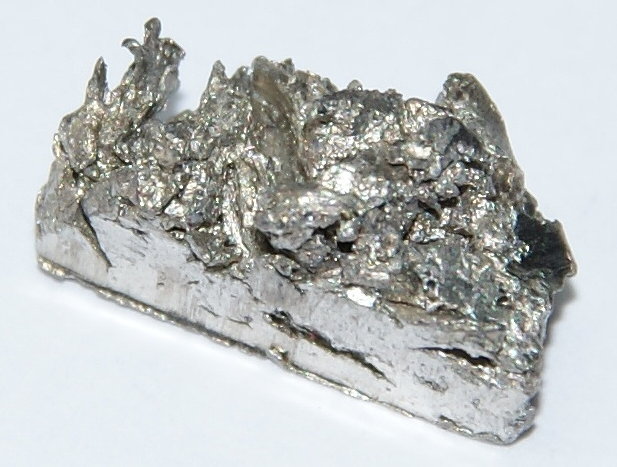
Ytterbium is a soft, silvery lanthanide named after the Ytterby quarry in Sweden, the fourth and last element to carry a piece of that village's name. In the metal, every one of its 4f orbitals is full, and that closed shell makes it lighter, softer and lower melting than its neighbours, more like a heavier version of calcium than a typical rare earth.
Where it is found
Ytterbium is found with the other rare earths in monazite, xenotime and bastnäsite, and in the heavy rare earth clays of southern China. It is one of the more common heavy lanthanides, comparable in crustal abundance to tin, and considerably more plentiful than thulium or lutetium.
Separation follows the usual route of solvent extraction, but ytterbium has a shortcut. Like europium, it can be reduced to a +2 ion that behaves quite differently from the +3 ions of its neighbours, and chemists can use this to pull it out of the mixture more easily. The metal is then made by reducing ytterbium oxide with lanthanum and distilling off the ytterbium, which boils at a far lower temperature.
How it was discovered
In 1878 the Swiss chemist Jean Charles Galissard de Marignac heated erbium nitrate until it decomposed, then extracted the residue and found a white oxide with a different atomic weight from erbia. He named it ytterbia.
Nearly thirty years later, in 1907, Georges Urbain in Paris and Carl Auer von Welsbach in Austria independently split ytterbia into two, revealing lutetium. The name ytterbium stayed with the larger portion.
What we use it for
Ytterbium doped fibre lasers are a workhorse of modern industry. Ytterbium ions emit near 1 micrometre with very high efficiency, and fibre lasers built around them deliver kilowatts of power in a beam that can be focused to a fine point. They cut and weld sheet steel and aluminium, mark parts, and drill tiny holes in medical devices.
Optical lattice clocks based on ytterbium-171 are among the most accurate measuring instruments ever made. They already outperform the caesium clocks that currently define the second, and the international community is moving towards a redefinition that could rest on ytterbium or a similar optical transition.
The isotope ytterbium-169, made in a reactor, is used as a portable gamma ray source for radiography of pipes and welds. Ytterbium's electrical resistance changes under pressure, so it has served in stress gauges that measure shock waves from explosions and earthquakes. Small amounts strengthen stainless steel, and ytterbium compounds are used in some infrared lasers and phosphors.
Reading the numbers
Ytterbium melts at about 824 °C and boils at roughly 1196 °C, the lowest boiling point of any lanthanide. Its density of 6.9 grams per cubic centimetre is well below iron and far below lutetium next door, which is over 9.8. These low values are the signature of a metal that shares only two electrons in its metallic bonding rather than three.
The configuration [Xe] 4f14 6s2 has a completely full 4f shell. Ytterbium gives up its two 6s electrons readily, but taking a third from the closed 4f shell costs more, so ytterbium(II) is unusually stable for a lanthanide. In most compounds it is still +3, but the +2 state is important in chemistry and in explaining the metal's properties. Its first ionisation energy of about 603 kJ/mol is the highest among the lanthanides before lutetium, reflecting that full shell. The electron affinity is slightly negative, meaning a neutral ytterbium atom will not hold an extra electron at all, which is exactly what you would expect of an atom with no empty low lying orbital to put it in.
Safety and the environment
Ytterbium compounds are of low toxicity and no biological role is known. The metal reacts slowly with air and water, and its powder is flammable. It is stored in sealed containers or under inert gas but is not otherwise hazardous. Ytterbium-169 sources are radioactive and used only in sealed, shielded form.
The element shares the environmental costs of rare earth extraction but is produced in modest volumes.
Did you know?
- Ytterbium optical lattice clocks are more accurate than the caesium clocks that currently define the second and may help redefine it.
- Ytterbium has the lowest boiling point of all the lanthanides, at roughly 1196 °C, which is exploited to purify it by distillation.
- Ytterbium doped fibre lasers cut and weld metal in factories worldwide, delivering kilowatts of power through a flexible glass fibre.
- Ytterbium is the fourth element named after Ytterby in Sweden, after yttrium, terbium and erbium.
- Ytterbium's electrical resistance changes measurably under pressure, so it has been used in gauges that record shock waves from explosions.
- Its electron affinity is slightly negative, meaning a neutral ytterbium atom will not accept an extra electron, a direct consequence of its completely full 4f shell.
More in the lanthanides
The nearest neighbours of ytterbium in the family, by atomic number.
See all 15 lanthanides on one page, or browse all 118 elements.
Frequently asked questions
What is ytterbium used for?
Its largest use is in ytterbium doped fibre lasers for cutting, welding and marking metal. It is also the basis of some of the world's most accurate atomic clocks, a portable gamma ray source in the form of ytterbium-169, and an additive to strengthen stainless steel.
Why is ytterbium used in atomic clocks?
Ytterbium-171 atoms have an optical transition that is extremely narrow and insensitive to disturbance, and they can be trapped in large numbers in a lattice of laser light. Counting the oscillations of that light gives a clock far more stable than caesium based designs.
Why is ytterbium softer and lighter than other rare earths?
Its 4f shell is completely full, so the metal shares only two electrons in its bonding instead of the three that most lanthanides use. Weaker bonding means larger spacing between atoms, lower density, lower melting and boiling points, and a softer metal.
How did ytterbium get its name?
Marignac named the oxide ytterbia in 1878 after Ytterby, the Swedish village whose quarry produced the mineral in which the rare earths were first found. Yttrium, terbium and erbium share the same origin.
Read next
Guess the mystery element in six tries. A new one every day, free, no sign-up.
Written by Anthony. Updated September 2026. Numerical data from Periodic-Table-JSON (CC BY-SA), cross-checked against the Ytterbium reference article. Spotted an error? Tell us.