Holmium · element 67
The most magnetic element in nature, and the working end of the laser that shatters kidney stones
Key facts
If you have had a kidney stone broken up without surgery in recent years, there is a good chance a holmium laser did the work. A thin fibre carried pulses of infrared light down a scope to the stone, and each pulse turned a little of the surrounding water into a shock that cracked the stone into fragments small enough to pass. The wavelength that makes this possible comes straight from the electrons of holmium ions.
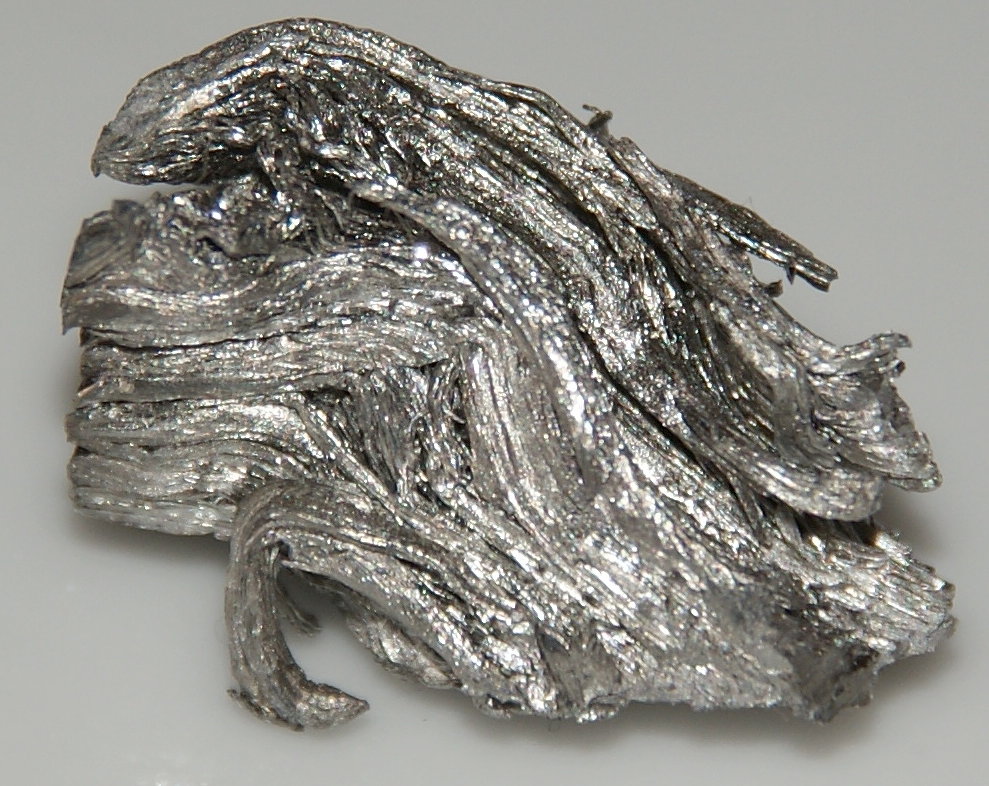
Holmium is a soft, silvery lanthanide named after Stockholm, the city where much of its early chemistry was done. It has the highest magnetic moment of any naturally occurring element, though the metal only becomes ferromagnetic when cooled far below freezing. Even so, that property has found real uses in the most powerful magnets and in experiments on storing data one atom at a time.
Where it is found
Holmium is one of the scarcer lanthanides, present at low levels in monazite, xenotime and bastnäsite, and in the heavy rare earth clays of southern China that supply most of the world's dysprosium and terbium. It is separated by the same multi-stage solvent extraction used for its neighbours, and is typically produced in tonnes per year rather than the thousands of tonnes that neodymium reaches.
How it was discovered
Holmium was found twice within a year. In 1878 the Swiss chemists Marc Delafontaine and Jacques-Louis Soret noticed absorption bands in the spectrum of erbium oxide that did not belong to erbium and reported a new element they called simply Element X. In 1879 the Swedish chemist Per Teodor Cleve, working independently on the same erbium oxide, separated two new oxides and named one holmia for Holmia, the Latin name of Stockholm. The other was thulia, the oxide of thulium.
Cleve's holmia was still not pure. In 1886 Lecoq de Boisbaudran showed that it contained yet another element, dysprosium. The tangled story shows how the rare earths were unpicked: not by finding a new mineral, but by looking ever more closely at the spectrum of a sample everyone thought was already understood.
What we use it for
The holmium laser is the headline application. Holmium ions doped into a yttrium aluminium garnet crystal emit light at about 2.1 micrometres, a wavelength that water absorbs strongly. Because the body is mostly water, the energy is deposited within a fraction of a millimetre of the fibre tip, making the laser precise and safe for cutting or vaporising tissue and fragmenting stones. Ho:YAG lasers are standard tools in urology and are also used in orthopaedics and dentistry.
Holmium's magnetism is put to work in the strongest laboratory magnets. Pole pieces made of holmium concentrate the field produced by the surrounding coils, squeezing more field strength into the working gap. In 2017 researchers demonstrated that a single holmium atom on a surface could hold a magnetic bit, a proof of principle for extremely dense data storage.
Holmium oxide has sharp, well defined absorption peaks, so glass containing it is used as a wavelength calibration standard for spectrophotometers. The same oxide gives a yellow or reddish tint to glass and to cubic zirconia gemstones.
Reading the numbers
Holmium melts at about 1461 °C and boils near 2600 °C. Its melting point is comparable to that of stainless steel, and its density of 8.79 grams per cubic centimetre is somewhat higher than iron, continuing the steady climb across the lanthanide series as atoms get smaller and heavier.
Its electron configuration is [Xe] 4f11 6s2. In the +3 ion that leaves ten 4f electrons, four of them unpaired, and the way their spins and orbital motions combine gives holmium(III) the highest magnetic moment of any ion in the series. Chemically it is a standard trivalent rare earth, with a first ionisation energy of about 581 kJ/mol and an electronegativity of 1.23. Natural holmium consists of a single stable isotope, holmium-165, which is why its atomic mass of 164.93 is so close to a whole number.
Safety and the environment
Holmium compounds are of low toxicity and the element has no known biological role. The metal tarnishes slowly in dry air and more quickly when damp, and the powder is flammable, so it is stored under inert conditions.
As a minor product of heavy rare earth mining, holmium shares the environmental footprint of that industry, including acid leaching waste and radioactive thorium from monazite. Its small production volume means it is not itself a significant pollutant.
Did you know?
- Holmium has the highest magnetic moment of any naturally occurring element, though the metal itself is only ferromagnetic when cooled far below room temperature.
- Holmium lasers are the standard tool for breaking kidney stones because their 2.1 micrometre light is absorbed almost instantly by water.
- Holmium was discovered twice in quick succession, first as Element X by Delafontaine and Soret in 1878, then by Cleve in 1879, who named it after Stockholm.
- Holmium oxide glass is used to calibrate laboratory spectrophotometers because its absorption peaks fall at very precisely known wavelengths.
- In 2017 researchers stored a magnetic bit of information on a single holmium atom, the smallest magnetic memory ever demonstrated at the time.
More in the lanthanides
The nearest neighbours of holmium in the family, by atomic number.
See all 15 lanthanides on one page, or browse all 118 elements.
Frequently asked questions
What is holmium used for?
The most common use is in holmium lasers for surgery, especially for breaking up kidney stones and treating enlarged prostates. Holmium is also used to concentrate magnetic fields in powerful magnets, as a wavelength standard in holmium oxide glass, and as a colourant in glass and cubic zirconia.
Why is holmium used in lasers?
Holmium ions emit infrared light at around 2.1 micrometres when placed in a suitable crystal, and water absorbs that wavelength very strongly. The energy is delivered to a tiny volume of tissue right at the fibre tip, making cutting and stone fragmentation precise while limiting damage nearby.
Is holmium the most magnetic element?
Holmium has the highest magnetic moment of any naturally occurring element, meaning each atom behaves like a very strong tiny magnet. However, holmium metal only lines those atomic magnets up into a permanent magnet at very low temperatures, so at room temperature it is not magnetic in the way iron is.
How did holmium get its name?
Per Teodor Cleve named it holmia in 1879 after Holmia, the Latin name for Stockholm, where he worked. It was one of two new elements he found hidden in erbium oxide; the other became thulium.
Read next
Guess the mystery element in six tries. A new one every day, free, no sign-up.
Written by Anthony. Updated September 2026. Numerical data from Periodic-Table-JSON (CC BY-SA), cross-checked against the Holmium reference article. Spotted an error? Tell us.