Dysprosium · element 66
Named 'hard to get at', now the metal electric cars and wind turbines cannot do without
Key facts
When Paul-Émile Lecoq de Boisbaudran finally isolated element 66 in 1886, he had been through dozens of rounds of dissolving and precipitating his sample. He named his prize dysprosium, from the Greek for hard to get at. The name has proved prophetic. More than a century later, dysprosium is one of the elements that governments and manufacturers worry about most, because modern electric motors need it and only a few places in the world supply it.
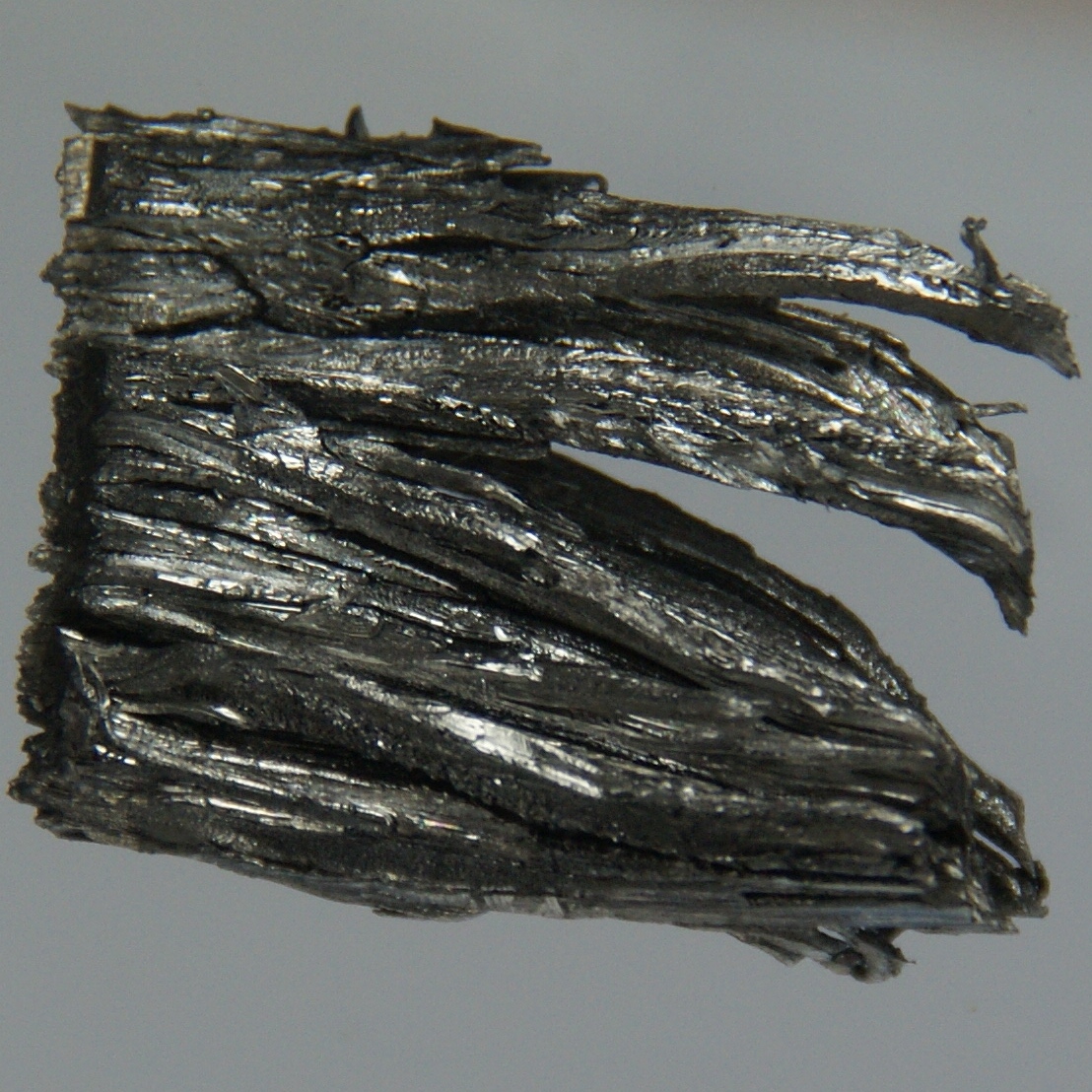
Dysprosium is a bright, silvery metal, soft enough to cut with a knife, that tarnishes slowly in air. Alongside its neighbour holmium it has one of the strongest magnetic moments of any element, and that magnetism, rather than any chemical trick, is what makes it valuable.
Where it is found
Dysprosium is never found as a free metal. It occurs in small quantities in monazite, bastnäsite and xenotime, and in the ion adsorption clays of southern China, which have become the dominant commercial source of the heavy rare earths.
In the Earth's crust dysprosium is roughly as abundant as tin or boron. The problem is not the total amount but its dilution and its concentration in few mining regions. Projects in Australia, the United States, Canada and Africa are working to broaden supply, and recycling old magnets is becoming a serious business.
How it was discovered
By the 1880s chemists were pulling rare earth oxides apart with a kind of chemical patience that is hard to imagine now. Working in Paris with a sample of holmium oxide, Lecoq de Boisbaudran carried out repeated partial precipitations with ammonia, examining the spectrum of each fraction. After more than thirty cycles he separated an oxide with its own spectral lines and announced dysprosium.
Lecoq de Boisbaudran had already discovered gallium and samarium, and his skill with the spectroscope made him one of the most successful element hunters of the century. Pure dysprosium metal, like most rare earths, waited for the ion exchange methods developed in the 1950s.
What we use it for
The most important use is in permanent magnets. Neodymium iron boron magnets are the strongest available, but they lose their magnetism as they warm up. Replacing a few per cent of the neodymium with dysprosium raises the temperature at which the magnet keeps working, which is essential in the motors of electric and hybrid cars and in the generators of large wind turbines, both of which run hot. A single large turbine can contain many kilograms of dysprosium.
Dysprosium is also a component of Terfenol-D, the magnetostrictive alloy used in sonar and actuators. In nuclear reactors, dysprosium oxide combined with nickel or titanium makes control rods that absorb neutrons steadily over a long life without swelling.
Its compounds appear in lasers, in infrared sources for chemical analysis, and in the glow-in-the-dark material strontium aluminate, where dysprosium helps store energy so the green glow lasts for hours. Dysprosium-165, a short lived isotope, has been used to treat inflamed joints.
Reading the numbers
Dysprosium melts at around 1407 °C and boils near 2567 °C. Its melting point is higher than that of iron, and it is a little denser than iron at 8.54 grams per cubic centimetre, in keeping with the gradual increase in density along the lanthanide row.
The configuration [Xe] 4f10 6s2 gives dysprosium ten 4f electrons, four of them unpaired in the +3 ion. That large number of unpaired electrons, combined with strong orbital contributions, produces a very high magnetic moment, which is why dysprosium and holmium are the most magnetic of the lanthanide ions at low temperature. Its first ionisation energy of about 573 kJ/mol and electronegativity of 1.22 are unremarkable for the series, confirming that dysprosium's special value lies in physics rather than chemistry. Its atomic mass of 162.5 reflects a mix of seven stable isotopes.
Safety and the environment
Dysprosium and its salts are of low toxicity, and no biological role is known. The metal powder can ignite in air and dysprosium reacts with water to release hydrogen, so the pure element is handled with ordinary care for reactive metals.
The larger concern is environmental and geopolitical. Extracting heavy rare earths from clay deposits has polluted rivers and farmland in parts of China, and the world's dependence on a small number of sources has made dysprosium a focus of critical materials strategies in Europe, the United States and Japan. Manufacturers are working to reduce the dysprosium content of magnets and to recover it from scrap motors and hard drives.
Did you know?
- Dysprosium's name means hard to get at in Greek, chosen after its discoverer needed more than thirty rounds of purification to isolate it.
- Adding a small amount of dysprosium lets neodymium magnets keep working at the high temperatures inside electric car motors and wind turbine generators.
- Together with holmium, dysprosium has one of the strongest magnetic moments of any element.
- Dysprosium is regularly ranked among the elements at greatest risk of supply shortage because most of it comes from a few clay deposits in southern China.
- Dysprosium helps glow-in-the-dark strontium aluminate store energy so that it can keep shining for hours after the lights go out.
- Dysprosium titanate control rods are used in some reactors because dysprosium absorbs neutrons steadily without swelling or producing troublesome gases.
More in the lanthanides
The nearest neighbours of dysprosium in the family, by atomic number.
See all 15 lanthanides on one page, or browse all 118 elements.
Frequently asked questions
What is dysprosium used for?
Its main use is as an additive in neodymium magnets, where it helps them keep their strength at high temperatures in electric vehicle motors and wind turbines. It is also used in nuclear control rods, magnetostrictive alloys, lasers and long lasting glow-in-the-dark materials.
Why is dysprosium so important for electric cars?
Motors in electric cars run hot, and pure neodymium magnets weaken as they heat up. Substituting a few per cent of dysprosium raises the temperature limit, so the motor stays efficient. Without dysprosium the magnets would need to be larger or cooled more aggressively.
Is dysprosium rare?
It is about as abundant in the Earth's crust as tin, so it is not rare in absolute terms. It is, however, thinly spread and concentrated in few workable deposits, mostly in southern China, which makes supply tight and prices volatile.
What does the name dysprosium mean?
It comes from the Greek word dysprositos, meaning hard to get at or difficult to obtain. Lecoq de Boisbaudran chose it in 1886 after an exhausting series of purification steps was needed to separate the element from holmium.
Read next
Guess the mystery element in six tries. A new one every day, free, no sign-up.
Written by Anthony. Updated September 2026. Numerical data from Periodic-Table-JSON (CC BY-SA), cross-checked against the Dysprosium reference article. Spotted an error? Tell us.