Polonium · element 84
Found by Marie Curie and named for her homeland, a metal so radioactive a small piece warms itself to a glow
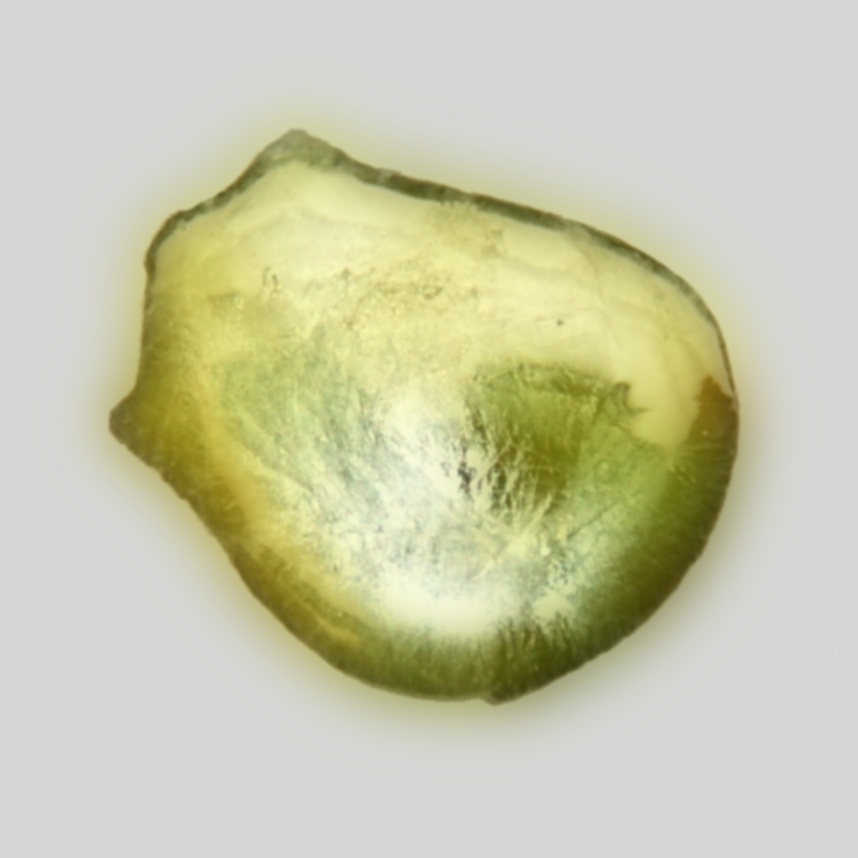
Key facts
Polonium was the first element ever discovered through its radioactivity. In 1898 Marie and Pierre Curie found that a sample of uranium ore was giving off far more radiation than its uranium could explain, and chased the excess to a new element. Marie named it after Poland, her homeland, which at the time did not exist as an independent country; it was the first element named to make a political point.
More than a century later polonium remains one of the most dangerous substances known. A speck too small to see is a lethal dose if swallowed or inhaled, and it is made in only a few nuclear reactors worldwide.
Where it is found
Polonium is constantly being created and destroyed in the Earth's rocks. It is a link in the chain of decays that turns uranium-238 into stable lead, so uranium ores contain traces of it, around a tenth of a milligram per tonne, but because polonium-210 has a half-life of just 138 days it never accumulates.
Tiny amounts also reach the air, soil and plants as radon gas decays, and tobacco leaves pick up polonium from the atmosphere and from phosphate fertilisers; this natural polonium in cigarette smoke is thought to add to smokers' lung cancer risk. Commercial polonium is made artificially, by placing bismuth-209 in a nuclear reactor, where it captures a neutron and decays to polonium-210. World production is a few hundred grams a year, mostly in Russia.
How it was discovered
Working in a converted shed in Paris, the Curies dissolved pitchblende, the black uranium ore, and separated its components chemically, measuring the radioactivity of each fraction with an electrometer Pierre had designed. One fraction that stuck with bismuth was hundreds of times more active than uranium. In July 1898 they announced a new element, before they had isolated a single visible grain of it.
That took decades. Polonium is so scarce and decays so quickly that useful quantities only became available once nuclear reactors could manufacture it. Marie Curie received her second Nobel Prize, for chemistry in 1911, for the discovery of polonium and radium.
What we use it for
Polonium-210 fires out alpha particles at a furious rate, ionising the air around it. That made polonium useful in anti-static brushes and in devices that remove static from photographic film, paper and textiles, though most have been replaced by safer designs. Mixed with beryllium it produces neutrons, and polonium-beryllium initiators triggered the first atomic bombs.
The energy it releases as heat, around 140 watts per gram, made it a compact heater, and the Soviet Lunokhod rovers that drove across the Moon in the early 1970s used polonium-210 to keep their electronics warm through the two week lunar night. Its notoriety today comes from its use as a poison: in 2006 the former Russian intelligence officer Alexander Litvinenko died in London after drinking tea laced with polonium-210.
Reading the numbers
Polonium melts at about 254 °C and boils near 960 °C, both low for a metal and similar to its neighbours lead and bismuth. That low boiling point, combined with its heat output, means polonium tends to vaporise and spread, which makes it hard to contain. Its density of 9.2 grams per cubic centimetre is a little less than bismuth.
The atomic mass is listed as a whole number, 209, because polonium has no stable isotopes; the figure is the mass number of the longest lived one, polonium-209, with a half-life of about 125 years. The electron configuration [Xe] 4f14 5d10 6s2 6p4 gives six outer electrons and places it in group 16 with oxygen, sulfur, selenium and tellurium. Down that group the elements become steadily more metallic, and polonium is the first that is a true metal, conducting electricity like one. It is also the only element whose room temperature crystal structure is a simple cube, with one atom at each corner.
Safety and the environment
Alpha particles cannot pass through skin or a sheet of paper, so polonium outside the body is not very dangerous. Inside the body it is catastrophic. Every alpha particle dumps its energy into the surrounding cells, and polonium-210 is estimated to be hundreds of thousands of times more toxic by weight than cyanide. A dose of a few micrograms, invisible to the eye, is fatal.
Polonium is handled only in sealed glove boxes under strict licensing. Its short half-life means contamination fades within a few years, so it is not a long term pollutant, and for most people the only meaningful exposure is the natural polonium in the air from radon decay and in tobacco smoke.
Did you know?
- Polonium was the first element discovered by detecting its radioactivity, and the first named to draw attention to a political cause.
- A gram of polonium-210 releases about 140 watts of heat and can warm itself until it glows.
- Polonium is the only element whose stable room temperature form has a simple cubic crystal structure.
- Soviet Lunokhod moon rovers used polonium-210 heaters to survive the freezing lunar night.
- Tobacco smoke contains natural polonium-210, absorbed by the leaves from the air and from fertiliser.
- Polonium-210 is estimated to be around 250,000 times more toxic than hydrogen cyanide, weight for weight.
More in the post-transition metals
Column-mates come first, since elements in one column have outer electrons arranged in a similar way and tend to behave alike; the rest are the nearest neighbours in the family.
See all 12 post-transition metals on one page, or browse all 118 elements.
Frequently asked questions
Why is polonium so dangerous?
Polonium-210 emits alpha particles extremely rapidly, and once inside the body those particles destroy nearby cells. Its short half-life means a tiny mass carries enormous radioactivity, so a few micrograms can be fatal. Outside the body, the alpha particles are stopped by skin.
Where does polonium come from?
Small natural amounts form continuously as uranium in rocks decays. The polonium used in industry and research is made in nuclear reactors by bombarding bismuth with neutrons. Only a few hundred grams are produced worldwide each year.
Is there really polonium in cigarettes?
Yes. Tobacco leaves collect polonium-210 from the atmosphere, where it forms as radon decays, and from phosphate fertilisers. The amounts are tiny, but smokers inhale them directly into the lungs, and it is one of several ways smoking causes cancer.
Who was polonium named after?
Not a person but a country. Marie Curie, born Maria Sklodowska in Warsaw, named it after Poland, which in 1898 was divided between Russia, Prussia and Austria. She hoped the name would draw attention to her homeland's lack of independence.
Read next
Guess the mystery element in six tries. A new one every day, free, no sign-up.
Written by Anthony. Updated September 2026. Numerical data from Periodic-Table-JSON (CC BY-SA), cross-checked against the Polonium reference article. Spotted an error? Tell us.