Astatine · element 85
The rarest natural element on Earth, so scarce that no one has ever seen a visible piece of it
Key facts
Astatine is the element that exists mostly on paper. Its name comes from the Greek astatos, meaning unstable, and it earns it: the longest lived isotope, astatine-210, has a half-life of just over eight hours. Every atom of astatine that ever formed in the Earth's rocks vanished within a day or two of appearing.
Add up all the astatine on the planet at any moment and you get a few tens of grams at most, scattered atom by atom through uranium ores. Nobody has ever collected enough to look at; if they did, its own radioactivity would heat it until it boiled away.
Where it is found, and why there is almost none
Astatine forms naturally as a fleeting step in the decay chains of uranium and thorium. Isotopes such as astatine-218 and astatine-219 appear for seconds or minutes before decaying onward. Because they are destroyed almost as soon as they are made, astatine is generally regarded as the rarest element that occurs on Earth outside the laboratory.
All the astatine ever studied has been made artificially, usually by firing alpha particles at a bismuth-209 target in a cyclotron to produce astatine-211, which has a half-life of about seven hours. Total production runs to fractions of a microgram, and even that must be used within a day.
How it was discovered
Element 85 was a blank in the periodic table for decades, and several chemists announced they had filled it. In the 1930s an American researcher claimed alabamine, named after his home state, and other groups proposed dakin and dor. None survived scrutiny.
The real discovery came in 1940 at the University of California, Berkeley, where Dale Corson, Kenneth MacKenzie and Emilio Segrè bombarded bismuth with alpha particles from the 60-inch cyclotron and detected a new element with the chemistry of a halogen. Segrè had already helped discover technetium and later won a Nobel Prize for the antiproton. The team waited until after the Second World War to name it, settling on astatine in 1947, and small traces were confirmed in natural minerals in 1943.
What we use it for
Astatine has one serious use, and it is a promising one. Astatine-211 emits alpha particles, which travel only a few cell widths in tissue and cause intense local damage. Attached to an antibody or small molecule that homes in on cancer cells, it can destroy a tumour while sparing the tissue around it. Clinical trials for leukaemia, brain tumours and ovarian cancer are under way at a handful of hospitals near cyclotrons able to make it.
Its seven hour half-life is almost ideal: long enough to prepare and inject, short enough that the radioactivity is gone from the patient within a couple of days. The obstacle is supply, since very few facilities can produce it, and chemists are still learning how to attach it firmly enough that it does not come loose in the body.
Reading the numbers
Every physical figure for astatine is an estimate, because no one has ever had enough to measure. The melting point of about 300 °C and boiling point near 340 °C are extrapolated from the trend down the halogens, where iodine melts at 114 °C and boils at 184 °C. The density of 6.35 grams per cubic centimetre is likewise a prediction, a step up from iodine's 4.9, and the atomic mass of 210 is the mass number of the longest lived isotope rather than a measured average.
The electron configuration [Xe] 4f14 5d10 6s2 6p5 leaves the outer shell one electron short of full, the signature of group 17, the halogens. Yet astatine is a reluctant halogen. Its electronegativity of 2.2 is the lowest in the group, so it is less keen to grab an electron than iodine, and in solution it sometimes behaves like a metal, forming positive ions. Calculations suggest solid astatine might even be metallic rather than made of At2 molecules like iodine, which is why it is often filed as a metalloid. Its first ionisation energy, 899 kJ/mol, was only measured experimentally in 2013, at CERN.
Safety and the environment
The hazard from astatine is purely radiological. It is an alpha emitter, harmless outside the body but damaging inside, and like iodine it concentrates in the thyroid gland. Researchers handle it behind shielding and hospitals treat it with the same care as other radiopharmaceuticals.
Its short half-life is an environmental blessing. Waste from astatine production or therapy is effectively inert within a week or two, and the natural traces in rocks are too small to matter. There has never been enough astatine to pollute anything.
Did you know?
- The total amount of astatine in the Earth's crust at any moment is estimated at less than about 30 grams.
- Astatine's name comes from the Greek word for unstable; its most durable isotope lasts just eight hours before half of it has decayed.
- A visible lump of astatine has never existed, because its own radioactivity would heat it until it vaporised.
- Before its true discovery in 1940, element 85 was falsely claimed under the names alabamine, dakin and dor.
- The first ionisation energy of astatine was not measured experimentally until 2013, at CERN.
- Astatine-211 is being tested as a cancer treatment that delivers alpha particles directly to tumour cells.
More in the halogens
These share a column with astatine, so their outer electrons are arranged in a similar way and they tend to behave alike.
See all 6 halogens on one page, or browse all 118 elements. Also listed under the metalloids.
Frequently asked questions
Why is astatine so rare?
It only forms as a brief intermediate when uranium and thorium decay, and every isotope is itself radioactive with a half-life of hours or less. Atoms are destroyed almost as fast as they appear, so the total on Earth never exceeds a few tens of grams.
What colour is astatine?
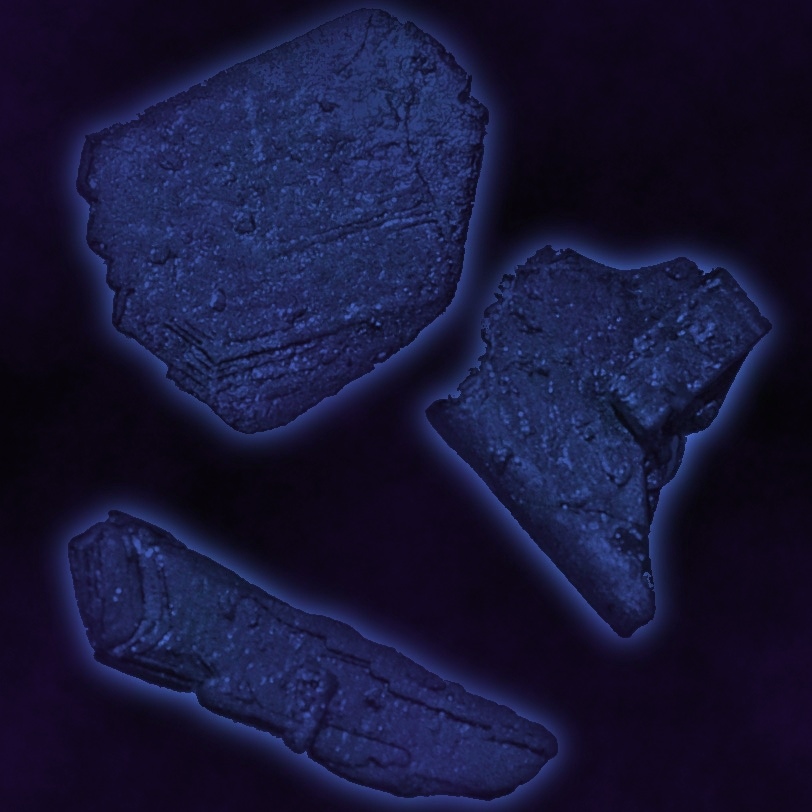
Nobody knows for certain because no visible quantity has ever been made. Following the trend from iodine, which is nearly black with a metallic sheen, astatine is expected to be a dark, possibly metallic looking solid.
Is astatine a metal or a non-metal?
It sits on the boundary. Its electron structure makes it a halogen like iodine, but it has the lowest electronegativity in the group and sometimes forms positive ions like a metal. Calculations suggest the solid might be metallic, so it is often classed as a metalloid.
What is astatine used for?
Its only practical application is experimental cancer therapy using astatine-211, an alpha emitter that can be attached to molecules targeting tumour cells. Beyond that it is studied purely for research into the chemistry of very heavy elements.
Read next
Guess the mystery element in six tries. A new one every day, free, no sign-up.
Written by Anthony. Updated September 2026. Numerical data from Periodic-Table-JSON (CC BY-SA), cross-checked against the Astatine reference article. Spotted an error? Tell us.