Radon · element 86
An invisible radioactive gas that seeps from the ground into homes and is the second biggest cause of lung cancer
Key facts
Radon is the noble gas nobody wants in the house. It is colourless, odourless and chemically almost inert, so you would never notice it. But it is radioactive, and it rises continuously out of the ground wherever rocks contain traces of uranium. In poorly ventilated buildings it collects, and breathing it over years is the second biggest cause of lung cancer after smoking.
Radon is also a curiously heavy gas, about eight times denser than air, and the element that completes period 6 of the periodic table.
Where it is found
Radon is made wherever there is radium, and radium is present in tiny amounts in almost all rock and soil as part of the uranium decay chain. The main isotope, radon-222, has a half-life of 3.8 days, long enough to migrate through cracks in the ground and into buildings through floors and gaps around pipes. Outdoors it is diluted to harmless levels; indoors it can build up.
Granite regions have the highest levels. In the UK that means Cornwall and Devon above all, along with parts of Derbyshire, Northamptonshire, Wales and Aberdeenshire. Radon also dissolves in groundwater and is released when well water is heated. Radon concentration is measured in becquerels per cubic metre; the average UK home has about 20, and action is recommended above 200.
How it was discovered
Radon was discovered in stages. In 1899 Ernest Rutherford and Robert Owens noticed that thorium compounds gave off a radioactive gas, now known as radon-220. In 1900 Friedrich Ernst Dorn in Germany found that radium did the same, releasing what he called radium emanation, the isotope we now call radon-222, and he is usually credited with the discovery.
William Ramsay and Robert Whytlaw-Gray collected enough of the gas in 1910 to measure its density and show it was the heaviest gas known. Ramsay named it niton, from the Latin for shining, because the gas glowed in the dark; the name radon was adopted in 1923. Rutherford's work with these emanations led directly to his theory of radioactive half-life.
What we use it for
Radon has almost no uses today, and its history is a cautionary tale. In the early twentieth century it was sold as a health tonic: people drank radon water, bathed in radon spas and sat in radon caves, believing the radiation was invigorating. Some spas still promote it, though the medical evidence is against them.
Doctors once sealed radon into tiny gold tubes and implanted them in tumours, an early form of internal radiotherapy later replaced by safer isotopes. Today radon serves science as a tracer: its short half-life lets researchers track air movement in the atmosphere and water underground, and changes in radon levels are studied as possible warnings of earthquakes.
Reading the numbers
Radon liquefies at minus 62 °C and freezes at minus 71 °C, so it is a gas everywhere people live, with only nine degrees separating its liquid and solid states. Its density of 9.73 grams per litre makes it the heaviest gaseous element, roughly eight times denser than air, and heavy gases tend to pool in low spaces, which adds to its tendency to collect in cellars and ground floors.
The electron configuration [Xe] 4f14 5d10 6s2 6p6 shows a complete outer shell of eight electrons, the defining feature of group 18, the noble gases, so radon is chemically almost inert, though radon fluoride has been made. Its first ionisation energy of 1037 kJ/mol is the lowest of the noble gases, less than half that of helium, following the trend that larger noble gases hold their outer electrons less tightly. The atomic mass of 222 is simply the mass number of the longest lived isotope, since radon has no stable ones.
Safety and the environment
Radon itself is mostly breathed in and out again. The damage is done by its decay products, short lived isotopes of polonium, lead and bismuth, which are solids that stick to dust, lodge in the lungs and fire alpha particles into the lining. Over years this raises the risk of lung cancer, and the risk is far higher for smokers.
In the UK radon is estimated to contribute to over a thousand lung cancer deaths a year. Testing is cheap: a small plastic detector left in the house for three months records the alpha particle tracks. If levels are high, a sump under the floor with a small fan, better sealing and improved ventilation can cut them sharply, and new homes in affected areas are built with radon-proof membranes.
Did you know?
- Radon is the densest gas among the elements, about eight times heavier than air.
- For the average person in the UK, radon accounts for roughly half of all the radiation dose they receive in a year.
- In the early 1900s radon was marketed as a health cure, sold in drinking water and offered in spa treatments.
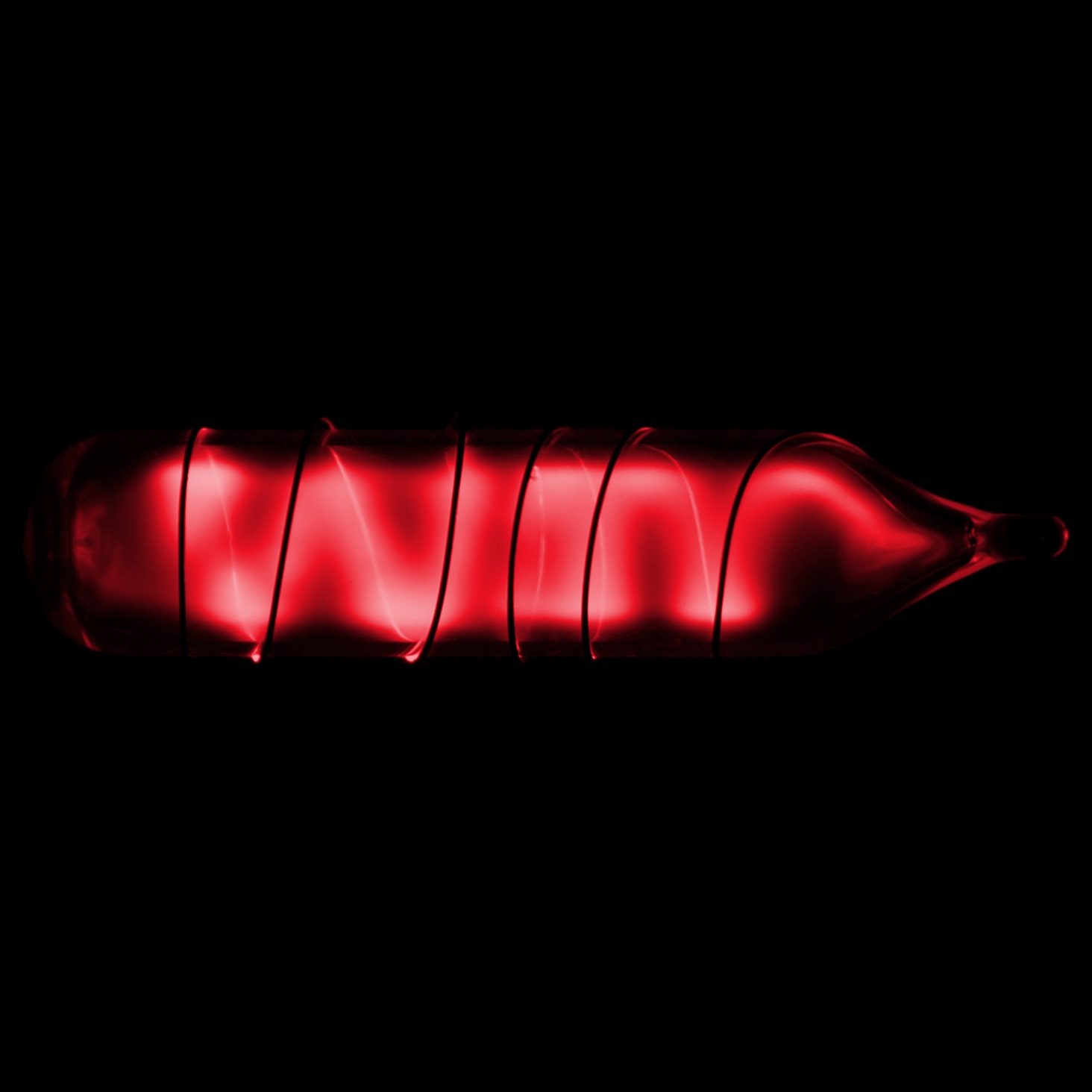
- When radon is cooled to a liquid or solid it glows, because its intense radioactivity excites the surrounding atoms.
- William Ramsay wanted to call radon niton, meaning the shining one; the current name was adopted in 1923.
- Radon detectors work by counting the microscopic pits that alpha particles leave in a piece of plastic.
More in the noble gases
These share a column with radon, so their outer electrons are arranged in a similar way and they tend to behave alike.
See all 7 noble gases on one page, or browse all 118 elements.
Compare Radon with another element
Each comparison has a side-by-side data table and a plain-English summary of the differences.
Frequently asked questions
How do I know if my house has radon?
You cannot see, smell or taste it, so the only way is to test. A passive detector, left in the home for three months and posted back to a laboratory, gives a reliable reading. UK public health bodies publish maps showing areas where testing is recommended.
Is radon dangerous?
Over long periods, yes. Breathing radon and its decay products is the leading cause of lung cancer among non-smokers and greatly increases the risk for smokers. Short exposures are not a concern; the risk builds over years of living with high levels.
Where in the UK is radon highest?
Cornwall and Devon have the highest levels because of their granite, followed by parts of Derbyshire, Northamptonshire, the Yorkshire Dales, Wales and north east Scotland. Levels can vary greatly between neighbouring houses, so a map only shows the likelihood, not the actual level in a given home.
Can you smell radon?
No. Radon is a colourless, odourless and tasteless gas, which is exactly what makes it hard to detect. The only way to know it is present is with a radon detector.
Read next
Guess the mystery element in six tries. A new one every day, free, no sign-up.
Written by Anthony. Updated September 2026. Numerical data from Periodic-Table-JSON (CC BY-SA), cross-checked against the Radon reference article. Spotted an error? Tell us.