Rhenium · element 75
One of the rarest metals on Earth, the last stable element found, and the secret ingredient in jet engine blades
Key facts
Rhenium is so scarce that there is no rhenium mine anywhere in the world. Every gram comes as a by-product, scraped from the flue dust of plants roasting molybdenum ores, which are themselves usually a by-product of copper mining. Despite that, the aviation industry cannot do without it, because a few per cent of rhenium in a nickel alloy lets a turbine blade survive temperatures that would otherwise destroy it.
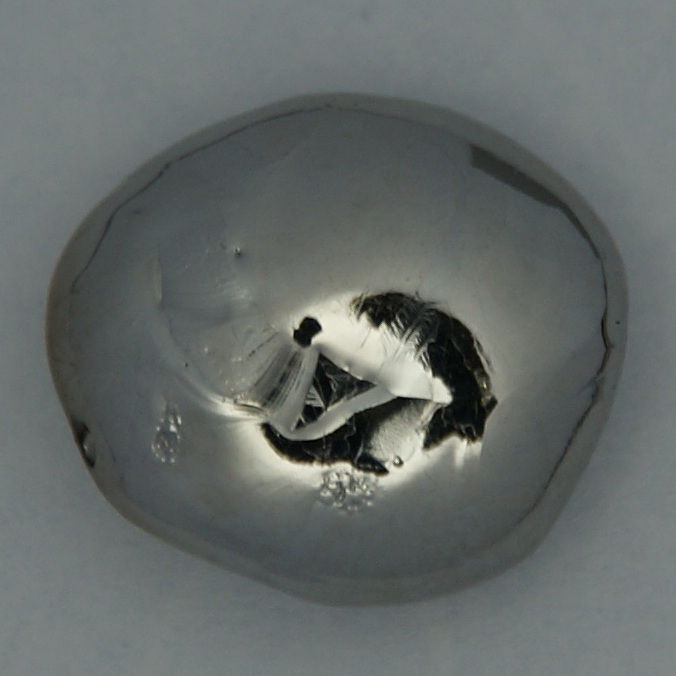
It was the last element with a stable isotope to be discovered, found in 1925 by German chemists who named it after the River Rhine. Rhenium is a dense, silvery grey metal with the third highest melting point of any element and, by most measurements, the highest boiling point of them all.
Where it is found
Rhenium is among the rarest elements in the Earth's crust, at roughly one part per billion. It forms no minerals of its own in any useful quantity, but it substitutes readily for molybdenum in the sulfide mineral molybdenite. When molybdenite concentrates from copper mines are roasted, the rhenium leaves as a volatile oxide and is captured from the exhaust gases and purified.
Chile is the leading producer, followed by the United States, Poland, Kazakhstan and a few others. Because supply is locked to copper and molybdenum output, rhenium prices can swing wildly. A price squeeze in the late 2000s prompted engine makers to develop alloys using less of it and to recycle scrap blades.
How it was discovered
In 1925 Walter Noddack, Ida Tacke and Otto Berg, working in Berlin, detected element 75 by X-ray spectroscopy in samples of platinum ore and the mineral columbite. They named it rhenium after the Rhine. It was the last stable element to be found; everything discovered since has been radioactive.
There is a twist. In 1908 the Japanese chemist Masataka Ogawa announced a new element he called nipponium and assigned it to position 43. His claim was rejected, but a re-examination of his samples and photographic plates in the early 2000s showed he had almost certainly isolated rhenium, element 75, seventeen years before Noddack's team.
What we use it for
The great majority of rhenium goes into nickel based superalloys for the hottest parts of jet engines and gas turbines. Adding three to six per cent rhenium slows the movement of atoms within the alloy at high temperature, so turbine blades resist creep and keep their shape for thousands of hours in gas hotter than their own melting point, protected by cooling channels and ceramic coatings.
The second major use is in catalysts. Platinum rhenium catalysts reform low grade petroleum fractions into high octane petrol and last far longer than platinum alone. Rhenium also appears in thermocouples paired with tungsten for measuring temperatures above 2000 °C, in filaments for mass spectrometers and ion gauges. Radioactive rhenium-186 and rhenium-188 have been used in medicine to treat bone pain and liver tumours.
Reading the numbers
Rhenium melts at about 3186 °C and boils near 5596 °C. Only tungsten and carbon have higher melting points, and rhenium's boiling point is generally quoted as the highest of any element. Its density of 21.02 grams per cubic centimetre is exceeded only by osmium, iridium and platinum, so a rhenium bar is heavier than the same bar in gold. Unusually for such a refractory metal, rhenium is ductile and can be bent, rolled and welded, which is why it is preferred to tungsten for some filaments and contacts.
The configuration [Xe] 4f14 5d5 6s2 puts it in group 7 beneath manganese and technetium. Its seven outer electrons give it the widest range of oxidation states of any element, from minus one to plus seven, with the +7 perrhenate ion the most stable in air. Its electronegativity of 1.9 and first ionisation energy of about 760 kJ/mol are typical of the heavy transition metals. Natural rhenium is two isotopes, and the more abundant one, rhenium-187, is faintly radioactive with a half-life around 41 billion years, decaying to osmium-187.
Safety and the environment
Little is known about the toxicity of rhenium simply because so few people ever encounter it. The metal is stable in air at room temperature and considered low in toxicity. The radioactivity of natural rhenium is far too weak to matter.
Because it is recovered from gases that would otherwise be waste, rhenium production adds little environmental burden of its own. Its scarcity and price make recycling attractive, and used turbine blades and spent catalysts are routinely processed to recover the metal.
Did you know?
- Rhenium was the last element with a stable isotope to be discovered, in 1925; every element found since has been radioactive.
- There are no rhenium mines. All of it is recovered from the exhaust gases of plants roasting molybdenum ore.
- Rhenium has the highest boiling point of any element by most measurements, and only tungsten and carbon melt at higher temperatures.
- Masataka Ogawa's 1908 nipponium, dismissed at the time, was shown decades later to have been rhenium.
- Rhenium shows oxidation states from minus one to plus seven, the widest range of any element.
- A few per cent of rhenium in nickel superalloys lets jet engine turbine blades operate in gas hotter than the melting point of the alloy itself.
More in the transition metals
Column-mates come first, since elements in one column have outer electrons arranged in a similar way and tend to behave alike; the rest are the nearest neighbours in the family.
See all 38 transition metals on one page, or browse all 118 elements.
Frequently asked questions
What is rhenium used for?
About four fifths of rhenium goes into nickel superalloys for jet engine and gas turbine blades, where it improves resistance to creep at high temperature. The rest is mainly used in platinum rhenium catalysts for making high octane petrol, plus thermocouples, filaments and some medical isotopes.
Why is rhenium so expensive?
It is one of the rarest elements in the crust, with no ores of its own, and is recovered only as a by-product of molybdenum and copper processing. World output is a few tens of tonnes a year, and demand from aerospace is steady, so the price is high and volatile.
Is rhenium radioactive?
Natural rhenium is mostly rhenium-187, which is very weakly radioactive with a half-life of around 41 billion years. The radiation is negligible and the metal needs no special handling. Its decay to osmium-187 is useful for dating rocks and ores.
Does rhenium have the highest melting point?
No, tungsten melts at a higher temperature, and carbon sublimes at a higher temperature still. Rhenium has the third highest melting point of any element at about 3186 °C, but it is generally credited with the highest boiling point of all, near 5600 °C.
Read next
Guess the mystery element in six tries. A new one every day, free, no sign-up.
Written by Anthony. Updated September 2026. Numerical data from Periodic-Table-JSON (CC BY-SA), cross-checked against the Rhenium reference article. Spotted an error? Tell us.