Lanthanum · element 57
The metal that hid inside cerium for decades and now sits in your camera lens and hybrid car battery
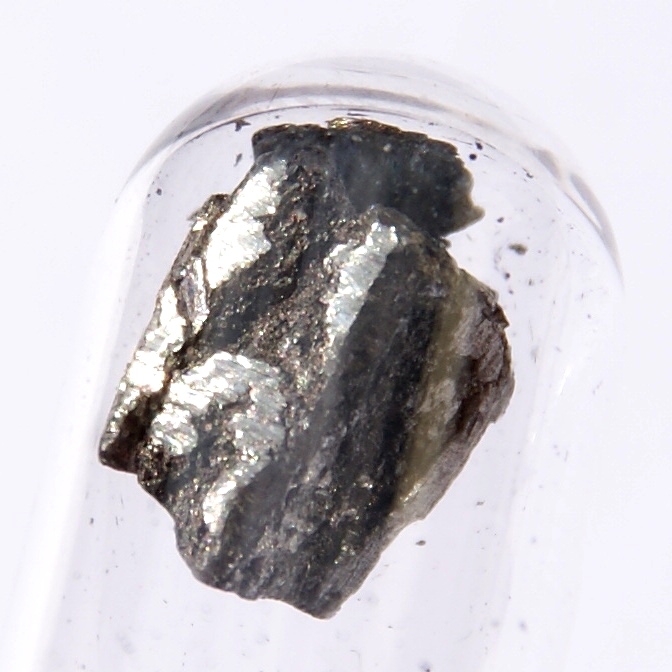
Key facts
Lanthanum lends its name to a whole family. The lanthanides, the fifteen elements pulled out into a row beneath the main table, all take after it: soft, silvery, reactive metals whose chemistry is so alike that separating them took chemists the best part of a century. Fittingly, lanthanum's own name means hidden, because that is exactly what it was.
It is not rare. There is more lanthanum in the Earth's crust than lead. But it never occurs on its own, always mixed with its chemical siblings, and that shared mineralogy shapes how it is mined, priced and used.
Where it is found
Lanthanum occurs in the same minerals as the other light rare earths. Bastnäsite, a fluorocarbonate, and monazite, a phosphate, are the two main ores, and both typically contain a substantial proportion of lanthanum alongside cerium and neodymium. Ion-adsorption clays in southern China also yield rare earths, and lanthanum is recovered from them.
The Bayan Obo deposit in Inner Mongolia is the world's largest rare earth mine, and China dominates both mining and refining. Mountain Pass in California, Mount Weld in Australia and deposits in Myanmar, Vietnam and Brazil also contribute. Because lanthanum is one of the more plentiful rare earths and is produced whenever neodymium is extracted for magnets, it is often in oversupply and comparatively cheap.
How it was discovered
In 1839 the Swedish chemist Carl Gustaf Mosander was working with cerium nitrate, a compound of an element discovered thirty-six years earlier. He suspected it was not pure. Treating it carefully with dilute nitric acid, he found a portion that dissolved differently and contained a new oxide. He named the element lanthanum from the Greek lanthanein, to lie hidden, because it had been concealed within cerium all along.
Mosander was working in the laboratory of Jöns Jacob Berzelius, one of cerium's discoverers, and he went on to find that his lanthanum was itself impure, splitting off a substance he called didymium. That in turn was later divided into praseodymium and neodymium. Reasonably pure lanthanum metal was not produced until 1923.
What we use it for
The largest use of lanthanum is in petroleum refining. Lanthanum-exchanged zeolites are the catalysts in fluid catalytic cracking, the process that breaks heavy crude oil fractions into petrol. Nearly every litre of petrol has passed over a lanthanum-containing catalyst at some point.
Lanthanum-nickel alloys store hydrogen and form the negative electrode in nickel-metal hydride batteries. The first generations of hybrid cars used battery packs containing several kilograms of lanthanum-rich alloy. Lanthanum oxide added to glass raises its refractive index without adding colour or dispersion, so it is used in high quality camera lenses and telescope optics. Lanthanum is part of mischmetal, the alloy in lighter flints and in some steelmaking. Lanthanum carbonate is prescribed to kidney patients to bind phosphate in the gut, and lanthanum compounds are used in phosphors,, and in some fuel cells.
Reading the numbers
Lanthanum melts at about 920 °C and boils at about 3464 °C. That is a very long liquid range, and the high boiling point means lanthanum vapour is hard to produce even in a furnace. Its density of 6.16 grams per cubic centimetre puts it a little below iron and around six times water, which is on the light side for a metal this far down the table.
The configuration [Xe] 5d1 6s2 is interesting because there is no 4f electron at all, even though lanthanum heads the f block. The three outer electrons are readily lost, giving the La3+ ion that dominates lanthanide chemistry, and its low electronegativity of 1.1 places it close to the alkaline earth metals in character. Chemists still debate whether lanthanum or lutetium belongs directly beneath yttrium in group 3; this site follows the traditional placement of lanthanum there. Its first ionisation energy of 538 kilojoules per mole is similar to barium's and shows how easily it reacts.
Safety and the environment
Lanthanum metal is reactive but not highly toxic. It tarnishes quickly in air, reacts slowly with water and burns if finely divided, so it is stored under oil or in an inert atmosphere. Lanthanum compounds are of low toxicity, and lanthanum carbonate is even swallowed as a medicine.
The environmental cost of lanthanum lies in its mining. Rare earth ores often contain thorium and uranium, so tailings can be mildly radioactive, and the acids and solvents used in separation have polluted water and soil around some processing sites. Improving these processes and recycling rare earths from old batteries and catalysts are active goals.
Did you know?
- Lanthanum means hidden, because it lay undetected inside cerium compounds for more than thirty years.
- Lanthanum is more abundant in the Earth's crust than lead, despite being called a rare earth.
- Early hybrid cars carried battery packs containing several kilograms of lanthanum in their nickel-metal hydride cells.
- Lanthanum glass gives camera lenses a high refractive index with little colour distortion, which lets designers use fewer and thinner lens elements.
- Lanthanum is soft enough to be cut with a kitchen knife and tarnishes within hours when exposed to air.
More in the lanthanides
The nearest neighbours of lanthanum in the family, by atomic number.
See all 15 lanthanides on one page, or browse all 118 elements.
Frequently asked questions
What is lanthanum used for?
Its biggest use is in catalysts that crack crude oil into petrol at refineries. It is also the hydrogen-storing metal in nickel-metal hydride batteries, an ingredient in high-quality camera lens glass, a component of lighter flints, and a medicine that binds phosphate in kidney patients.
Is lanthanum a rare earth element?
Yes, it is the first of the lanthanide series and gives the group its name. Rare earth is a historical label; lanthanum is actually more plentiful in the crust than lead, but it is always mixed with the other lanthanides in its ores and is difficult to separate from them.
Is lanthanum radioactive?
Natural lanthanum is almost entirely the stable isotope lanthanum-139, with a tiny fraction of lanthanum-138, which is so weakly radioactive that it is harmless. The radioactivity concern in rare earth mining comes from thorium and uranium found in the same ores, not from lanthanum itself.
Why is it called lanthanum?
The name comes from the Greek word lanthanein, meaning to lie hidden. Carl Gustaf Mosander chose it in 1839 because the element had been concealed inside cerium compounds since cerium's discovery in 1803.
Read next
Guess the mystery element in six tries. A new one every day, free, no sign-up.
Written by Anthony. Updated September 2026. Numerical data from Periodic-Table-JSON (CC BY-SA), cross-checked against the Lanthanum reference article. Spotted an error? Tell us.