Arsenic · element 33
The poison of choice for centuries, now a treatment for leukaemia and a component in your phone's chips
Key facts
Few elements carry as much reputation as arsenic. It was the classic murder weapon of Renaissance courts and Victorian novels, tasteless and once impossible to detect. Yet it has also been a medicine for over two thousand years, a pigment that coloured wallpapers and paintings, and today a licensed drug for a form of leukaemia. Its compound with gallium is a high-performance semiconductor inside almost every mobile phone.
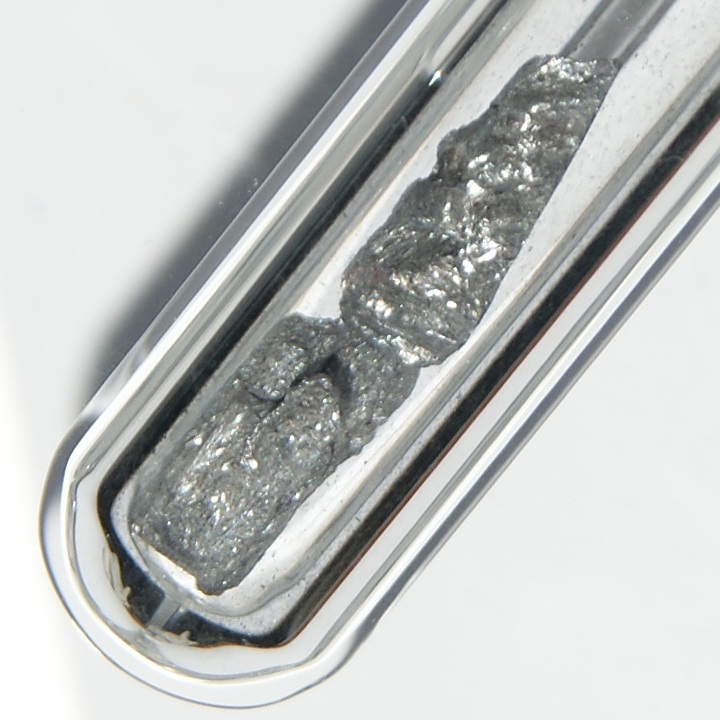
Arsenic is a metalloid in group 15, below phosphorus. Its most common form is a brittle, grey, metallic-looking solid that tarnishes in air. Unusually, at normal pressure it never melts: heat it and it passes straight from solid to vapour, giving off a smell of garlic.
Where it is found
Arsenic occurs in over two hundred minerals, most often combined with sulfur or with metals. The commonest is arsenopyrite, an iron arsenic sulfide. Two others are famous for their colours: realgar is orange-red and orpiment is a rich golden yellow, and both were ground up as pigments in ancient times.
Almost no arsenic is mined deliberately. It is collected as arsenic trioxide from the flue dusts of copper, gold and lead smelters, with China as the main producer. Arsenic also dissolves naturally out of certain rocks into groundwater. Tens of millions of people in Bangladesh, West Bengal and parts of South America drink from wells with arsenic above safe levels, making it one of the world's largest natural contamination problems.
How it was discovered
Arsenic compounds were known in the Bronze Age, when copper alloyed with arsenic was worked before tin bronze became common. The name comes through Greek and Latin from a Persian word for the yellow mineral orpiment. The element itself is usually credited to Albertus Magnus, who is said to have heated orpiment with soap around 1250 and obtained the grey metal, though the details are uncertain.
Its later history is bound up with detection rather than discovery. In 1836 the English chemist James Marsh devised a test sensitive enough to reveal tiny traces of arsenic in body tissue. Poisoners who had relied on arsenic leaving no trace suddenly faced the courts, and the Marsh test became one of the founding tools of forensic science.
What we use it for
The most important modern use is gallium arsenide, a semiconductor that switches faster than silicon and converts electricity to light efficiently. It is found in phone radio chips, LEDs, laser diodes and satellite solar cells. Small amounts of arsenic are also added to lead to harden it for car battery grids and shot.
Medicine has come full circle. In 1910 Paul Ehrlich's arsenic compound Salvarsan became the first effective treatment for syphilis and the first modern chemotherapy drug. Today arsenic trioxide is an approved and highly effective treatment for acute promyelocytic leukaemia. Older uses have mostly gone: arsenic-based pigments such as Scheele's green and Paris green, arsenic pesticides, and chromated copper arsenate wood preservative have been withdrawn or heavily restricted in most countries.
Reading the numbers
Arsenic has no melting or boiling point in our data because at ordinary pressure it sublimes, turning from solid directly into gas at about 615 °C. It only melts if squeezed under many times atmospheric pressure. Its density of 5.73 grams per cubic centimetre is nearly six times that of water and roughly three quarters of iron.
The configuration [Ar] 3d10 4s2 4p3 gives five outer electrons, the same pattern as nitrogen and phosphorus above it. Arsenic can gain three electrons to form arsenides or share three or five to form compounds in the +3 and +5 states, and the +3 compounds are the more toxic. Its electronegativity of 2.18 and first ionisation energy of 947 kJ/mol are higher than germanium's, as expected moving right across period 4, and mark it as more non-metal than metal. Its position under phosphorus explains its toxicity: cells confuse arsenate with phosphate and build it into molecules where it does not belong.
Safety and the environment
Arsenic is toxic in all soluble forms. It binds to sulfur groups on enzymes and interferes with the way cells make energy. Acute poisoning causes vomiting, cramps and organ failure. Long-term exposure to lower doses, mainly through drinking water, causes skin lesions, heart disease and cancers of the skin, bladder and lung. The World Health Organization guideline for drinking water is 10 micrograms per litre.
Rice absorbs more arsenic from soil and water than other cereals, so food agencies set limits for rice products, especially those for babies. Arsenic is released into the environment by mining, coal burning and old pesticide use, and contaminated sites can remain hazardous for decades.
Did you know?
- At normal air pressure arsenic never becomes a liquid: it goes straight from solid to vapour at about 615 °C.
- Copper alloyed with arsenic was in use before tin bronze, so arsenic metallurgy is older than the Bronze Age name suggests.
- The 1836 Marsh test could detect arsenic in a corpse, and it ended the era when arsenic poisoning was effectively undetectable.
- Arsenic trioxide, once a notorious poison, is now a standard and very successful drug for acute promyelocytic leukaemia.
- Victorian wallpapers coloured with arsenic-based greens shed toxic dust and were blamed for illness in fashionable homes.
- Samples of Napoleon's hair contain elevated arsenic, and historians still argue about whether it came from medicine, wallpaper or something more sinister.
More in the metalloids
Column-mates come first, since elements in one column have outer electrons arranged in a similar way and tend to behave alike; the rest are the nearest neighbours in the family.
See all 7 metalloids on one page, or browse all 118 elements.
Compare Arsenic with another element
Each comparison has a side-by-side data table and a plain-English summary of the differences.
Frequently asked questions
Is arsenic in rice dangerous?
Rice takes up more arsenic from soil and water than other grains, so it usually contains small but measurable amounts. For most people eating a varied diet the risk is low, but regulators set limits for rice-based baby foods. Rinsing rice and cooking it in plenty of water lowers the arsenic content.
How does arsenic poison you?
Arsenic compounds attach to sulfur-containing parts of enzymes and disrupt the chemical reactions cells use to produce energy. Arsenate also mimics phosphate and gets built into molecules where it does not work. The result ranges from severe stomach illness in acute cases to cancer and heart disease after years of low exposure.
Why is there arsenic in groundwater?
Some sediments and rocks naturally contain arsenic minerals that dissolve into water under the right chemical conditions, particularly where oxygen is scarce underground. This is why deep wells in parts of Bangladesh, India, Chile and the United States exceed safe limits. It is a natural problem rather than industrial pollution in most cases.
Is arsenic still used in anything?
Yes. Gallium arsenide semiconductors are in phones, LEDs and satellite solar cells, arsenic hardens the lead in car batteries, and arsenic trioxide is a licensed leukaemia drug. Its use in pesticides, pigments and wood preservatives has largely been phased out.
Read next
Guess the mystery element in six tries. A new one every day, free, no sign-up.
Written by Anthony. Updated September 2026. Numerical data from Periodic-Table-JSON (CC BY-SA), cross-checked against the Arsenic reference article. Spotted an error? Tell us.