Why Is Carbon the Element of Life?
Carbon is the element of life because it forms four strong bonds, links to itself in chains and rings, and builds millions of molecules. Here is how.
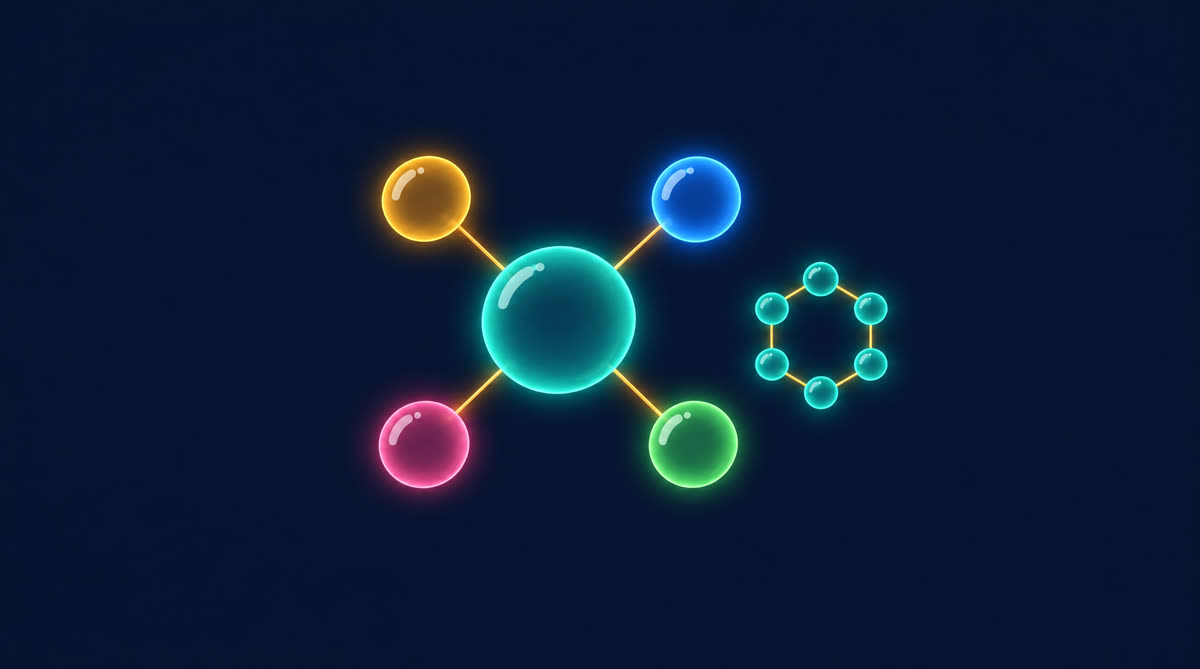
Carbon is the element of life because each carbon atom can make four bonds, and it is unusually good at bonding to other carbon atoms as well as to hydrogen, oxygen and nitrogen. That lets it build chains, rings and branching shapes of almost any size, and living things need exactly that: a huge toolkit of different molecules, all stable enough to last and flexible enough to change.
Think of carbon as the friendliest atom at the party. It shakes hands with four people at once, never leaves anyone out, and still has time to hold hands with itself in a circle. Other atoms stand by the wall. Carbon runs the conga line.
What makes carbon so good at bonding?
It comes down to the outer electrons. Carbon has atomic number 6, so a neutral atom has 6 electrons: two in the inner shell and four in the outer shell. Those four outer electrons are called valence electrons, and they are the ones that do the bonding. If that term is new, valence electrons and ion charges explains it from scratch.
An atom is happiest with a full outer shell, which for carbon means eight electrons. Carbon is exactly halfway there. It could lose four electrons or gain four, but both are a big ask, so it does something cleverer: it shares. Each shared pair of electrons is a covalent bond, a link that holds two atoms together. Four electrons to share means four bonds.
That number is the sweet spot. An element that makes one bond, like hydrogen, can only stick on the end of things. One that makes two, like oxygen, can build a chain but nothing that branches. One that makes three, like nitrogen, can start to branch. Carbon, with four, can join four different neighbours and still be part of a chain, a ring or a branching tree. It is the Swiss army knife of the table, only without the corkscrew nobody ever uses.
You can see this in the periodic table too. Carbon sits in group 14, the column where every element has four outer electrons, and it is classed as a non-metal.
Why can carbon build such huge molecules?
Three things happen together, and carbon is unusually good at all of them.
- It bonds strongly to itself. Carbon to carbon bonds are tough, so long chains and rings stay put instead of falling apart.
- It bonds well to the other building blocks of life. Hydrogen, oxygen and nitrogen are the usual partners, with phosphorus and sulfur joining in for special jobs.
- It can share more than one pair. Two carbon atoms can be joined by a single bond, a double bond (two shared pairs) or a triple bond (three), which changes the shape and behaviour of the molecule.
Chemists call the study of carbon compounds organic chemistry, a name from the days when people thought these molecules could only come from living things. Today the number of known carbon compounds is usually quoted in the millions, far more than for any other element, though the exact figure depends on who is counting and keeps growing.
Why does that matter for life? A living thing needs jobs done: carrying energy, storing instructions, building walls, speeding up reactions. Each job needs a different molecule, and carbon can build all of them from the same few ingredients. Sugars, fats, proteins and DNA are all carbon frameworks decorated with hydrogen, oxygen, nitrogen and a pinch of other elements. Same atoms in different arrangements, a bit like building everything from one box of Lego, which is also why stepping on it hurts so much.
Why not silicon instead?
A fair question, and a popular one in science fiction. Silicon sits directly below carbon in group 14, so it also has four outer electrons and also forms four bonds. On paper it looks like carbon's twin. In practice it is more like a cousin who turns up to the family party and is a bit stiff.
There are a few reasons, and a note of caution: this is the standard chemistry explanation, not a proof that silicon life is impossible anywhere in the universe.
- Silicon to silicon bonds are weaker. Long chains of silicon atoms exist, but they are less stable than carbon chains and tend to react with water and oxygen. Carbon chains are generally far sturdier.
- Silicon prefers oxygen. Silicon bonds very strongly to oxygen, so in nature it is mostly found locked up in rocks and sand, not building long chains of its own.
- Its oxide is a rock, not a gas. When living things burn food for energy, carbon ends up as carbon dioxide, a gas that is easily breathed out or carried away. Silicon’s equivalent, silicon dioxide, is a hard solid (it is the main ingredient of sand and quartz). Imagine breathing out sand. Nobody wants that, least of all the carpet.
Silicon is not useless: it is the star of computer chips, so carbon does life and silicon does phones. You can compare the two directly on the carbon versus silicon page.
How do carbon and silicon compare?
Here are the two side by side. The numbers come from the data behind this site.
| Property | Carbon | Silicon |
|---|---|---|
| Symbol | C | Si |
| Atomic number | 6 | 14 |
| Group | 14 | 14 |
| State at room temperature | Solid | Solid |
| Atomic mass | 12.011 | 28.085 |
| Melting point | No ordinary melting at normal pressure: graphite turns straight to gas at very high temperatures, around 3,900 K (roughly 3,600 °C) | 1,687 K (about 1,414 °C) |
| Density | 1.821 g/cm³ in the data set (varies a lot by form) | 2.329 g/cm³ |
| Why the bonds matter | Strong carbon to carbon bonds make long, stable chains and rings | Weaker silicon to silicon bonds, but very strong silicon to oxygen bonds, so it forms rocks and glass |
Notice the melting point row. Silicon is a normal solid that melts at a normal (if toasty) temperature. Carbon is odd: at everyday pressure it does not melt at all. It sublimes, which means it goes directly from solid to gas, at a temperature well above silicon’s melting point. That tells you how strongly its atoms are held together.
Try it on Periodic Bubbles. Open the bubbles and pop carbon, then silicon. You can check their numbers against the table above, and see that they sit in the same column of the table. If you want to see their neighbours, germanium is the next one down in group 14.
Why are diamond and pencil lead the same element?
Here is where carbon gets properly theatrical. The same carbon atoms, arranged in different ways, make materials that look and behave nothing alike. Different forms of the same element are called allotropes, and carbon has several famous ones.
- Diamond: every carbon atom is bonded to four others in a rigid three-dimensional framework. No loose electrons, no weak spots. The result is clear, extremely hard and a poor conductor of electricity.
- Graphite: each carbon atom bonds to three others, forming flat sheets of hexagons. The sheets are only loosely attached to one another, so they slide over each other easily, and each atom has a spare electron that can move. That makes graphite soft, slippery, grey-black and a good conductor.
- Graphene: a single sheet of graphite, one atom thick. It is a very active area of research for its strength and conductivity.
- Fullerenes: hollow balls and tubes of carbon atoms. The best known, C60, has 60 atoms arranged like a football, and was nicknamed “buckyball”.
The pencil “lead”, by the way, contains no lead at all. It is graphite mixed with clay. As you drag a pencil across paper, tiny layers of graphite slide off and stick to it. You are literally writing with a thin film of sheets of carbon.
| Property | Diamond | Graphite |
|---|---|---|
| Structure | Each atom bonded to four others in a rigid 3D lattice | Flat sheets of hexagons, each atom bonded to three others |
| Hardness | Among the hardest natural materials known | Very soft; the layers slide |
| Conducts electricity? | No (it is an insulator) | Yes, along the sheets |
| Appearance | Clear and sparkling when cut (colourless when pure) | Dark grey and slightly shiny |
| One use | Cutting and drilling tools, and jewellery | Pencils, and electrodes in some batteries |
The lesson is that an element is not just a list of atoms. How the atoms connect changes everything. It is also a handy answer next time somebody asks whether a diamond is just a lump of pencil. Strictly, both are pure carbon, only arranged very differently.
How does carbon dating work?
Carbon has more than one isotope, meaning versions of the same element with different numbers of neutrons (the particles in the nucleus with no charge). Most carbon is carbon-12, but a tiny amount is carbon-14, which is radioactive. You can learn how isotopes work in relative atomic mass and isotopes.
Living things keep taking in carbon, so the tiny proportion of carbon-14 inside them matches the air around them. Once an organism dies, it stops taking in more, and the carbon-14 already inside slowly decays. Its half-life, the time for half of it to decay, is about 5,730 years. By measuring how much is left, scientists can estimate the age of once-living material such as wood, bone or charcoal. It works for tens of thousands of years, not for millions, and it needs careful calibration, so it gives an estimate with a margin, not an exact birthday. For more on radioactivity, see which elements are radioactive.
What is the carbon cycle?
Carbon does not get used up. It moves around. Plants take in carbon dioxide from the air and use sunlight to turn it into sugars, a process called photosynthesis. Animals eat the plants, and both plants and animals release carbon dioxide again when they use that food for energy. When living things die and rot, or when fuels such as wood and coal are burned, more carbon goes back to the air. Some also ends up in the oceans, in rocks and in the soil, where it can stay for a very long time.
Your breakfast toast was made from carbon that was in the air not long ago, and when you breathe out, you are returning some of it.
How much of you is carbon?
Quite a lot. After oxygen (the body is mostly water), carbon is the biggest part of your body by mass. It is usually given as about 18 percent of your mass, though the exact figure depends on the source and the person.
The element takes its name from the Latin word carbo, meaning charcoal. People have known carbon for as long as they have had fires: soot and charcoal are impure carbon, so it was known in ancient times, long before anyone knew what an element was. That puts it among the oldest chemical acquaintances humanity has. See the history of the periodic table for how elements were later sorted, and the carbon page for its full data.
Frequently asked questions
Is carbon the most common element in the body?
By mass, no. Oxygen comes first, because the body is mostly water. Carbon is second. By number of atoms, hydrogen is first. Carbon is the one that does the structural work, though.
Could life be based on something other than carbon?
Nobody has found any, and nobody knows for certain that it cannot exist. Silicon is the usual candidate, but it faces the problems above. For now, every living thing we know of is built on carbon.
Are graphite and diamond different elements?
No. Both are pure carbon. They are different allotropes, meaning different arrangements of the same atoms, which is why one is a soft writing material and the other a famously hard gem.
Why is carbon dating no good for rocks?
Carbon-14 decays too quickly to be useful beyond a few tens of thousands of years, and the method only works on material that was once alive. Rocks are usually far older than its range, so other radioactive clocks are used for them.
Ready to test what you have learned? Try the Pop Quiz, or check today’s element in the Daily Bubble.