Why Isn't Atomic Mass a Whole Number? Isotopes and Relative Atomic Mass Explained
Why the atomic mass of an element has decimals, how isotopes explain it, and how to work it out step by step for chlorine, copper and boron.
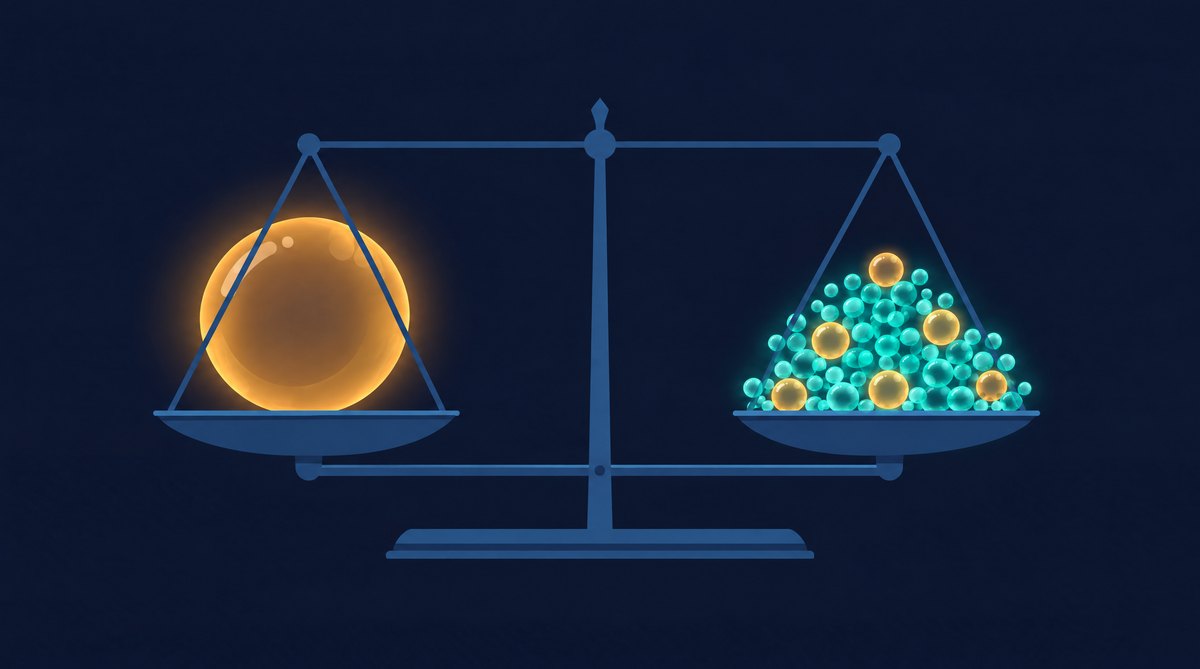
For most elements, atomic mass has decimals because the number on the periodic table is an average, not the mass of any single atom. It is a weighted average over the natural mix of an element's isotopes (versions of the element whose atoms carry different numbers of neutrons, which are heavy particles in the atom's core), where common kinds count for more than rare ones. The mass number of one isotope (its protons plus neutrons, the two kinds of heavy particle in the core), by contrast, is always a whole number.
So no real chlorine atom weighs 35.45: virtually every natural chlorine atom is chlorine-35 or chlorine-37, and the table shows the blend. There are two special cases. First, sodium, like fluorine, aluminium and gold, has only one natural isotope, sodium-23, yet it is listed as about 22.99 rather than 23, because even a single isotope is slightly off a whole number (see the section on exactness). Second, elements whose atoms are all radioactive (unstable, so they break apart over time) have no settled natural mix. Technetium is one: it is shown with the mass number of one chosen long-lived isotope, 98. Thorium and uranium are radioactive too but do occur in a steady mix, so they have ordinary decimal values.
The puzzle: atoms are countable, so why the decimals?
Here are five numbers from the element pages (and the bubbles view, when you size or colour by atomic mass): chlorine 35.45, magnesium 24.305, copper 63.5463, boron 10.81 and bromine 79.904.
Atoms are built from whole particles, so how can chlorine weigh 35.45? No single atom does. In a class where the average pupil owns 2.4 pets, nobody owns 0.4 of a hamster; the figure describes the crowd. The table's decimals describe a crowd of atoms in the same way.
The crowd is mixed because chlorine atoms differ: some carry 18 neutrons, some 20. Every atom has a core made of protons and neutrons, with very light electrons outside it. Protons and neutrons weigh about the same and an electron is roughly 1,800 times lighter. Every chlorine atom has 17 protons, so the neutrons make one chlorine atom heavier than another.
The words you need
To recap the particles: a proton and a neutron are the heavy particles in the nucleus, the tiny core of an atom; electrons are the very light particles outside it. What Is an Atom? has the full tour. Four terms cause most of the confusion. The last two are measured against carbon-12, the carbon atom with 6 protons and 6 neutrons.
| Term | What it is | Whole number? |
|---|---|---|
| Atomic number | Protons in one atom. It decides the element. | Always |
| Mass number | Protons plus neutrons in one atom of one isotope. | Always |
| Relative isotopic mass | One atom of one isotope, compared with one twelfth of a carbon-12 atom. | Very close, not exact |
| Relative atomic mass, Ar | The weighted mean mass of an atom of the element, compared with one twelfth of an atom of carbon-12. It has no units. | Usually not |
Ar looks like Ar, the symbol for argon; the context tells you which. Atomic weight is another name for relative atomic mass, and US books say average atomic mass. Single atoms are measured in atomic mass units (u), one u being a twelfth of a carbon-12 atom; relative atomic mass is a ratio, so strictly it has no unit.
How do you read chlorine-35 and chlorine-37?
Isotopes are named by element and mass number, also written 35Cl, with the 35 raised and in front. Reading an atom takes three rules.
- Protons equal the atomic number. Chlorine is element 17, so it has 17 protons.
- Neutrons equal the mass number minus the atomic number.
- Electrons equal the protons in a neutral atom, because the charges cancel.
Chlorine-35 has 17 protons, 18 neutrons and 17 electrons; chlorine-37 has 17, 20 and 17. Same protons means the same electrons, so the same electron arrangement and almost identical chemistry. The extra neutrons change only the mass, so density and how fast a gas spreads out differ slightly. Carbon-12 and carbon-14 follow the same pattern, with 6 protons each but 6 and 8 neutrons. The difference is that carbon-14 is radioactive and neither chlorine isotope is.
How do you calculate relative atomic mass?
Imagine a bag of 100 chlorine atoms that holds the natural proportions, in tidy numbers: 75 of chlorine-35 and 25 of chlorine-37. Weigh the bag, then share its mass equally among the 100 atoms. Each share is the relative atomic mass.
- Chlorine-35: 75 atoms × 35 = 2625
- Chlorine-37: 25 atoms × 37 = 925
- Add: 2625 + 925 = 3550
- Divide by 100 atoms: 3550 ÷ 100 = 35.5
These are exam-style numbers: tidy percentages for sums without a calculator. UK exam periodic tables traditionally list chlorine as 35.5. Real chlorine is about 75.8 per cent chlorine-35 and 24.2 per cent chlorine-37, and the table value is 35.45. The method is identical, but do not mistake the tidy answer for the exact truth.
Why divide by 100? The percentages describe a bag of 100 atoms. Why not average 35 and 37 to get 36? That treats both kinds as equally common. Three atoms in four are chlorine-35, so the answer sits a quarter of the way from 35 towards 37. Hence the check: it must lie between the lightest and heaviest isotope and lean towards the commoner one.
Where do the percentages come from?
A mass spectrometer turns a sample into ions (charged particles), speeds them up with an electric field and separates them by mass-to-charge ratio (mass divided by electric charge, which for ions with a single plus charge is just their mass). Its chart has one bar per isotope, its height showing how common it is. Chlorine gives a tall bar at 35 and one about a third as tall at 37. Heights are percentages only if they add up to 100; if not, divide each by the total and multiply by 100, so heights of 100 and 32 give 100 ÷ 132 × 100 = 75.8 per cent and 32 ÷ 132 × 100 = 24.2 per cent.
Three more worked examples
Same moves each time, with exam-style numbers first and the real table value beside them.
Magnesium, with three isotopes
Take 79 per cent magnesium-24, 10 per cent magnesium-25 and 11 per cent magnesium-26. Then 79 × 24 = 1896, 10 × 25 = 250 and 11 × 26 = 286. The total is 2432, and 2432 ÷ 100 = 24.32. Table value: 24.305. Check: just above 24, because nearly four atoms in five are magnesium-24.
Copper, with two isotopes
Take 69 per cent copper-63 and 31 per cent copper-65. Then 69 × 63 = 4347 and 31 × 65 = 2015, so the total is 6362 and the answer is 63.62. Table value: 63.546 (the element page gives 63.5463), from real percentages of about 69.15 and 30.85. Check: between 63 and 65, nearer 63. This lands further from the table value than chlorine did; the section on exactness below says why.
Boron, with a lopsided mix
Take 20 per cent boron-10 and 80 per cent boron-11. Then 20 × 10 = 200 and 80 × 11 = 880, so the total is 1080 and the answer is 10.8. Table value: 10.81, from real percentages of about 19.9 and 80.1. Check: between 10 and 11, close to 11.
Try it on Periodic Bubbles. Open chlorine, magnesium, copper, boron and bromine and read each atomic mass. Spot which is closest to a whole number (bromine, about 0.1 from 80), then match the other four to the sums above. In the bubbles, choose Size: atomic mass to watch the heavy elements swell.
Can you work backwards?
Exams love the reverse. Boron has two isotopes, boron-10 and boron-11. Its relative atomic mass is 10.8. What percentage is boron-10?
- Let p be the percentage of boron-10, so boron-11 is 100 minus p.
- One hundred atoms weigh 10.8 × 100 = 1080.
- So 10 × p + 11 × (100 minus p) = 1080, which multiplies out to 10p + 1100 minus 11p = 1080, then 1100 minus p = 1080.
- Therefore p = 20. Boron-10 is 20 per cent and boron-11 is 80 per cent.
- Check forwards: 200 + 880 = 1080, and 1080 ÷ 100 = 10.8.
Bromine is the near-even case: 79.904 sits almost halfway between 79 and 81, with about 50.7 per cent bromine-79 and 49.3 per cent bromine-81. Chlorine, in the same halogen family, is lopsided three to one; see chlorine against bromine.
Common mistakes
- Forgetting to divide. An answer of 3550 for chlorine is the total mass of 100 atoms. Divide by 100, or by the total of the ratio parts: for 3 : 1, (3 × 35 + 1 × 37) ÷ 4 = 35.5.
- Multiplying by the atomic number. Chlorine's atomic number is 17, but you multiply each of 35 and 37 by its own percentage.
- Mixing up mass number and relative atomic mass. The first belongs to one isotope and is whole; the second covers the whole mix and is usually a decimal.
- Rounding in the middle of the sum. Keep every digit until the last line.
A one-line way for parents to help: before any sums, ask "which isotope is commoner, so which whole number should the answer be nearer to?"
How exact is this method?
Not perfectly. A mass number is a count of particles, but a real atom's mass is a measurement, and it comes out very slightly different. A chlorine-35 atom weighs 34.969 u, not 35. Each proton and neutron is a touch over 1 u, which pushes the total up, but a nucleus weighs less than its separate particles because some mass left as energy when they joined, and for chlorine-35 that loss wins. (For a few light isotopes the first effect wins instead: hydrogen-1 weighs 1.008 u.) The shortfall varies: copper-63 sits about 0.07 u under its mass number, chlorine-35 only about 0.03 u, which is a big reason copper lands further out.
So the whole-number method gives a close answer, not an exact one. Copper with its real percentages still gives 63.62, while real isotope masses of 62.930 and 64.928 give the true 63.546. Working backwards makes the slip bigger: treat bromine's 79.904 as a mix of exactly 79 and 81 and you would predict about 55 per cent bromine-79, against the real 50.7.
The percentages wobble too. The isotope mix varies slightly with where a sample came from, so IUPAC, the international chemistry body that publishes the official values, now gives some atomic weights as ranges, such as 10.806 to 10.821 for boron. Single table figures like 10.81 are conventional values, one agreed figure from inside the range.
Where the decimals turn up next
Relative atomic mass becomes molar mass: the same decimal, in grams per mole, where a mole is a fixed, huge batch of atoms. A mole of chlorine atoms weighs about 35.45 grams. What Is a Mole in Chemistry? picks up the story, and the properties worksheet drills comparing atomic masses.
The Daily Bubble mass clue compares exactly these decimals, telling you whether the mystery element is heavier or lighter than your guess. It follows true atomic mass, not table position, so for a few pairs it points against the table order. Tellurium (about 127.6) sits before iodine (about 126.9) because the table is ordered by protons, 52 against 53, not by mass; iodine has a single natural isotope, while tellurium's mix leans towards the heavier tellurium-128 and tellurium-130. Mendeleev trusted the chemistry and put tellurium first anyway, as the history of the table explains.
Key takeaways
- For most elements, relative atomic mass (above the symbol on UK exam tables, below it on many others) is a weighted average over the natural mix of isotopes, so it is usually a decimal; one isotope's mass number is always whole.
- One-isotope elements such as sodium still have decimals; elements with no settled natural mix, such as technetium, show the mass number of one chosen isotope (98 for technetium).
- Multiply each mass number by its percentage, add, and divide by 100. Exam-style numbers give tidy answers such as 35.5; the real value is 35.45.
- To work backwards, let p be the unknown percentage, write the equation for 100 atoms and solve.
- Check that the answer lies between the lightest and heaviest isotope, nearer the commoner.