How to Find Valence Electrons and Ion Charges From the Periodic Table
Find outer electrons from the group number, predict ions such as magnesium 2+ and chlorine 1-, then write formulae. Worked across a row, with a self-test.
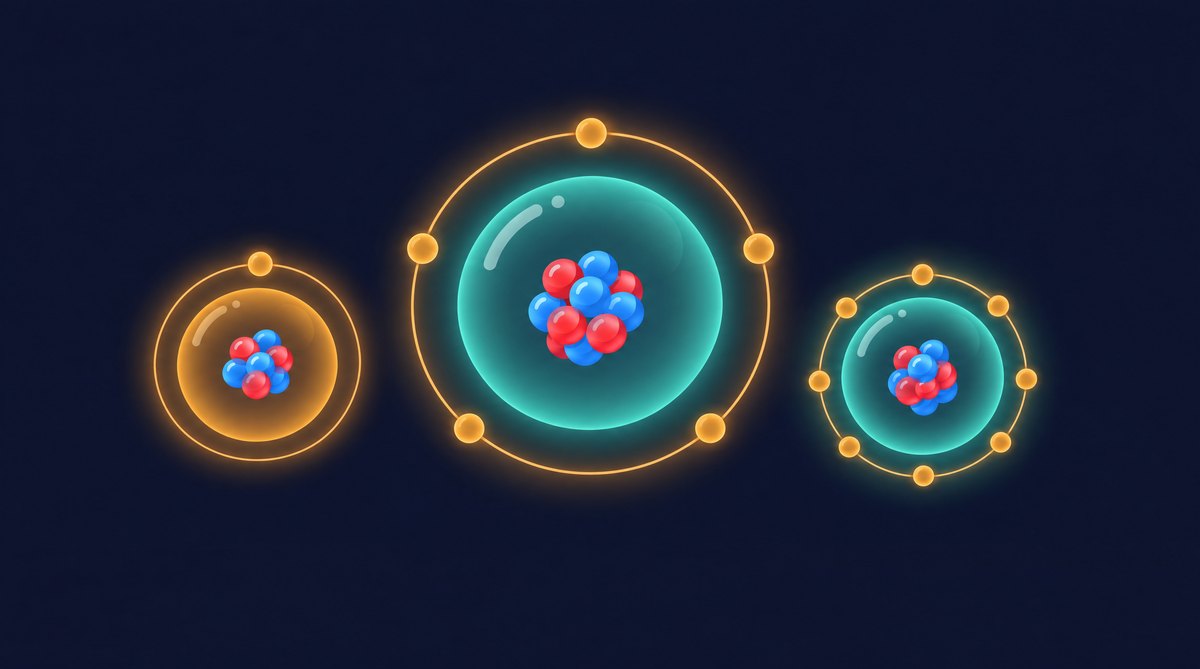
Valence electrons are the electrons in the outermost layer, or shell, of an atom. The periodic table tells you how many. Each column of the table is called a group, numbered 1 to 18 from left to right, and the group number gives the answer: the number itself for groups 1 and 2, the number minus 10 for groups 13 to 18, and 2 for helium. Those outer electrons decide the usual ion, an atom that has gained or lost electrons and so carries a charge. Electrons are negative, so losing them leaves a positive ion: magnesium, with 2 outer electrons, loses them and becomes a 2+ ion, while chlorine, with 7, gains one and becomes a 1- ion.
Two notes on names. "Valence electrons" is the term in many textbooks and in US courses; UK GCSE courses usually say "outer shell electrons". GCSE courses also number the main groups 1 to 7 and then 0, where this site's table runs 1 to 18; the conversion is below.
What are valence electrons?
Electrons sit in layers called shells, filled from the inside out: up to 2 in the first, 8 in the second, and for the first twenty elements 8 in the third before a fourth begins. That is a simplification (the atom article has more), but it gives the right answers here.
Only the outermost shell matters in most school chemistry, until you reach the transition metals, the block in the middle of the table. Sodium has 11 electrons, just one in its outer shell, so it has 1 valence electron.
How do you find valence electrons from the periodic table?
For groups 1, 2 and 13 to 18 there are two routes, and they agree. The transition metals in the middle of the table, and the two rows printed beneath it, do not follow these rules (more below). New to the table? Start with how to read the periodic table.
- From the group number. Groups 1 and 2: the group number. Groups 13 to 18: the group number minus 10. Helium: 2. (The "minus 10" skips the ten transition metal columns between groups 2 and 13.)
- From the shells. Every element page here, and every bubble's pop-up, has a Shells line, such as 2 · 8 · 1 for sodium (the pop-up writes it 2, 8, 1). The last number is the outer electron count.
GCSE groups 3 to 7 and 0 are this site's groups 13 to 18, in order, so at GCSE the outer electron count is simply the group number (group 0 has 8, except helium with 2).
Walking across period 3: sodium to argon
A row of the table is called a period, and period 3 is the best one to practise on: three shells, one more outer electron at each step.
| Element | Group | Shells | Outer electrons | Usual simple ion |
|---|---|---|---|---|
| Sodium (Na) | 1 | 2,8,1 | 1 | 1+ (loses 1) |
| Magnesium (Mg) | 2 | 2,8,2 | 2 | 2+ (loses 2) |
| Aluminium (Al) | 13 | 2,8,3 | 3 | 3+ (loses 3) |
| Silicon (Si) | 14 | 2,8,4 | 4 | None, shares |
| Phosphorus (P) | 15 | 2,8,5 | 5 | 3- (gains 3, but see below) |
| Sulfur (S) | 16 | 2,8,6 | 6 | 2- (gains 2) |
| Chlorine (Cl) | 17 | 2,8,7 | 7 | 1- (gains 1) |
| Argon (Ar) | 18 | 2,8,8 | 8 | None, full shell |
Sodium is one electron over a tidy 2,8, so it loses that one. Chlorine is one short of 2,8,8, so it gains one. Silicon is four from either end, so it shares. Phosphorus is awkward: with very reactive metals it forms phosphides, usually described as containing P3-, but in everyday phosphates it shares electrons with oxygen.
Try it on Periodic Bubbles. Open the bubbles and choose Colour: block from the colour menu (on a phone, tap Display first). A block is a region of the table, named s, p, d or f after the kind of space an atom's newest electron fills (the key under the bubbles calls it the electron home). The s block (groups 1 and 2, plus helium) and the top rows of the p block (groups 13 to 18, apart from helium) follow the rules here; the d block, the transition metals, bends them. What to look for: use the key to match colours to blocks. Sodium and magnesium wear the s colour, aluminium, oxygen and chlorine the p colour, and iron the d colour. Then pop the sodium, magnesium and aluminium bubbles, or open their pages (sodium, magnesium, aluminium), to watch the last Shells number climb 1, 2, 3, then check oxygen (6) and chlorine (7).
What charge does an atom form?
An ion is an atom, or small group of atoms, that has lost or gained electrons, so it has an overall charge. Atoms are often said to "want" a full outer shell, and GCSE answers are commonly worded "to get a full outer shell", but atoms want nothing; energy decides. A metal loses its outer electrons because the energy released when the ions pack together into a crystal (a tidy, repeating block of ions) more than repays the cost. It stops where the next electron would come from a full shell close to the nucleus, which costs far too much. A non-metal gains electrons for the same reason, stopping when its shell is full.
Pulling one electron off each of a mole of free sodium atoms in a gas (the mole article explains that counting unit) costs about 496 kJ, kilojoules, a unit of energy. This is the ionisation energy; only the comparison between the numbers matters. The second electron comes from the full shell beneath and costs 4562, over nine times as much and more than the crystal can repay, so sodium stops at 1+. Magnesium runs 738, 1451, then 7733: two fairly easy electrons, then a huge jump, so 2+. The periodic trends article explains why these costs shift across the table.
Charge is just counting. A sodium atom has 11 protons (positive particles in the nucleus, the atom's centre) and 11 electrons (negative particles), so it is neutral. Lose an electron and it is 11 protons against 10 electrons: 1+. An oxygen atom has 8 protons and 8 electrons; gain two and it is 8 against 10: 2-. Both ions have neon's arrangement, 2,8, but neither is neon: protons never change in a chemical reaction.
Write a charge as the number then the sign: 2+ and 2-. Sign first, as in +2, is for oxidation states, a later idea, so keep the two apart. Single-atom positive ions keep the element's name; single-atom negative ions end in "-ide" (chloride, oxide, sulfide). Compound ions have their own names, such as sulfate and nitrate, though hydroxide also ends in "-ide".
The group to charge map
GCSE group numbers are in brackets.
- Groups 1, 2 and 13 (1, 2 and 3): 1+, 2+ and 3+. These common metals lose all their outer electrons, so the charge equals the outer electron count. The alkali metals are the 1+ family; aluminium is the one to know in group 13 (boron shares).
- Group 14 (4): usually none. Four is too many to lose or gain, so carbon and silicon share.
- Groups 15, 16 and 17 (5, 6 and 7): 3-, 2- and 1-. The non-metals at the top of these groups gain electrons when they react with metals, until they have 8 outer electrons, so the charge is 8 minus the outer electrons. The halogens are the 1- family. Nitrogen and phosphorus form 3- only with very reactive metals.
- Group 18 (0): no simple ions. The noble gases have full outer shells, so adding or removing electrons costs a great deal (heavier xenon does form a few compounds).
Group 14, hydrogen and the transition metals bend these rules, as below. Groups and periods explained has all 18 groups in one table.
How do you write a formula from ion charges?
A compound (two or more elements joined together) has no overall charge, so the charges in its formula must add to zero. The criss-cross method: write each ion with its charge, ignore the plus and minus signs, swap the numbers so each becomes the small lowered number (subscript) on the other element, then reduce. Raised numbers are charges (O2-); lowered numbers are counts (O2).
- Sodium chloride. Na+ and Cl-. Swap 1 and 1, drop the 1s: NaCl.
- Magnesium oxide. Mg2+ and O2-. Swapping gives Mg2O2, but both numbers divide by 2, so it is MgO.
- Aluminium oxide. Al3+ and O2-. Swapping gives Al2O3. Check: two lots of 3+ is 6+, three lots of 2- is 6-, so zero.
Compound ions to learn
Some ions are small groups of atoms that share one charge. Learn these five:
- Hydroxide, OH-, in alkalis.
- Nitrate, NO3-, in fertilisers.
- Sulfate, SO42-, in Epsom salts.
- Carbonate, CO32-, in chalk and limestone.
- Ammonium, NH4+, the only positive one here.
More than one of a compound ion needs brackets. Magnesium hydroxide, the main ingredient of milk of magnesia, is Mg2+ with OH-. Swapping gives Mg(OH)2: one magnesium, two hydroxides. A single ion needs none: NaOH, CaCO3.
Where do the rules bend?
- Transition metals vary. The transition metals in the middle of the table often form more than one ion. Iron forms 2+ or 3+ and copper 1+ or 2+, so in an ionic compound's name a Roman numeral (I, II, III) gives the charge on the metal ion: iron(III) chloride contains 3+ iron. Iron's shells are 2,8,14,2 (beyond the first twenty elements the third shell can hold up to 18), and some electrons in the shell beneath have almost the same energy as the outer pair. After the first two there is no huge jump in cost: iron's third electron costs under twice its second (2957 kJ against 1562), where magnesium's third costs over five times its second. Losing a third is dearer but still affordable, and which ion forms depends on the crystal it ends up in. The outer electron count therefore does not predict the charge here. In school chemistry silver is always 1+ and zinc always 2+.
- Tin and lead are in group 14 but are metals. Lead is usually 2+, and tin forms 2+ or 4+.
- Hydrogen mostly shares electrons. In acids it is 1+, and it is 1- only in salt-like compounds such as sodium hydride.
Test yourself
- How many outer electrons does bromine have?
- What is the usual ion of calcium, and how many electrons does it have?
- Write the formula of potassium sulfide.
- Write the formula of magnesium nitrate.
Answers
- 7. Bromine is in group 17, and 17 minus 10 is 7. It forms a Br- ion, like chlorine.
- Ca2+. It has 20 protons and loses 2 electrons, leaving 18, the same arrangement as argon.
- K2S. Two K+ (2+) cancel one S2-.
- Mg(NO3)2. Mg2+ needs two NO3-, so the nitrate takes brackets.
For practice on shells and outer electrons, try the printable worksheet Electronic structure (first 20 elements); Groups, periods and families helps you find an element's group. Both have answer keys. The Daily Bubble is good practice too. A tick in its Group cell means your guess and the mystery element are in the same group, so for groups 1, 2 and 13 to 18 they have the same number of outer electrons. The one exception is helium, which has 2 where the rest of group 18 have 8.
Key takeaways
- Outer electrons: the group number (groups 1 and 2), the group number minus 10 (groups 13 to 18), or 2 for helium.
- The common metals in groups 1, 2 and 13 lose their outer electrons (1+, 2+, 3+); the non-metals at the top of groups 15, 16 and 17 gain electrons when they react with metals, up to 8 outer electrons (3-, 2-, 1-).
- Criss-cross the numbers, ignoring the signs, then check the charges add to zero.
- Learn the five compound ions, and use brackets for more than one.
- Transition metals such as iron can form more than one ion, shown by a Roman numeral.