Electron Configuration Explained Simply: How to Write It From the Periodic Table
How to write electron configurations such as 1s2 2s2 2p6, read them from the periodic table, use noble gas shorthand, and handle chromium and copper.
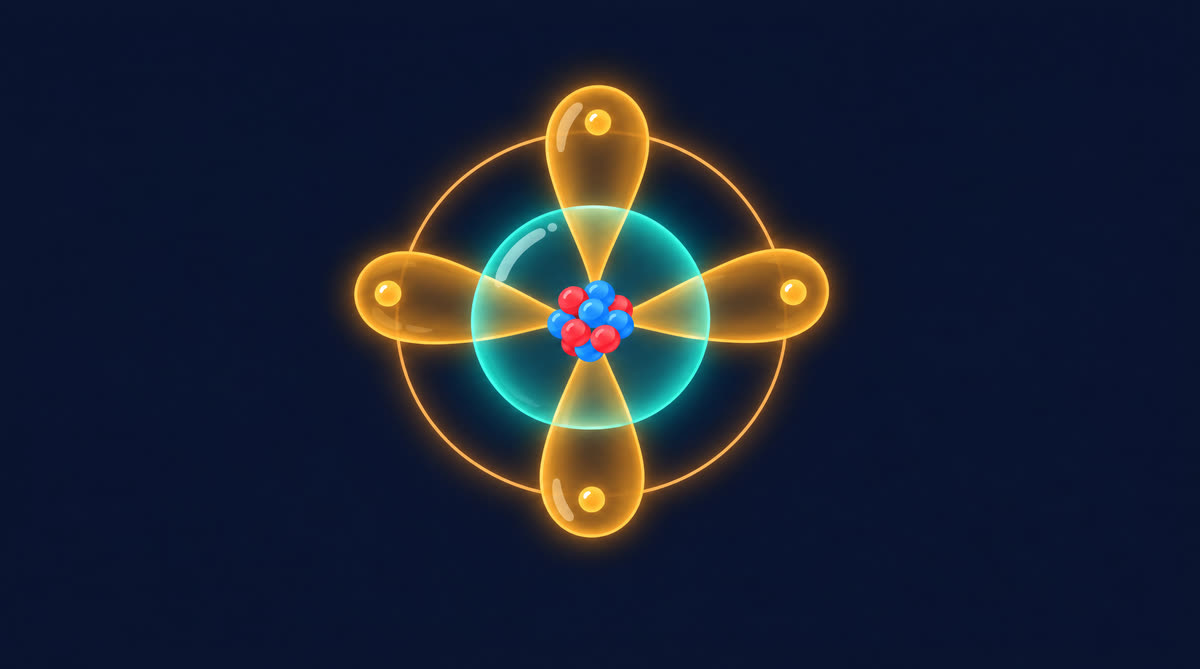
An electron configuration is a short code that lists where an atom's electrons sit. Oxygen is 1s2 2s2 2p4, which says: two electrons in the 1s space, two in 2s and four in 2p, eight in all. You do not have to memorise it. The periodic table is built from these configurations, so its shape tells you how to write them: read along the rows from hydrogen, and fill the spaces in the order the table's regions (called blocks) appear.
Two notes on names. UK GCSE courses describe electrons by shells only, such as 2,8,6 for sulfur. The s, p, d notation on this page is the next step, used at A level, in the IB and in US high school and AP courses. If shells are new to you, start with what is an atom.
What does an electron configuration show?
Electrons sit in layers called shells, numbered 1, 2, 3 and so on outwards from the nucleus (the atom's centre). Each shell is split into smaller spaces called subshells, named s, p, d and f. Each subshell is made of orbitals, regions of space where an electron is likely to be found, and each orbital holds at most two electrons.
- s: one orbital, so up to 2 electrons.
- p: three orbitals, so up to 6 electrons.
- d: five orbitals, so up to 10 electrons.
- f: seven orbitals, so up to 14 electrons.
Shell 1 has only an s subshell, shell 2 has s and p, shell 3 adds d, and shell 4 adds f. That is why shells hold 2, 8, 18 and 32 electrons: 2, then 2 + 6, then 2 + 6 + 10, then 2 + 6 + 10 + 14.
A configuration is written as a number for the shell, a letter for the subshell, and a small raised number for how many electrons are in it. So 3p4 means four electrons in the 3p subshell. The raised numbers must add up to the atom's atomic number, because a neutral atom has as many electrons as protons. That is your built-in check.
In what order do the subshells fill?
Electrons go into the lowest-energy space available, filling from the inside out. For the first 36 elements the order is:
1s, 2s, 2p, 3s, 3p, 4s, 3d, 4p
Notice that 4s fills before 3d. In potassium and calcium the 4s subshell is slightly lower in energy than 3d, so shell 4 starts before 3d begins to fill. After 4p the order continues 5s, 4d, 5p, 6s, 4f, 5d, 6p, 7s, 5f, 6d, 7p. You never need to learn that list, because the periodic table lays it out for you (next section).
Two rules decide the details. Each orbital holds at most two electrons, and those two spin in opposite directions (spin is a property of electrons). And when a subshell has several orbitals, such as the three in p, electrons spread out one per orbital before any orbital gets a second. That is why oxygen's four 2p electrons are arranged as two singles and a pair, not as two pairs.
Period 2 step by step
A row of the table is called a period. Period 2 shows the whole method in eight steps, and the first column of numbers is each element's atomic number.
| Atomic number | Element | Configuration | Shells |
|---|---|---|---|
| 3 | Lithium (Li) | 1s2 2s1 | 2,1 |
| 4 | Beryllium (Be) | 1s2 2s2 | 2,2 |
| 5 | Boron (B) | 1s2 2s2 2p1 | 2,3 |
| 6 | Carbon (C) | 1s2 2s2 2p2 | 2,4 |
| 7 | Nitrogen (N) | 1s2 2s2 2p3 | 2,5 |
| 8 | Oxygen (O) | 1s2 2s2 2p4 | 2,6 |
| 9 | Fluorine (F) | 1s2 2s2 2p5 | 2,7 |
| 10 | Neon (Ne) | 1s2 2s2 2p6 | 2,8 |
Each step adds one electron to the lowest space with room. Lithium has 3 electrons: two fill 1s, so the third must start 2s. Neon finishes the 2p subshell, so shell 2 is full at 8 electrons. The shells column is just the configuration with the subshells added together, which is how the GCSE version and the A level version always agree: for oxygen, 2 in shell 1 and 2 + 4 = 6 in shell 2.
How do you read the configuration from the periodic table?
The table's four blocks are named after the subshell that is filling in them, so you can read the order of filling straight off it. Here is the map:
- The s block: groups 1 and 2, plus helium. The last electron goes into an s subshell.
- The p block: groups 13 to 18. The last electron goes into a p subshell.
- The d block: groups 3 to 12, the transition metals (the everyday metals such as iron and copper). The last electron goes into a d subshell.
- The f block: the two rows printed beneath the table, the lanthanides and actinides (two rows of heavy metals, the actinides all radioactive). The last electron goes into an f subshell.
To write a configuration, walk along the table from hydrogen until you reach your element, counting the electrons you add in each block. In period 4, for example, you cross the two s block elements (4s), then the ten d block elements (3d, one shell behind the period number), then the six p block elements (4p). That is exactly the order 4s, 3d, 4p.
The same table shows the pattern for the outermost shell. Every group in the s and p blocks has the same ending, where n is the shell number: the alkali metals (group 1) end in ns1, the alkaline earth metals (group 2) in ns2, the halogens (group 17) in ns2 np5 and the noble gases (group 18) in ns2 np6, with helium the exception at 1s2. A group is a column of the table, and that shared ending is why a group behaves as a family. Valence electrons and ion charges picks up that story.
Try it on Periodic Bubbles. Open the bubbles and choose Colour: block from the colour menu (on a phone, tap Display first). The bubbles split into the s, p, d and f regions described above. Pop one and its pop-up lists its electron configuration, so you can check your answers against it.
What is noble gas shorthand?
Writing every subshell gets long. Chlorine is 1s2 2s2 2p6 3s2 3p5, but the first part is just neon's configuration, so you can replace it with the neon symbol in square brackets: [Ne] 3s2 3p5. The core you are skipping is always the noble gas from the row above.
The method: find the nearest noble gas before your element, write its symbol in brackets, then write only the subshells filled since. Some examples from the data on this site:
- Sodium (11): [Ne] 3s1
- Calcium (20): [Ar] 4s2
- Iron (26): [Ar] 3d6 4s2
- Bromine (35): [Ar] 3d10 4s2 4p5
- Barium (56): [Xe] 6s2
The part outside the brackets also hands you the outer electrons at a glance. Chlorine's 3s2 3p5 is 2 + 5 = 7 electrons in the outer shell, which is its group 17 position.
One thing about order. Textbooks write iron as either [Ar] 3d6 4s2 (shells together, as here and on the element pages) or [Ar] 4s2 3d6 (filling order). Both are correct and mean the same thing, so check which your course expects.
Why are chromium and copper different?
Follow the rules and chromium (24) should be [Ar] 3d4 4s2. In reality it is [Ar] 3d5 4s1. Copper (29) should be [Ar] 3d9 4s2 and is really [Ar] 3d10 4s1. One electron moves from 4s into 3d.
The usual classroom explanation is that a half-full d subshell (5 electrons) or a full one (10) is a little more stable. That works as a memory aid, but it is a simplification. The 3d and 4s energies are very close in these atoms, so the balance between electron repulsion and the extra stability of a half-full or full 3d subshell can tip one electron across. Going deeper is university-level chemistry. The same pattern repeats lower down: silver is [Kr] 4d10 5s1 and gold is [Xe] 4f14 5d10 6s1. At school level, learn chromium and copper as the two exceptions to remember. Other exceptions exist further down the table, and you are not usually expected to predict them.
| Element | Expected | Actual |
|---|---|---|
| Chromium (24) | [Ar] 3d4 4s2 | [Ar] 3d5 4s1 |
| Copper (29) | [Ar] 3d9 4s2 | [Ar] 3d10 4s1 |
| Silver (47) | [Kr] 4d9 5s2 | [Kr] 4d10 5s1 |
How do you write the configuration of an ion?
An ion is an atom that has lost or gained electrons. To write one, start with the neutral atom's configuration, then add or remove electrons.
- Gaining electrons fills the next space as normal. Chlorine gains one electron to become Cl-: [Ne] 3s2 3p5 becomes [Ne] 3s2 3p6, which is argon's configuration.
- Losing electrons removes them from the outermost shell first, not from the subshell that filled last. Sodium loses its 3s electron: Na+ is 1s2 2s2 2p6, which is neon's.
The outermost-shell rule matters for transition metals. Iron is [Ar] 3d6 4s2. To make Fe2+ it loses the two 4s electrons, not two from 3d, giving [Ar] 3d6. Fe3+ then loses one 3d electron too, giving [Ar] 3d5, a half-full d subshell, one reason iron(III) is so common. Copper(II) is [Ar] 3d9 and zinc(II) is [Ar] 3d10.
Notice that Na+ and Cl- end up with the same arrangements as the noble gases neon and argon. Particles (atoms or ions) with the same number of electrons, and so the same arrangement, are called isoelectronic: Na+ is isoelectronic with neon, and Cl- with argon. They are still different particles, because they have different numbers of protons. The valence electrons article explains why those ions form.
Why does electron configuration matter?
It explains the shape and many of the trends of the table. Elements in a group share an outer configuration, so they react alike. The first big jump in successive ionisation energies (the energy needed to remove each electron in turn) comes once the outer electrons are gone and the next one must come from an inner shell, closer to the nucleus and held much more tightly. That is why sodium forms 1+ and magnesium 2+. Atoms get bigger down a group because each row starts a new shell, which periodic trends explained covers with real values. And the d block's partly filled subshells are the main reason many transition metal compounds are coloured and why these metals can form ions with several different charges.
See how rows and columns fit together in groups and periods explained.
Practice questions
Write each answer before reading the one underneath.
- Write the full configuration of magnesium (12).
- Write the noble gas shorthand for phosphorus (15).
- Write the configuration of potassium (19). Which subshell does the last electron go into?
- Which element is [Ne] 3s2 3p4?
- Write the configuration of the Fe3+ ion.
Answers.
- 1s2 2s2 2p6 3s2. That is 2 + 2 + 6 + 2 = 12 electrons.
- [Ne] 3s2 3p3. The 2 + 3 outer electrons (3s2 and 3p3) add to 5, matching group 15.
- 1s2 2s2 2p6 3s2 3p6 4s1, or [Ar] 4s1. The last electron goes into 4s, not 3d, which is why potassium is an alkali metal.
- Sulfur. Count the electrons: the neon core has 10, plus 2 + 4 = 16.
- [Ar] 3d5. Start from [Ar] 3d6 4s2, remove the two 4s electrons first, then one 3d electron.
Common questions
Why does 4s fill before 3d?
Because in atoms of potassium and calcium the 4s subshell has slightly lower energy than 3d, so it fills first. Once electrons are in 3d, the energies shift, which is why 4s electrons are the ones lost first when a transition metal forms an ion.
Do the configurations on the element pages always match what I should write in an exam?
They show the accepted ground state, the lowest-energy arrangement of the atom. Exam questions usually follow the filling order, with chromium and copper as the exceptions. The pages here write the subshells in shell order, such as [Ar] 3d6 4s2 for iron, so reorder to match your course.
How many electrons can each shell hold?
Shell 1 holds 2, shell 2 holds 8, shell 3 holds 18 and shell 4 holds 32. Up to calcium, school courses fill the third shell only to 8 (calcium is 2,8,8,2). The third shell reaches 18 later, as the 3d subshell fills from scandium to zinc.
Ready to test what you know? Play the Pop Quiz, or try today's Daily Bubble and see how many clues you can read from an element's position on the table.