Why Is Table Salt Made From a Wild Metal and a Toxic Gas?
Table salt is sodium, a soft reactive metal, joined to chlorine, a toxic gas. Swapping one electron makes a safe, cube-shaped crystal. Here is how.
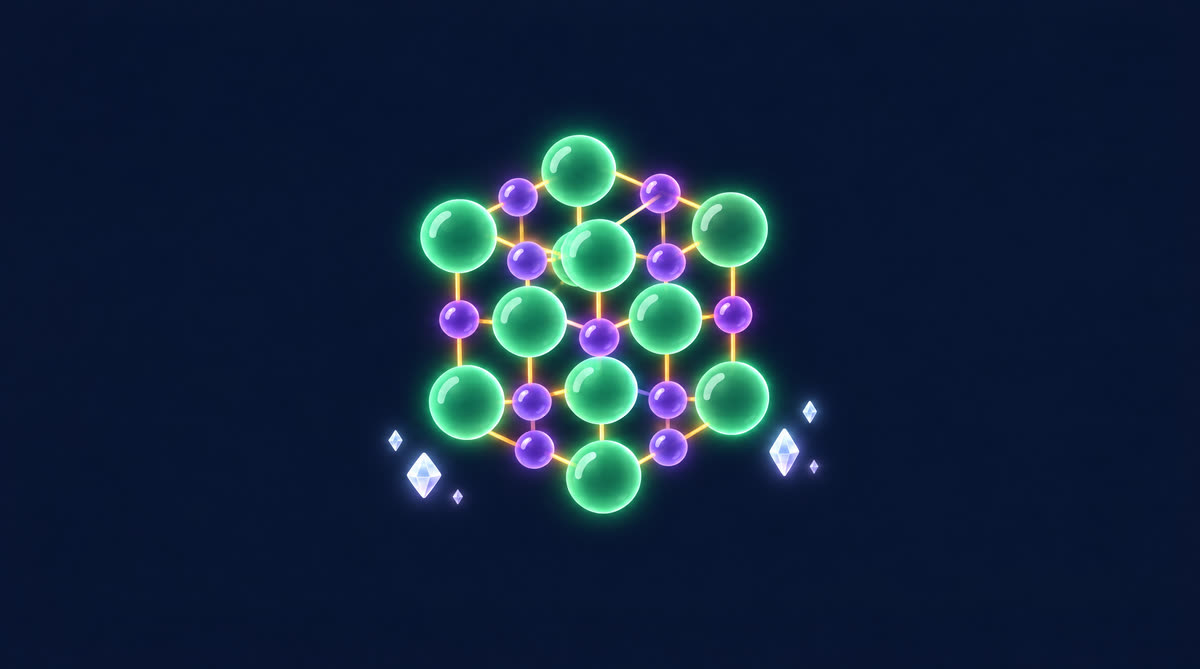
Table salt is sodium chloride, and it is made of two ingredients you would never want on your chips: sodium, a soft and very reactive metal, and chlorine, a toxic green-yellow gas. When they meet, each sodium atom hands one electron to a chlorine atom. Both end up as stable, electrically charged atoms called ions, and the pair stick together in a harmless crystal.
So salt is the chemistry equivalent of two terrible parents raising a lovely child. The parents are a hothead and a bully. The child is the polite crystal that puts up with being sprinkled on a bag of chips without complaint. Let us find out how that works.
Is table salt really made of a metal and a gas?
Yes. Table salt has the chemical formula NaCl, where Na is the symbol for sodium (from its old Latin name, natrium) and Cl is the symbol for chlorine. One sodium atom for every chlorine atom, repeated trillions upon trillions of times in every pinch.
A compound (a substance made of different elements joined together) can behave nothing like its ingredients, much as flour, eggs and sugar are not a cake. Here are the three substances side by side.
| Property | Sodium (Na) | Chlorine (Cl2) | Sodium chloride (NaCl) |
|---|---|---|---|
| Appearance | Soft, silvery metal that quickly dulls in air | Pale green-yellow gas with a sharp smell | Colourless to white crystals |
| State at room temperature | Solid | Gas | Solid |
| Melting point (Celsius) | About 98 | About minus 102 | About 801 |
| Reactive? | Very | Very | No, very stable |
| Safe to eat? | No | No | Yes, in small amounts |
Look at that melting point row. Sodium melts at about 98 degrees Celsius, which is far hotter than a cup of tea and only just shy of boiling water. Chlorine is a gas until it is colder than about minus 34 degrees Celsius. The compound they make needs roughly 801 degrees Celsius to melt. Joining up made something far tougher than either parent.
What is sodium like on its own?
Sodium is an alkali metal, which means it sits in the first column of the periodic table, in the family we cover on our alkali metals page. It has atomic number 11, so each atom has 11 protons. And it is not what most people picture when they hear the word metal.
- It is soft. In a lab, a lump of sodium can be cut with an ordinary knife, a bit like cold butter. A fresh cut shines like silver, then goes dull within moments as the surface reacts with air.
- It floats. Its density is about 0.97 grams per cubic centimetre, just under the 1.0 of water. A metal that floats.
- It is stored under oil. Air and moisture attack it, so labs keep it in a jar of oil, like a grumpy pet kept away from the sink.
- It reacts hard with water. It skates about on the surface, fizzing and giving off hydrogen gas, and the reaction makes a lot of heat.
A plain warning. Reactions like that belong with trained teachers, in a lab with proper safety equipment. They are not something to try at home, and this article is not instructions. If you want to see it, a school demonstration or a video from a reliable source is the way.
Why is sodium so keen to react? Every atom has electrons, tiny charged particles arranged in layers. Sodium has just one electron in its outermost layer, and the atom is happiest when it gets rid of it. Chemists call outer-layer electrons valence electrons, and our guide to valence electrons and ion charges goes through them in detail. For now, picture sodium as someone holding a hot potato who is desperate to pass it on to anybody.
What is chlorine like on its own?
Chlorine is atomic number 17, and it lives in the halogens, the column just before the noble gases. At room temperature it is a gas, pale green-yellow, with a sharp smell a little like a swimming pool (pools smell that way because of chlorine compounds in the water).
Here is the surprising part: chlorine is very useful. Tiny, carefully controlled amounts of chlorine, or compounds made from it, are added to drinking water and pools to kill germs. The pure gas is a job for industry and trained professionals, and you will not meet it at home.
Chlorine's problem is the mirror image of sodium's. It has seven electrons in its outer layer, and it badly wants an eighth. Where sodium is holding a hot potato, chlorine is standing there with its hands out. They are, you might say, made for each other. If you want to compare chlorine with its neighbours, see chlorine versus fluorine and chlorine versus bromine.
What happens when sodium meets chlorine?
The swap is beautifully simple. A sodium atom gives its one outer electron to a chlorine atom. After the handover:
- Sodium has lost a negative electron, so it is left with one more proton than electrons. That makes it a positive ion, written Na+.
- Chlorine has gained a negative electron, so it has one more electron than protons. That makes it a negative ion, written Cl- (chloride is the name for it).
An ion is an atom that has gained or lost electrons and so carries an electric charge. The clever bit is that both ions are now stable. Each has a full outer layer of electrons, the same arrangement as a noble gas: sodium ends up like neon, and chlorine like argon. Our article on electron configuration explains why a full outer layer is so comfortable, and our noble gases guide introduces the most settled elements of all.
Opposite charges attract. The positive sodium ion and the negative chloride ion pull towards each other strongly. That pull is called an ionic bond.
Why does the reaction release so much energy?
When sodium burns in chlorine, a great deal of energy comes out as heat and bright light. Why so much? Roughly, because the ions end up in a much lower-energy, much more stable arrangement than the separate atoms started in. Think of a ball rolling down a steep hill.
The biggest part of that drop comes from the ions pulling together into a crystal, which releases a lot of energy. Handing over the electron actually costs energy (sodium has to be pushed to let go), but the payoff from all those ions attracting each other more than covers the bill. A reaction that gives out energy is called exothermic. Salt is so stable that splitting it again takes that same energy back, so it just sits on the table next to the pepper.
Why are salt crystals cubes?
Look at table salt through a magnifying glass and you will see tiny cubes. That is no coincidence. It is the shape of the pattern inside.
In solid salt, the ions do not pair off. Instead, every sodium ion is surrounded by chloride ions, and every chloride ion is surrounded by sodium ions, in a regular, repeating three-dimensional grid called a lattice. Along any row the ions alternate, like a very tidy 3D chessboard where nobody argues. The repeating grid builds up into a block with flat faces at right angles, which is why the crystals are cubes.
Countless strong bonds also explain the high melting point. Melting salt means loosening the whole lattice, which takes about 801 degrees Celsius (the figure varies a little with purity).
Try it on Periodic Bubbles. Open the bubbles and pop sodium, then chlorine, and compare their states, melting points and densities. Then try today's Daily Bubble.
Why does salt dissolve in water, and when does it conduct electricity?
Water molecules have a slightly positive end and a slightly negative end. When a salt crystal drops into water, those ends pull on the ions at the surface. The negative ends of the water molecules cluster around the sodium ions, and the positive ends cluster around the chloride ions, gently tugging them out of the lattice one by one. Soon the whole crystal has been taken apart and spread through the water.
That also explains the electricity. For a substance to carry an electric current, it needs charged particles that are free to move. Here is how salt measures up:
- As a solid: the ions are locked in the lattice and cannot travel, so salt does not conduct.
- Melted: the ions are free to move, so molten salt conducts.
- Dissolved in water: the ions are free again, so salty water conducts. This is why you are told to keep electrical gadgets away from the bath, and why seawater conducts better than pure water.
Sodium metal conducts as a solid because its electrons drift through it. Salt uses ions instead. See metals, non-metals and metalloids for the wider picture.
Where does table salt come from?
There are two main sources, and neither involves mixing a metal with a gas.
- Seawater. Sodium and chloride ions are the most plentiful dissolved ions in the sea. In warm, sunny places, seawater can be left in shallow pools so that the water evaporates and leaves the salt behind.
- Underground deposits. Long ago, some ancient seas and salty lakes dried up and left layers of salt, which later got buried. Salt is mined from these deposits, and it is often called rock salt. Some is also taken out by pumping water into the deposit and collecting the brine (very salty water).
Either way, the ions were already there, already happily joined.
Why do our bodies need sodium and chloride?
Here is the twist in the tale. Sodium on its own would be a disaster in your body, yet sodium ions are essential to you. In the right amounts, sodium and chloride ions help with several jobs:
- Nerves. Nerve signals rely on charged ions moving in and out of cells, and sodium ions are a big part of that story.
- Fluid balance. Sodium and chloride ions help control how much water is in and around your cells.
We cover more of these jobs in our article on elements in everyday life. A word of balance, though: too much salt is not good for you, and most health advice for adults is to keep salt intake down. This is a chemistry article, not medical advice. If you have questions about your own diet, a doctor or dietitian is the right person to ask.
What about other salts?
Sodium chloride is the salt you sprinkle, but in chemistry, "salt" is a whole family. The pattern is always the same: usually a positive metal ion balanced by a negative ion, so that the total charge adds up to zero. Here are a few examples.
| Salt | Formula | Positive ion | Negative ion | Why that ratio? |
|---|---|---|---|---|
| Sodium chloride | NaCl | Na+ | Cl- | One plus cancels one minus |
| Potassium chloride | KCl | K+ | Cl- | One plus cancels one minus |
| Magnesium oxide | MgO | Mg2+ | O2- | Two plus cancels two minus |
| Calcium chloride | CaCl2 | Ca2+ | Cl- | One calcium (2+) needs two chlorides (1- each) |
The ions' charges come from their families: first-column metals like potassium form 1+ ions, second-column metals like magnesium and calcium form 2+ ions, and oxygen forms 2- ions. See our alkaline earth metals page for that second column, and the groups and periods guide for the reason the columns matter so much.
Potassium chloride is also used as a salt substitute, since it tastes salty to many people (some find it slightly bitter or metallic). It is simply sodium's neighbour in the same column, doing a similar job. See sodium versus potassium for the family resemblance. If you use any substitute for health reasons, check with a doctor first, because it is not right for everybody.
FAQ
Could I make salt by mixing sodium and chlorine at home?
No. That means handling a reactive metal and a toxic gas, a job for trained professionals. Salt is cheap anyway.
Is table salt an element or a compound?
A compound. An element has just one kind of atom, while salt has two: sodium and chlorine, joined by ionic bonds.
Why is salt safe if chlorine is toxic?
Because in salt, chlorine is a chloride ion with a full outer layer of electrons, a completely different thing from the gas.
Why is salt not a metal if it contains one?
Because the sodium in it has given up its outer electron and is an ion locked in a lattice, not a metal.
Fancy testing what you have learned? Take the Pop Quiz, or find out which element is waiting for you in the Daily Bubble.