What Is the Universe Made Of? The Most Common Elements, From Space to You
The universe is roughly 90% hydrogen by number of atoms and 8 to 9% helium, with a thin dusting of the rest. See the top elements in space, Earth and you.
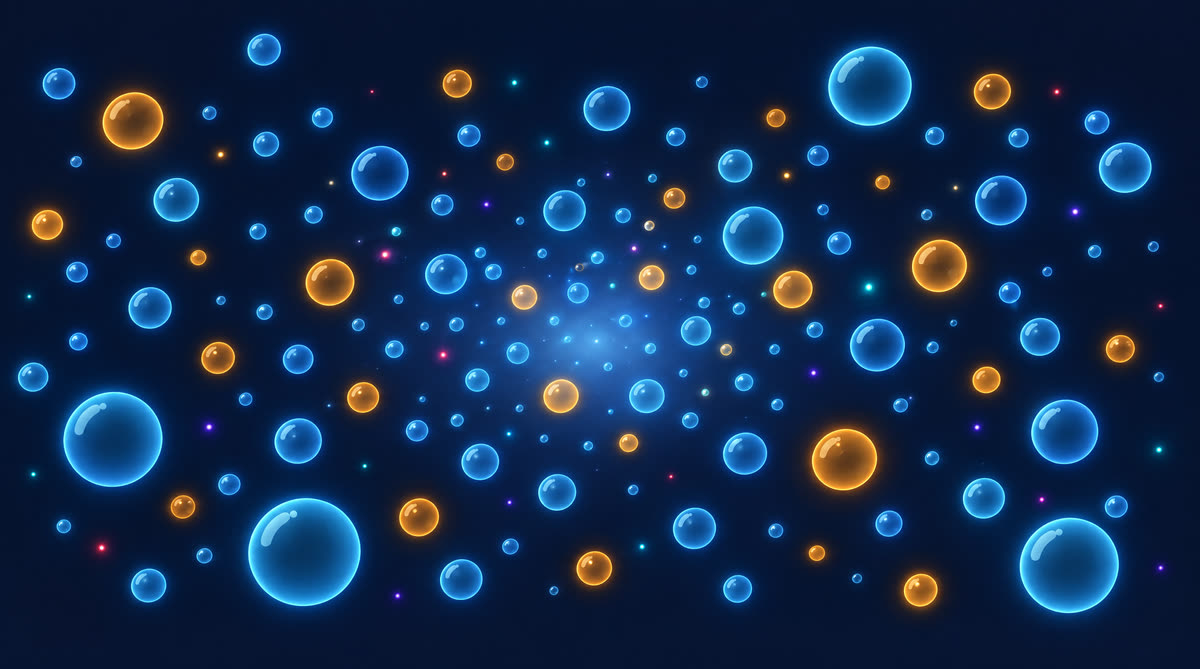
Count the atoms in the universe and roughly nine in every ten are hydrogen. Most of the rest are helium, about 8 or 9 in every hundred. Everything else on the periodic table, including the carbon, oxygen and iron that make planets and people, adds up to well under 1 percent of the atoms (and only around 1 or 2 percent of the mass). So the universe is basically a vast cloud of the two lightest elements, with a thin dusting of everything else sprinkled on top, like a cosmic trifle.
Now for the plot twist: you live in that dusting. This article tours the most common elements in space, in Earth's crust, in the air, in the sea and in your own body, and asks why the numbers look so lopsided.
What is the most common element in the universe?
Hydrogen, by a landslide. It is element number 1, the simplest atom there is: usually one proton (a tiny positively charged particle) in the middle and one electron (a tiny negatively charged particle) buzzing around it. Our guide to atoms explains the parts if you need a refresher.
Here is the universe's ingredient list. Every figure is rounded and approximate, because astronomers work these out from starlight and gas clouds rather than from a cosmic till receipt, and different sources round them slightly differently.
| Ingredient | Share by number of atoms (about) | Share by mass of ordinary matter (roughly) |
|---|---|---|
| Hydrogen | 90% | 74% |
| Helium | 8 to 9% | 24% |
| Everything else | well under 1% | 1 to 2% |
Why do the two columns disagree? Because atoms have different weights. A helium atom is roughly four times heavier than a hydrogen atom (relative atomic masses of about 4.0 and 1.0, if you want the numbers from our mass and isotopes article). So helium is a small crowd of heavyweights: few in number, but a decent slice of the total weight. Think of a bus with ninety toddlers and eight adults. The toddlers win on headcount, the adults claim a hefty share of the weight.
Behind hydrogen and helium, oxygen and carbon are usually ranked next, with neon, nitrogen, silicon, magnesium, iron and sulfur jostling for the places after that. The exact order depends on whether you are counting atoms or weighing them and on which part of space you sample, so treat the pecking order below the top two as a rough guide.
Why are hydrogen and helium so common?
Because they were first, and nothing much has managed to use them up. According to the Big Bang theory, the universe began about 13.8 billion years ago as an unimaginably hot, dense state that expanded and cooled. In the first few minutes it was hot enough and dense enough for particles to fuse (stick together) into the lightest atomic nuclei, then too cool for fusion to carry on. The result was mostly hydrogen, roughly a quarter helium by mass, and a pinch of lithium. That ratio is roughly the one we still see in the oldest gas clouds.
Hydrogen is also the ultimate starter kit. Its nucleus is just one proton, so there is nothing to build, and the early universe produced it in huge quantities. Helium is the next simplest, and the early universe could make it before cooling shut the factory.
Anything heavier than the first few elements had to wait for a better kitchen.
Where did all the other elements come from?
From stars, and from some spectacular endings. Here is the short version, hedged where scientists are still working out the details.
- The Big Bang made hydrogen, helium and a trace of lithium.
- Stars are fusion machines. Gravity squeezes the gas in the core of a star until hydrogen nuclei fuse into helium, releasing the energy that makes starlight. Stars that are heavy enough go on to fuse helium into carbon and oxygen, and the biggest keep going through heavier elements up to roughly the region of iron.
- Supernovae are the explosions of massive stars at the end of their lives. They scatter freshly made elements into space and help create elements beyond iron.
- Neutron star collisions are crashes between the super-dense leftovers of dead stars. Astronomers now think they make a good share of the heaviest elements, with gold a famous example, though exactly how much comes from where is still being worked out.
Iron is the awkward milestone. Fusing lighter nuclei up to the iron region releases energy, which keeps a star shining, but fusing iron itself does not pay its way. That is a big part of why a massive star's fuel runs out and its core collapses. Iron is the end of the line for easy fusion, not the end of the periodic table.
All of this recycles. Gas thrown out by dying stars drifts into clouds, the clouds collapse into new stars and planets, and so on. Most of the atoms in your body heavier than hydrogen were forged in earlier generations of stars, which is the sort of fact that makes "I'm made of stardust" actually true rather than just a poster slogan. The hydrogen, mind you, is older still, going back to the Big Bang.
Humans have added a few of our own: elements that do not occur in useful amounts naturally and are made in laboratories. If you fancy the nuclear workshop version, read how new elements are made. For the unstable ones, see which elements are radioactive.
What is Earth made of?
This is where the leftovers get interesting. Earth is made almost entirely of the heavier elements, because the light gases, hydrogen and helium, mostly escaped when the planets formed close to the young Sun. The big gas giants such as Jupiter held on to them, which is why they are mostly hydrogen and helium. Earth, a small rocky planet, let most of its lightest gases drift off into space.
Earth's crust is the thin outer rock layer we walk on. Here are its most abundant elements by mass. Again, these are approximate, and sources vary by a little.
| Rank | Element in the crust | Share by mass (about) |
|---|---|---|
| 1 | Oxygen | 46% |
| 2 | Silicon | 28% |
| 3 | Aluminium | 8% |
| 4 | Iron | 5% |
| 5 | Calcium | 4% |
| 6 to 8 | Sodium, potassium and magnesium | roughly 2 to 3% each |
The top two alone make up roughly three quarters of the crust. That surprises people, because we do not see much loose oxygen lying about in rocks. But oxygen is locked into compounds (substances where different elements are joined together) such as silica, the stuff of sand and quartz, which is silicon joined to oxygen. A rock is mostly oxygen in a suit made of other elements. Sand, glass and most of the ground you stand on is basically silicon and oxygen holding hands.
Deeper down, Earth as a whole is thought to be dominated by iron, oxygen, silicon and magnesium, with much of the iron sunk into the core. Crust figures and whole-planet figures are different lists, so do not mix them up in an exam.
What is the air made of?
Dry air, meaning air with the water vapour taken out, is about 78 percent nitrogen and about 21 percent oxygen. Next comes argon, just under 1 percent. Argon is a noble gas, a famously unreactive family you can meet in the noble gases article. After that come trace gases, including carbon dioxide at around 0.04 percent. Air also holds a variable amount of water vapour, which is why a damp day feels different.
Nitrogen is the quiet majority here. It mostly sits about doing nothing, which is a talent. Oxygen, the 21 percent, is the part that keeps you going, and a head-to-head of the two is in our oxygen versus nitrogen page. Pure oxygen would make fires far fiercer, so a calm four-fifths is a relief.
What is the sea made of?
Water is hydrogen and oxygen, so most of the sea's mass is oxygen, followed by hydrogen. Seawater also holds dissolved salts, around 3.5 percent of its mass on average. Chlorine and sodium make up most of that, which is why the sea tastes like a very large, very cold crisp. For the gas and liquid story of other elements, see which elements are gases, liquids and solids.
What is the human body made of?
This is the best bit. Your body's recipe is not much like the universe's recipe, and it is not much like Earth's crust either. Here are the top six by mass, which are approximate and vary from person to person.
| Element in the body | Share by mass (about) | Main job |
|---|---|---|
| Oxygen | 65% | Mostly in water |
| Carbon | 18% | The backbone of body chemicals |
| Hydrogen | 10% | Water and body chemicals |
| Nitrogen | 3% | Proteins and DNA |
| Calcium | 1.5% | Bones and teeth |
| Phosphorus | 1% | Bones, DNA and energy chemicals |
Why so much oxygen? Because you are mostly water, and oxygen is the heavy part of a water molecule. Count atoms rather than weighing them and hydrogen leaps to first place, at roughly three in every five of your atoms (a rounded estimate), because water has two hydrogen atoms for every oxygen. In other words, you are a walking bag of water with some carbon-based chemistry stirred in.
The rest of you, from sulfur and potassium to sodium and chlorine, is a long tail of smaller amounts. Some of them, such as iron and iodine, are needed in tiny quantities and matter enormously. The ranking and the percentages move a little depending on whose figures you use, so if an exam wants a number, quote your textbook. For everyday uses of these elements, see elements in everyday life.
Why does the tiny sliver of heavier elements matter so much?
Because hydrogen and helium on their own are boring. Do not tell them. Helium barely joins in with anything, and hydrogen on its own is just a gas that is very keen to leave. Chemistry, the business of atoms joining and swapping partners, needs variety. Carbon can form long chains and rings. Oxygen is happy to link up with almost everything. Silicon builds rock. Iron makes magnets, tools and the red in your blood.
So the heavier elements are a bit like the sprinkle of yeast in a loaf: a tiny fraction of the ingredients, and the reason anything interesting happens. All the rocky planets, oceans, mountains, trees, pets and pupils trying to remember what a mole is come out of that sliver. Meanwhile the hydrogen and helium get the vast majority of the universe's atoms, and the satisfaction of having been there first.
Is the universe only made of atoms?
No, and this is the humbling bit. Astronomers estimate that ordinary matter, meaning the atoms and everything made from them, is only about 5 percent of the universe's total contents, with the rest thought to be dark matter and dark energy that we can only detect through their effects. So when this article says "the universe is 90 percent hydrogen", it means 90 percent of the atoms, the ordinary stuff. The other 95 percent is a mystery that scientists are still investigating, and the periodic table does not describe it.
Where can I explore these elements?
Try it on Periodic Bubbles. Pop hydrogen and helium to meet the two heavyweights of the cosmos, or line them up in the hydrogen versus helium comparison. Then find oxygen and carbon, and ask yourself how many of your own atoms they account for. The element records and extremes article has more superlatives to argue about.
Frequently asked questions
What is the most abundant element in the universe?
Hydrogen, at roughly 90 percent of atoms and about 74 percent of the mass of ordinary matter. Helium is second.
What is the most abundant element in Earth's crust?
Oxygen, at about 46 percent by mass, followed by silicon at about 28 percent. Most of that oxygen is locked up in compounds such as silica rather than floating about as a gas.
What is the human body mostly made of?
By mass, oxygen (about 65 percent), then carbon (about 18 percent) and hydrogen (about 10 percent). By number of atoms, hydrogen comes first because water contains so much of it.
Are we really made of stardust?
Broadly, yes. Elements heavier than hydrogen, helium and a trace of lithium were made in stars and stellar explosions. Hydrogen goes back further, to the Big Bang itself.
Ready to test the recipe? Try the Pop Quiz or today's Daily Bubble.